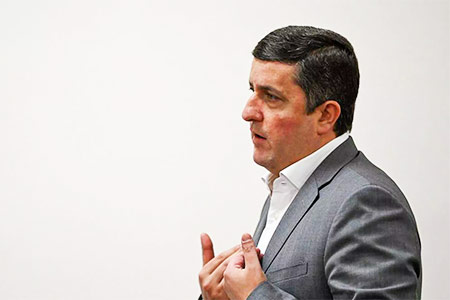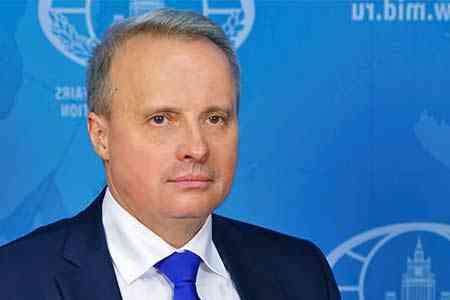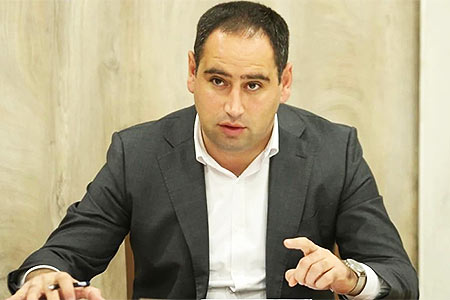


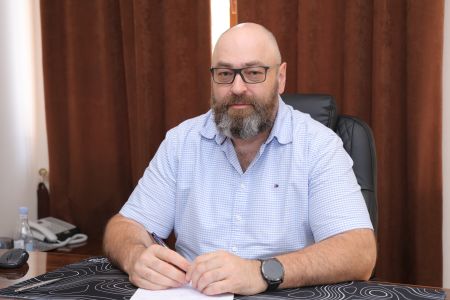
ArmInfo. CJSC "Agarak Copper-Molybdenum Mine Complex" (ACMMC) is one of the flagship mining enterprises in Armenia, holding top positions in the list of the country's largest taxpayers. Ahead of Miner and Metallurgist Day, an ArmInfo correspondent approached Aleksandr Belyaev, Director General of CJSC "Agarak Copper-Molybdenum Mine Complex" (ACMMC), for an interview.
– Aleksandr Grigorievich, the mine complex you lead, which was commissioned back in the mid-1950s, has been undergoing continuous modernization for over 10 years now. Capital investments during this time have exceeded 100 million USD. All this increases production efficiency and makes it more resilient to the global market turbulence we have witnessed in recent years. What are the enterprise's objectives today?
– We are consistently continuing the modernization of the enterprise. Our main task is to complete the maximum volume of work precisely during a favorable market environment, when raw material prices are high. We understand that this situation cannot last indefinitely. The market is cyclical: a period of growth is inevitably followed by a downturn. Therefore, our goal is to meet a potential drop in prices fully prepared—with modern production, high efficiency, and a sufficient margin of competitiveness to operate confidently under any conditions.
Despite the favorable situation on the global commodity market, we deliberately do not slow down the pace of modernization. On the contrary, right now, when the enterprise's economy allows for large-scale projects, we are investing to the maximum in development. The significant growth in global commodity prices, which in recent years has been largely driven by the sustainable development of China's economy, did not become an excuse for us to relax. We view this period as an opportunity to carry out modernization in full, understanding that long-term stability does not exist and one must prepare for any market changes in advance.
I have been working in Armenia for four years now and I can say that I do so with great professional pleasure. Solving the tasks that the complex faces today has become possible thanks to a constructive partnership with the state, effective interaction with local communities, and, of course, with the enterprise's workforce. Over these years, we have managed to build normal working relationships with everyone involved in the development of the complex. It is this mutual understanding that allows us to consistently implement our goals.
I am often reminded of Mikhail Bulgakov's words from "Heart of a Dog." Professor Preobrazhensky, talking about ruin, says that it begins in the mind. This thought has always been not just a literary quote for me, but a life and professional principle.
Therefore, your task is not only to increase the enterprise's productivity during a favorable market environment. It is much more important to make the complex as efficient, sustainable, and competitive as possible for many years ahead.
Since 2014, a large-scale modernization of key production sections has been carried out at the enterprise. A new flotation section was built, followed by the commissioning of a new grinding section with two additional mills. We began a phased replacement of outdated classifiers with modern hydrocyclone units and are completing this work today. All these projects are aimed at increasing productivity, reducing production costs, and creating a technological base that will allow the enterprise to operate efficiently regardless of market conditions.
Last year, two flotation machines for molybdenum extraction were installed and commissioned. In June of this year, two more flotation machines for producing copper concentrate were added.
The main equipment is subject to wear and tear and requires constant care. We have completely replaced 7 out of 11 mills, as well as the mill drums. Today, for the purpose of modernization, we are conducting experiments on the lining of mill drums (a special protective inner lining of the mill drum that protects the metal shell from mechanical wear and impact loads – Ed.), and experimenting with materials to optimize the production process. Right now, we are choosing the most efficient equipment on the market; there are many different offers that we are trying to implement at the enterprise. It is important that specialists do not work "the old-fashioned way," but go on business trips abroad—to China, Russia, Europe, and Canada—to familiarize themselves with technological innovations.
____________________________________________________________
"Agarak Copper-Molybdenum Mine Complex" (ACMMC) is part of the NeoMetals, UAE group of companies and is one of the largest industrial enterprises in the Syunik Province, providing jobs for more than 1,100 people. The complex is included in the list of the country's largest taxpayers and is a town-forming enterprise. The group acquired ACMMC in 2007. The complex became its second asset in Armenia. The group's first acquisition was "GPM Gold," which operates the Sotk gold mine and the Ararat gold extraction factory. The group's entry into the Armenian market coincided with the international financial and economic crisis, which was followed by the systemic crisis of 2014, and then the pandemic crisis. In fact, the state of permanent, successive crises motivated the group to carry out constant work to increase production efficiency and profitability to maintain competitiveness. A phased process of production modernization has been underway at the Agarak Copper-Molybdenum Mine Complex for more than 15 years, aimed at capital renovation of production: technological re-equipment, retrofitting of the open-pit mine and the factory, and the implementation of a number of environmental projects.
____________________________________________________________
– Still, the complex has been operating for seven decades now; what strategic goals do you face to ensure long-term prospects?
– We are working on increasing the factory's productivity to 6–6.5 million tons from the current 4.5 million tons. Alongside this, we are working on a program to increase metal recovery from ore. While the recovery rate for copper three years ago was somewhere around 74%, it is now 79–81%, and for molybdenum, it has grown to 80–81% compared to 72–76% previously.
Our major strategic task is the development of a Feasibility Study (FS) for the dry stacking of tailings. This is the primary step that will allow us to reduce the load on tailings storage facilities. Dry tailings stacking is a modern and environmentally safe technology for disposing of ore processing waste (tailings), in which the waste is dewatered to a paste-like or solid state and then stacked without constructing traditional liquid hydro-technical dams. This modern technology is successfully implemented in many countries and is very actively used in China. We visited China and saw it—it works quite well. I hope the Feasibility Study will be ready by September, and then we will move on to developing the detailed design and coordinating with the administration on land allocation for dry stacking.
– What is the amount of investment you have planned for these programs?
– We are talking about investments of around 50–60 million USD. These are serious investments, but they allow us to solve the key strategic tasks of the enterprise. First of all, to increase the productivity of the complex, extend its effective operating life, and create a modern tailings storage system that meets international environmental and technical standards.
Today, ACMMC's operating tailings storage facility is designed for approximately another 10–12 years of operation. If over the next five years we manage to build facilities for dry tailings stacking with a volume of 5–6 million tons per year, we will be able to extend the lifespan of the complex by at least another 15 years. Especially since the enterprise's mineral resource base allows for this—ore reserves are more than sufficient.
In parallel, we are preparing for further exploration of the deposit. We face two important tasks: clarifying mineral reserves and comprehensively studying the stability of the pit walls. These studies are necessary for the long-term planning of mining operations, ensuring industrial safety, and the further development of the enterprise.
– You mentioned further exploration at the deposit. Will you conduct it yourself, and what is your view on the revival of Armgeology in Armenia?
– The problem of geological exploration is very acute today, not only in Armenia but also in Russia and Kazakhstan. In many countries, enterprises are already forced to independently establish geological exploration units and organize this entire complex process on their own.
To a large extent, this is a consequence of the fact that for many years the industry relied on reserves explored back in the Soviet era. During this period, we largely lost both professional competencies and a strong school of geological exploration. Therefore, I fully share the position of the Government of Armenia on the need to create a specialized state structure that will deal with the development of this direction. For the mining industry, this is a matter of strategic importance.
The staffing issue is no less serious. The average age of specialists is constantly growing, and not enough young professionals are coming in. We have developed targeted programs for staff recruitment and training, but their effectiveness is not yet high. Young people are less and less willing to tie their lives to working in the mining industry, especially if the enterprise is located far from major cities. And this is typical not only for Armenia.
I myself graduated from the Kuzbass State Technical University with a degree in Open-Pit Mining. For Kuzbass, this is one of the key professions. When I was studying, there were about a hundred people in the course. Roughly half started working in their specialty, and about twenty graduates subsequently headed large enterprises in the industry.
Recently, I learned that the university enrolled another course—only 16 students. Seven made it to graduation, and only two decided to work in the profession. This is a very disturbing trend. Even a high salary level is no longer a decisive argument for young people when choosing a career. Meanwhile, it is precisely young, well-trained specialists who are particularly needed in the industry today, as its further development and competitiveness largely depend on them.
– Environmental issues have taken on paramount importance in recent years. What sustainable development measures are you taking at the complex?
– Any mining enterprise damages the environment, and our main task is to minimize it by using international standards and modern technologies. In Soviet times, there were no alternatives, but now they exist.
– Since we are talking about people, what social programs does the complex implement in Agarak, or perhaps in Meghri?
– We are always close to the people because we are a town-forming enterprise. Practically every family in the community is directly or indirectly connected to the complex, so the well-being of the city and the well-being of the enterprise are inseparable.
We constantly interact with local administrations and help solve municipal management issues. Recently, we completely renovated the roofs of 11 apartment buildings, and we participate in the repair of entrances, as well as road construction and restoration. Our immediate plans include the reconstruction of the city stadium. For us, these are not one-off projects, but systematic work to improve people's quality of life.
A separate direction is the support of cultural initiatives. This year, Meghri was declared the Cultural Capital of the CIS, and many festivals, creative meetings, and other events are taking place in the city. We are actively involved in organizing them and consider such support an important part of our social responsibility.
It is especially pleasing to see that these events are gaining an international scale. Tourists are coming to Meghri, including many guests from Iran and other countries. This creates new opportunities for the development of the service sector, small businesses, and the urban economy as a whole. During major events, hotels, guesthouses, and restaurants are almost fully occupied; the city lives a vibrant life, and this is a good example of how cultural projects become a stimulus for economic development.
Overall, we have built very constructive interaction with both state authorities and local communities. This is exactly what I particularly value in Armenia—there is a live, open, and substantive dialogue between the state, business, and society. When all sides hear each other and work for a common result, many tasks can be solved significantly faster and more efficiently.