

ArmInfo. Moody's has improved the outlook on Armenia's sovereign rating from "Stable" to "Positive," affirming the long-term rating at "Ba3." As noted in a statement released today by the Central Bank of Armenia, the rating agency made this decision yesterday. Moody's based the change in Armenia's sovereign rating outlook on the following key factors: Reducing geopolitical and political risks. a material reduction in political risks underpinned by a lower probability of renewed large-scale hostilities with Azerbaijan, the normalization of relations with Turkey. a rebalancing of external relations toward a more diversified set of partners, and contained domestic political risks
Improved medium-term economic growth prospects. In 2026-2027, Moody's expects economic growth of 5-5.5%, driven by stable domestic demand, increased investment, continued development of the services sector, and expanded government spending. Armenia's long-term growth potential could increase further, exceeding the current estimate of 5%, if investment inflows continue to grow. - Strengthening of the economy's structural potential. This is driven by increased investment (especially in the technology and infrastructure sectors), continued economic diversification, and prospects for increased labor productivity.
Thus, the positive outlook is driven by reduced geopolitical risks and the diversification of Armenia's external relations, which, along with sustainable economic growth, contribute to improved fundamentals. Moody's decision to affirm the sovereign rating at 'Ba3' reflects Armenia's robust growth potential, moderately strong institutional development, and strong public administration.
Moody's notes that these strengths are offset by rising interest costs and persistent geopolitical risks, which continue to weigh on the sovereign credit profile. While geopolitical risks have subsided, uncertainty surrounding Armenia's evolving external orientation and its relationship with Russia continues to pose risks to Armenia's economic security, given the close economic ties between the two countries.
Armenia's country rating ceilings for local and foreign currency obligations remained unchanged at 'Baa2' and 'Ba1', respectively. The four-notch gap between the local currency rating ceiling and the sovereign rating reflects the balance between the small state presence in the economy and relatively strong institutions, on the one hand, and geopolitical risks and a large current account deficit, which exposes the economy to external shocks, on the other. The two-notch gap between the foreign currency rating ceiling and the local currency ceiling takes into account Moody's assessment of Armenia's moderate policy effectiveness and open capital account, which indicates the presence of some transfer and convertibility risks in periods of stress.
Ratings and Positive Outlook Justification
Political risks have diminished significantly, but the sustainability of regional stability remains to be seen: Relative stability between Armenia and Azerbaijan since the signing of the US-brokered peace framework agreement in August 2025 has significantly reduced the risk of large-scale hostilities. Meanwhile, the normalization process with Turkey is improving regional connectivity, but a full-scale peace is unlikely due to Azerbaijan's demands on Armenia's constitution. Armenia has gradually diversified its external relations, achieving a ore balanced engagement with Russia, the US, and the EU, which has strengthened its resilience to external shocks: The country has reduced its dependence on Russia as its primary security partner, although economic ties between them remain significant. However, Armenia's shift to a more balanced external orientation has been accompanied by some friction in its relations with Russia. This is evident in the expansion of Russian import restrictions on certain Armenian goods, but the impact remains limited for now, as the list of affected goods remains limited. At the same time, Armenia has deepened its engagement with the US and EU through a combination of diplomatic mediation, connectivity initiatives, and reform-linked financial assistance.
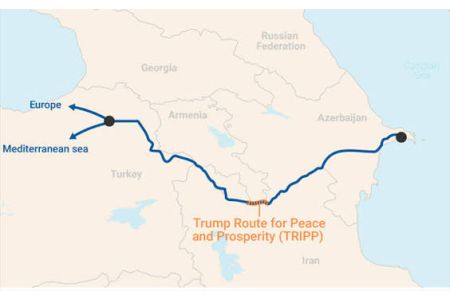
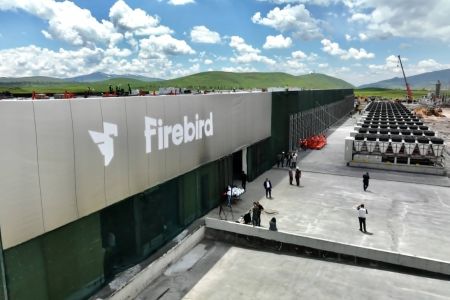
Engagement with the US has particularly strengthened thanks to its role in promoting regional peace, linking efforts to normalize relations with improved transport and infrastructure connectivity in southern Armenia. Improved relations with the US are leading to increased investment in Armenia's technology and infrastructure sectors. The announcement of the second phase of a joint US-Armenian data center project for artificial intelligence (AI) supercomputing, valued at approximately $3.5 billion (equivalent to approximately 12% of Armenia's 2025 GDP), clearly illustrates the scale of the projects the country has been able to attract recently. If these investment inflows are sustained, they are likely to drive higher productivity growth, accelerate economic diversification, and strengthen Armenia's medium-term growth prospects. Armenia has also intensified cooperation with the EU through reform-oriented programs and financial support aimed at strengthening institutions and economic resilience.
Domestic political risks are largely contained. Political polarization remains elevated, reflecting sensitivities around border delimitation and peace negotiations. However, institutions have remained effective, while episodes of protests have been sporadic and contained. The outcome of the June 2026 parliamentary elections, in which Prime Minister Nikol Pashinyan and the ruling Civil Contract party secured a renewed mandate and a parliamentary majority, supports policy continuity.
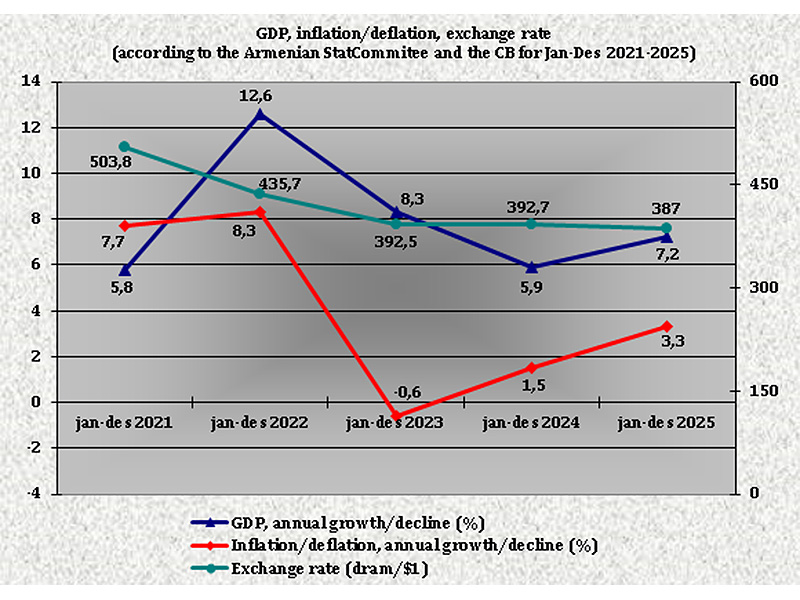
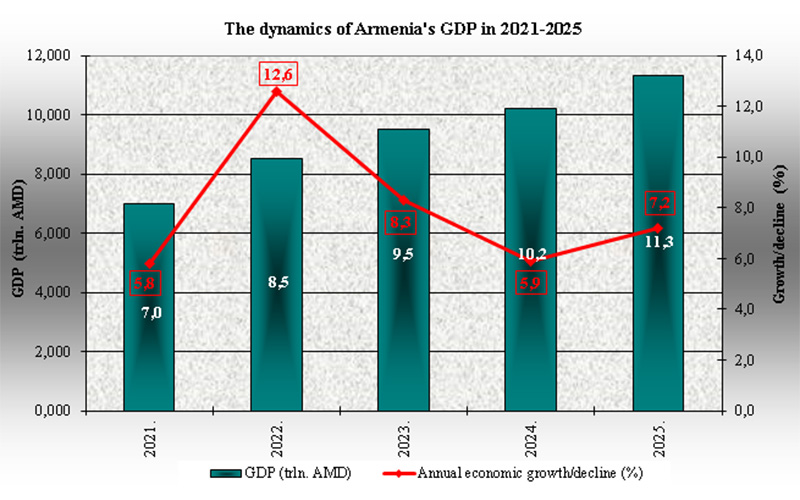
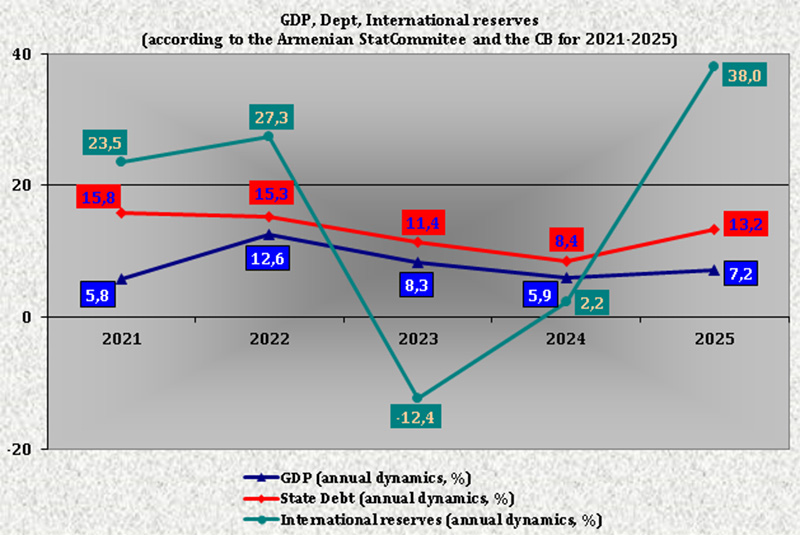
Strengthening growth prospects raise the likelihood of broader improvements in economic fundamentals: Armenia's growth has been exceptionally strong, averaging 8.5% annually over 2022-2025, following the Russia-Ukraine war. Large inflows of capital, labour and remittances, alongside the relocation of businesses and skilled workers from Russia, have supported consumption, investment and services activity. Moody's forecasts Armenia's real GDP growth to come in at 5-5.5% for 2026 and 2027, supported by robust domestic demand, continued, albeit moderating, inflows of capital and labor, and sustained activity in services and trade sectorsAdditional fiscal impulse from the rollout of universal health insurance and pension-related spending will support household consumption. We expect the ongoing Middle East conflict to have only a moderate impact, given Armenia's limited direct trade and financial linkages with the region and the cushioning effect of preferential gas supply arrangements with Russia.
According to Moody's, Armenia's longer-term growth potential could rise further, beyond our current estimate of 5%, if investments pick up further. Gross fixed capital formation growth has remained elevated, averaging 12.5% annually over 2022–2025, compared with 6.3% over 2017–2019. Labour productivity growth has also strengthened, averaging 6.4% year-on-year over 2022–2025, up from 5.8% over 2015– 2019, according to Conference Board data. Economic diversification has deepened. The ICT sector's share of GDP rose to 6.5% in 2025, from 5.0% in 2022 and 3.7% in 2017, with ICT exports mainly directed toward the US and EU. In addition, Armenia's debt structure has improved due to a shift in emphasis towards domestic borrowing and a decrease in the share of debt in foreign currency. However, this was accompanied by a slight deterioration in debt servicing affordability. The share of government debt in foreign currency fell to approximately 47% in 2025 from an average of around 80% in 2017-2019. Interest payments, meanwhile, increased to 11.5% of government revenue in 2025, compared to an average of around 10% in 2017-2019, despite the overall debt burden being higher in that earlier period.
However, the spillovers from strong growth outcomes to broader improvements in economic fundamentals are not yet evident. The pass-through to labour market outcomes appears weak. The unemployment rate has declined but remains in double digits, in part reflecting a narrow growth base concentrated in a few sectors, as well as structural constraints such as skills mismatches and high informality. Domestic savings have also remained low, weighed down by shallow domestic capital markets and the same informality that limits household savings mobilization. As a result, Armenia continues to run sizeable current account deficits financed largely by external capital inflows, with only a modest contribution from foreign direct investment, which remains low at around 2% of GDP. Moreover, another consequence of shallow savings is relatively high domestic borrowing costs.Moody's expects The fiscal deficit will widen to about 4.5% of GDP in 2026 reflecting a ramp-up in capital expenditure and social spending, including the rollout of universal health insurance. Beyond 2026, Moody expects the government to resume consolidation, supported by ongoing tax policy efforts, strengthened revenue administration and expenditure prioritization, with the IMF Stand-By Arrangement serving as a credible policy anchor.
Moody's expects the interest payments to revenue ratio to remain broadly stable, with the government debt burden stabilizing at around 50% of GDP, well below the 2020 peak of 63.5%. These credit strengths are balanced against elevated geopolitical risks, which continue to weigh on the sovereign's credit profile. Despite recent improvements in regional stability, Armenia's evolving security and foreign policy orientation introduces uncertainties regarding its relations with Russia, with potential implications for Armenia's economic and fiscal prospects given the two countries' deep economic linkages.