

ArmInfo. Armenia's gross international reserves (GIR) surged by 45.7% year-on-year, or by $1.852 billion, reaching a historic high of $5.899 billion by July 2026, according to data released by the Central Bank of the Republic of Armenia. By comparison, growth during the same period in 2025 was a more modest 20.7% (or $693.2 million), bringing reserves to $4.047 billion.
In June alone, reserves experienced a slight increase of 0.6% ($36.3 million), contrasting with a more notable growth of 3.9% ($150.8 million) recorded in the same month the previous year. For the first half of 2026, GIR expanded by 16% ($812.6 million), outpacing the 9.8% growth ($362.2 million) registered during the first half of 2025.
During the second quarter of 2026, the growth rate of international reserves slowed from 9% to 6.4%— adding $355.3 million—which nonetheless outpaced the quarterly growth rate of 3.1% ($121.3 million) recorded a year ago. The annual growth in reserves as of June 2026 was primarily driven by a 45.8% surge in foreign assets in convertible currencies, reaching $5.897 billion, alongside a 34% decline in Armenia's SDR (Special Drawing Rights) holdings with the IMF to $1.2 million. For context, during the corresponding period in 2025, foreign assets posted a more modest increase of 20.9%, while SDR holdings experienced a steeper drop of 77.3%.
For the first half of this year, the growth of GMR was due to a similar growth of external assets in foreign currency by 16% with a decline in the share of SDR in the IMF by 14.3%, which was observed at a more modest pace a year earlier during the same period, when the growth of the former by 9.8% was accompanied by a decline in the latter by 12%. Moreover, in the second quarter of this year, the growth of external assets in foreign currency slowed from 9% to 6.4%, and the dynamics of the share of SDR in the IMF reversed from 19.2% growth towards a 28.1% decline, whereas a year earlier, the slowdown in quarterly growth of the former from 6.5% to 3.1% was accompanied by a trend of the latter going from a 15% decline to 3.6% growth.
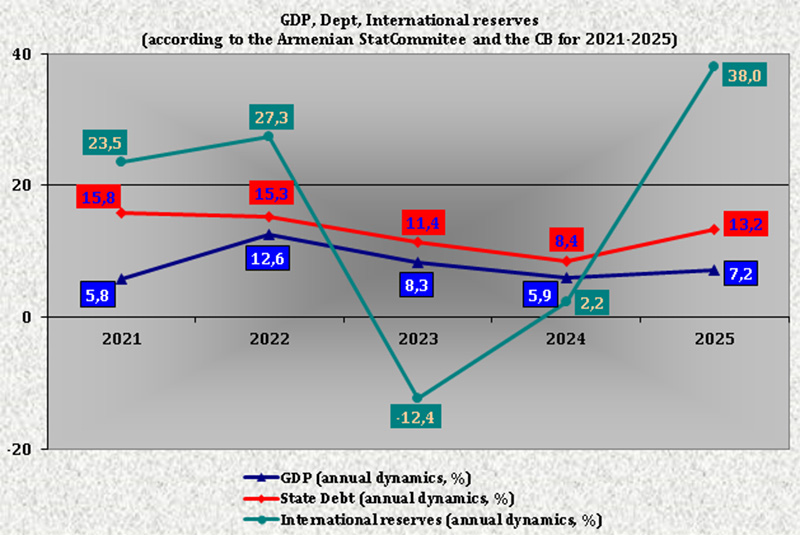
It should be noted that Armenia's gross international reserves (GIR) increased by 38% or $1.4 billion in 2025, reaching $5.086 billion, while in 2024 there was a weak growth of 2.2% or $76.2 million, reaching $3.685 billion. In particular, external assets in foreign currency increased by 38.1% to $5.085 billion, with a decline in the share of SDRs in the IMF by 32.1% to $1.3 million, while in 2024 there was a weak growth of the former by 2.1% and a jump in the latter by 4 times. It is worth mentioning that in August 2023, both the GIR and external assets in foreign currency reached a record high of $4.220 billion and $4.217 billion, respectively, a level that was surpassed two years later, with subsequent monthly record-breaking and a continuation of this trend in 2026. The historical maximum of the SDR share in the IMF was recorded in August 2021 - $178.2 million. The share of bank gold in Armenia's GIR was reset to zero back in December 2003.
Recall, in the first decade of June 2026, the International Monetary Fund (IMF) granted Armenia access to a Stand-By Arrangement (SBA) credit equivalent to 18.4 million SDR (approximately $25.1 million). This brings the total volume of available funds since the program's launch in December 2025 to 36.8 million SDR (approximately $50.2 million).
The primary objective of the SBA is to support state policies and reform initiatives aimed at maintaining macroeconomic stability, fostering sustainable and inclusive growth, and providing a safeguard against downside risks amid global economic uncertainty.
Prior to this, in early December 2025, the IMF Executive Board approved a new three-year SBA (Stand-By Arrangement) with Armenia for a total of SDR 128.8 million, or approximately $175 million (100% of Armenia's IMF quota). Concurrently, the IMF completed the previous sixth review under the SBA, which was set to expire on December 11, 2025.