


ArmInfo. In Armenia, the public debt as of July 1, 2026, amounted to $14.543 billion, keeping the per capita debt burden at $4.7 thousand. Year-on-year, public debt growth slowed from a double-digit 13% to 5%, slowing the per capita debt burden to 4.3% (from $4.5 thousand a year ago).
However, unlike previous years, the per capita debt burden began to come more from domestic debt than from external debt - $2.4 thousand versus $2.3 thousand, with a less noticeable slowdown in the annual growth of the former, from 16.9% to 7.8%, than the latter, from 11.2% to 2.2%. This was observed against the backdrop of a slight slowdown in Armenia's population growth by July 1, 2026, to 0.6%, or by 19.5 thousand people, to 3.104 million people. For comparison, we recall that a year ago, a 13% increase in the per capita debt burden was accompanied by a population growth of 0.9%, or by 26.6 thousand people, to 3.084 million people. The ratio of external debt coverage by gold and foreign exchange reserves jumped to 83.1% as of July 1, 2026, from 58.3% a year earlier, amid a markedly accelerated annual growth in reserves to 45.7% and a slowdown in external debt growth to 2.2%. A year earlier, both indicators demonstrated a noticeable improvement: external debt recovered from a 3% decline to an 11.2% increase, while reserves recovered from a 14.2% decline to a 20.7% increase. Notably, by July 1, 2026, gross international reserves set a new record at $5.9 billion, while external debt retreated from the level recorded in April of this year. The national debt reached a historical high of $7.2 billion and amounted to $7.1 billion.
According to the Statistical Committee of the Republic of Armenia, the share of external debt in the structure of Armenia's public debt decreased year-on-year from 50.1% to 48.8% as of July 1, 2026, while the share of domestic debt increased from 49.9% to 51.2%. Domestic debt began to outweigh the national debt in July 2025, and will continue to dominate in 2026.
ArmInfo news agency considers it appropriate to point out that the RA Statistics Committee will publish its public debt report in a new format starting in 2026. A note in this report states: in accordance with the amendments to the RA Law "On Public Debt" introduced on December 17, 2025, the Ministry of Finance will henceforth summarize public debt indicators in a new (modified) structure. Specifically, in the new format, public debt includes the external and internal debt of the government and communities, while the Central Bank's debt and external/internal government guarantees are reported separately and are not included in the total public debt. As a result, this excluded amount amounted to approximately $634 million at the end of 2025, and already exceeded $642 million by the end of June 2026. However, to present a complete picture of public debt and its actual annual dynamics (while maintaining comparability), ArmInfo will continue to include the above-mentioned excluded data in its materials when calculating the total public debt.
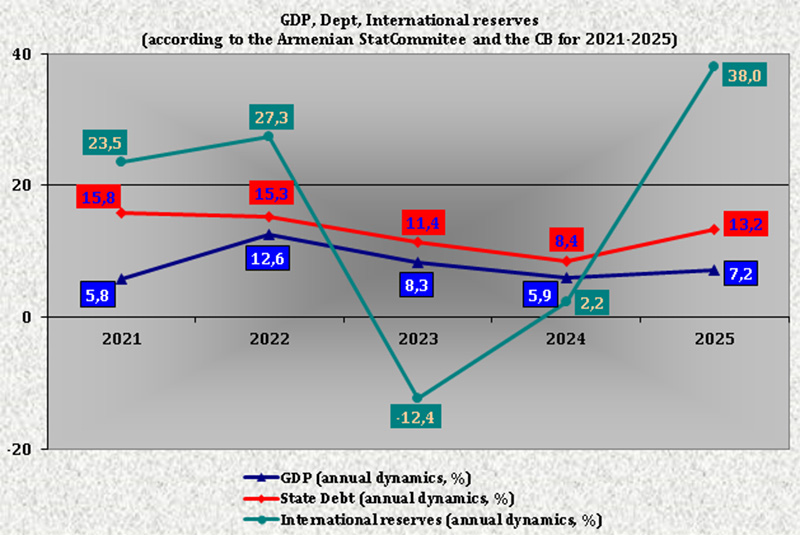
According to the Statistical Committee of the Republic of Armenia, Armenia's public debt as of January 1, 2026, amounted to $14.54 billion (over 5.5 trillion drams), accelerating in annual growth from 8.4% to 13.2%. This was due to an improvement in external debt dynamics, while domestic debt growth continued to slow. Specifically, external debt accelerated from a 1% decline to 9% growth, exceeding $7 billion (2.7 trillion drams), while domestic debt continued to stall in growth, from 19.5% to 17.3%, reaching $7.5 billion (2.8 trillion drams). Moreover, in absolute terms, domestic debt began to outpace external debt in July 2025, having previously almost equaled it in June.
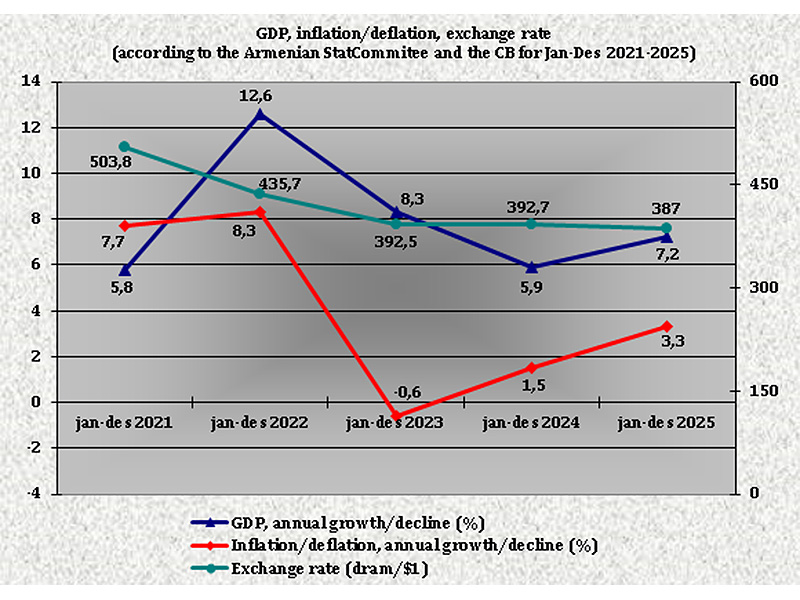
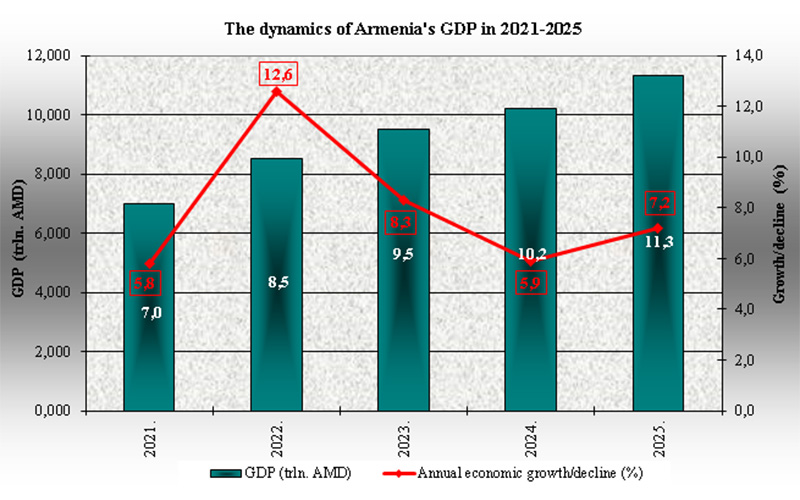
The public debt-to-GDP ratio fell from 49.7% to 48.9% by 2025, with both GDP growth accelerating from 5.9% to 7.1% and public debt growth accelerating from 8.4% to 13.2%. Specifically, the external debt-to- GDP ratio fell further by 2025, from 25% to 23.7%, while the domestic debt ratio increased slightly from 24.7% to 25.2%.
The per capita debt burden increased to $4.7 thousand in 2025 (from $4.2 thousand in 2024), an annual increase of 5%. Moreover, the per capita debt burden from external debt increased in 2025 from $2.1 thousand to $2.3 thousand (by 9.5%), and from domestic debt from $2.1 thousand to $2.4 thousand (by 14.3%). This is observed against the backdrop of weak annual population growth in Armenia of 0.7%, or by 20.8 thousand people, to 3.097 million people by January 1, 2026. In 2024, a similar 5% increase in the per capita debt burden was accompanied by a more pronounced population growth of 2.8%, or by 85 thousand people.
The ratio of external debt coverage by gold and foreign exchange reserves increased from 57.1% to 72.3% in 2025, amid a significant annual growth of 38% in reserves and a moderate growth of 9% in external debt. It is noteworthy that by the end of 2025, both gross international reserves and external debt reached a new record high - $5.1 billion and $7.04 billion, respectively. Moreover, in July 2025, external debt gave way to domestic debt, continuing to move further apart in the following months, which resulted in their shares in the public debt at 48.4% and 51.6%, respectively, by January 1, 2026. However, according to the Ministry of Finance's plan, this ratio will be slightly changed in the near future in favor of external debt, which, from a liquidity standpoint, will reduce the pressure on Armenia's banking system, which will be able to channel more investment into the country's economy.