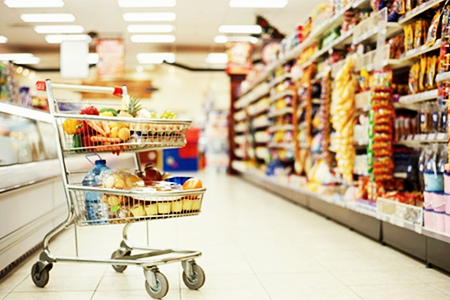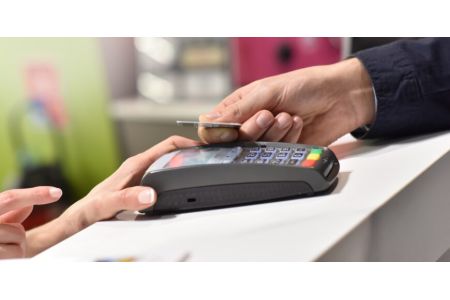
ArmInfo. Non-cash transactions have been steadily gaining ground in the Armenian plastic card market, increasing to 60.7% of the total by July 2026 (from 55.8% a year ago), exceeding AMD 2.3 trillion ($6.3 billion) in absolute terms in the first half of the year. This is evidenced by data from the Central Bank of Armenia on transactions made in Armenia and abroad using cards issued by Armenian banks.
This result was achieved despite the annual growth rate of non-cash card payments returning to the natural growth range, following a surge in 2022 caused by the introduction of legislative restrictions on cash transactions on July 1 of that year. Moreover, impressive growth rates of non-cash transactions were also observed in 2023 (77%). These growth rates weakened in 2024, but remained at a double-digit 11%, accelerating to 17% in 2025. This trend continued in the first half of 2026, with non-cash transactions accelerating in annual growth to 23%. At the same time, the share of cash in cash declined in the overall volume of plastic transactions: from 66% to 59% in 2022, losing its dominant position in 2023 to 49%, then continuing to decline to 47% in 2024 and 43% in 2025, falling further in the first half of 2026 to 39.3%.
It's worth noting that the share of cashless transactions conducted through virtual vPOS decreased slightly to 58.4% in the first half of 2026 (from 60.5% in the same period of 2025), amounting to 1.4 trillion drams ($3.7 billion), while continuing to accelerate with double-digit annual growth from 10.2% to 19%. However, in the total volume of plastic transactions, the share of operations through vPOS continues to grow, exceeding 35.4% in the first half of 2026 (versus 33.8% in the same period of 2025).
Supported by the dynamics of non-cash transactions, the total volume of plastic transactions also demonstrated double-digit annual growth of 12%, exceeding 3.8 trillion drams or over $10.4 billion in the first half of 2026 (including transactions abroad using cards of Armenian issuing banks). Moreover, the share of transactions abroad using cards of Armenian issuing banks in total plastic transactions decreased during the reporting period to 11.7% (from 14.4% in the first half of 2025), with an emerging decline in the latter by 8% year-on-year (versus 32.3% growth the previous year) to 449.7 billion drams ($1.2 billion). Taking into account transactions made in Armenia using cards issued by foreign banks, the total volume of plastic transactions exceeded 3.99 trillion drams ($10.9 billion), of which 61.5%, or 2.5 trillion drams ($6.7 billion), were non-cash transactions (including vPOS transactions - 1.4 trillion drams or $3.7 billion). International cards demonstrated the highest growth rate in plastic transactions, but more noteworthy is the return of double-digit growth in transactions using local cards. Visa cards retained the lead in transaction volume - over 2.4 trillion drams ($6.6 billion) in the first half of 2026, with annual growth accelerating from 10.7% to 14.1%. Mastercard cards secured second place with AMD 862.8 billion ($2.3 billion), up 9% from a 2% decline. Arca domestic cards came in third with AMD 463.8 billion ($1.3 billion), accelerating year-on-year growth from 6% to a double-digit 16.1%. Other international cards (AmEx, Diners Club, MIR, UPI) came in fourth with AMD 79.2 billion ($215.3 million), up 8% from a 60.4% decline. Moreover, the latter managed to regain momentum thanks to the continued activity of American Express (AmEx) cards issued by Acba Bank. In the total volume of plastic transactions, Visa cards dominate - 63.4% (versus 62.8% in the first half of 2025), Mastercard is in second place - 22.5% (versus 23.3% in the first half of 2025), Arca is in third place - 12.1% (versus 11.8% a year ago), and the remaining 2% (versus 2.1% a year ago) are transactions with other foreign cards (AmEx, Diners Club, MIR, UPI). In terms of the total number of bank cards, Visa cards also retain the lead - 52.7%, followed by Mastercard - 21.5% and Arca - 19%, and the remaining 6.8% are other foreign cards (AmEx, Diners Club, MIR, UPI). In terms of year-on-year growth, local Arca cards demonstrated the highest rate of growth at 30.4%, followed by international Visa cards at 19.4% and Mastercard cards at 17.5%. Other international cards (AmEx, Diners Club, MIR, UPI) increased by 9.6%, and this growth is being maintained thanks to the active expansion of AmEx cards, whose share of all other international cards has already reached 45%.
It's worth noting that the Armenian Card national payment system, in order to strengthen the position of local cards and provide technological support, launched the ArcaPay (since November 2024) and ArcaQR (since October 2025) systems. The government, for its part, has decided to increase consumer interest in ArCa cards by introducing a 2% cashback on all cards starting in January 2026 and increasing cashback for pensioners and those receiving benefits from the previous 12% to the current 22% (including the general 2%). Furthermore, Armenian Card has reached an agreement with the international payment systems Mastercard and UPI (a memorandum was signed in November 2025) to issue co-branded Arca cards (scheduled for the second half of 2026, with ArCa-UPI being the first) with the possibility of using them internationally. Currently, in addition to ArCa tokenization in Google Pay and Apple Pay, the process of replacing digital chips on local cards (including co-branded ones) has also been initiated. This is necessary to ensure full accessibility of ArCa cards (including co-branded ones) in international services, i.e., token payments through Google Pay and Apple Pay.
As a reminder, all 17 banks operating in Armenia operate in the plastic card market. Among them is a relatively new entrant, Fast Bank, which simultaneously issues local Arca cards and international Visa and Mastercard cards. (The settled exchange rate of the dram against the US dollar as of June 30, 2026, was 367.89 drams per US dollar.)