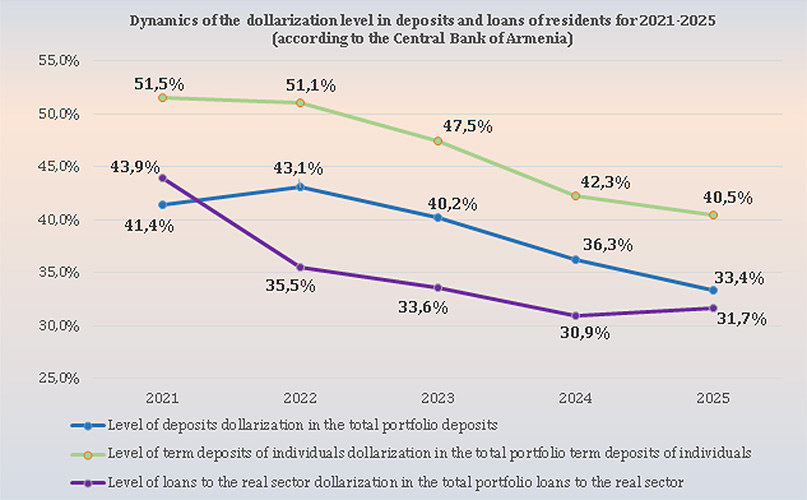


ArmInfo. In Armenia, the dollarization rate of demand deposits has increased since May 2026, from 36.8% to 42.3% in July, while continuing to decrease in loans and term deposits, with the dram component remaining dominant in these portfolios. This is evidenced by data from the Central Bank of Armenia, calculated based on indicators of banks and credit companies.
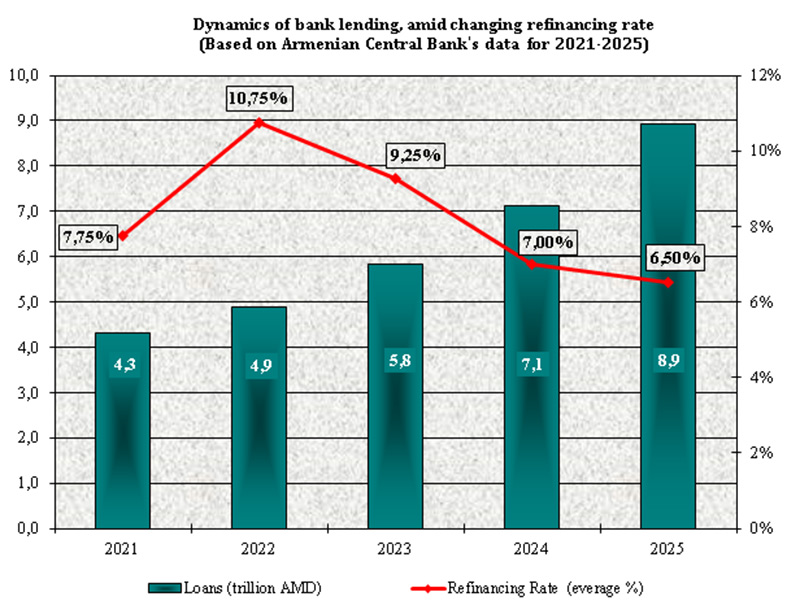
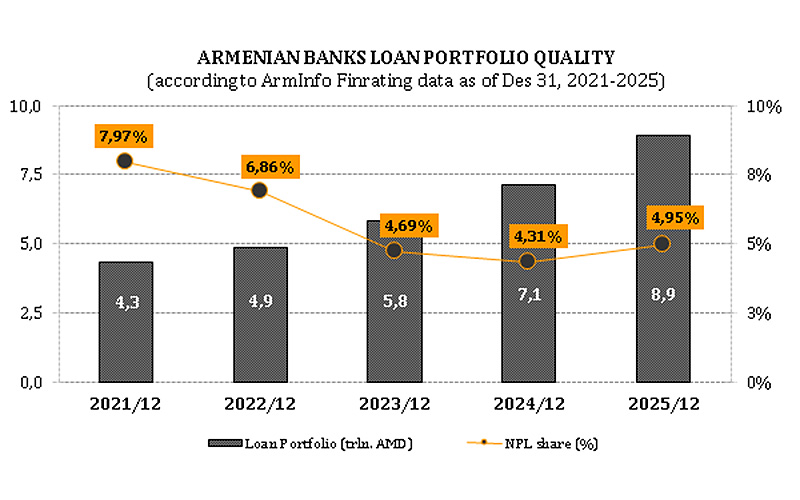
According to the Central Bank of Armenia, the volume of lending by resident banks exceeded 8.8 trillion drams ($24.1 billion) by August 2026. Specifically, dram-denominated loans exceeded 5.99 trillion drams ($16.4 billion), while foreign currency loans totaled 2.8 trillion drams ($7.7 billion), with annual growth for both decelerating to a flat 26% (from 27-31% a year ago). Consumer loans and mortgages account for the largest share of these loans (a combined total of over 3.8 trillion drams or $10.5 billion, a 22% annual increase). Among economic sectors, the industrial sector, trade, food service/services, construction, transportation, and communications are the most likely to receive foreign currency loans, while the agricultural sector, conversely, sees dram-denominated loans predominate.
In the structure of deposits, which reached 8.3 trillion drams ($22.6 billion) by August 2026, 6.6 trillion drams ($17.9 billion) are resident funds, 68.4% of which are attracted in drams. The volume of the latter accelerated in year-on-year growth from 24% to 33%, while the growth of residents' foreign currency deposits accelerated more moderately - from 6% to 12%. In particular, residents' demand deposits exceeded 2.8 trillion drams ($7.7 billion), and time deposits - 3.7 trillion drams ($10.2 billion), with the former growing year-on-year by 26% and the latter by 25%. This kept the growth of the total resident deposit portfolio at 26%. Non-resident deposits grew by a double-digit 17% year-on-year (to 1.7 trillion drams or $4.7 billion), with a similar change in the dynamics of dominant foreign currency deposits (to 1.4 trillion drams or $3.9 billion).
The historical maximum level of loan dollarization was recorded in February 2016 at 64.4%, but over the following three years, this dominant factor declined, and by May 2019, the dram component had taken over, reaching 50.1%. From that point through July 2025, the dramization level of the loan portfolio increased to 69%, decreasing only slightly to 68.4% by August 2026.
The regulator also notes that the dollarization level of residents' deposits and loans, having reached a historical maximum of 66.8% in August 2015, then declined over the next four years, and in July 2019, the baton was passed to the dram component, whose level has since increased from 50.2% to 68.5% in July 2026 (versus 64.8% in July 2025). This reduced the share of foreign currency deposits and loans in the money supply from a historical maximum of 55.2% in January 2016 to 27.2% in July 2026, i.e., the level of dramization over this period increased from 44.8% to 72.8% (versus 70% in July 2025).
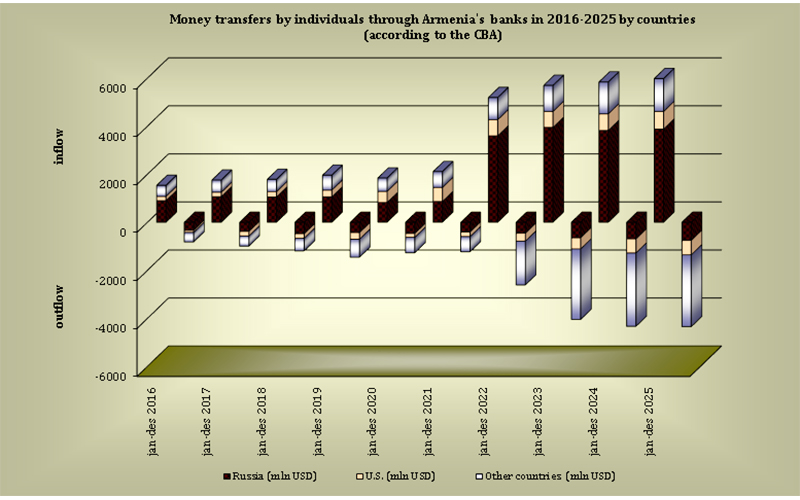
Specifically, the dollarization rate of resident individual demand deposits as a percentage of total individual demand deposits reached a historic high of 56.4% in January 2015. However, two years later, in January 2018, the dram and foreign currency components were completely equal. Subsequently, the dollarization rate in this portfolio declined more often than it increased, a trend that continued until February 2022, when it regained its dominant position. Its subsequent growth throughout the year nearly returned it to its historic high of 55.8% in February 2023 (versus a record 56.4% in January 2015). This preponderance of the foreign currency component in individual demand deposits in 2022 and partially in 2023 was explained by the influx of a large number of relocated individuals (mainly from Russia) into Armenia, who massively opened accounts in Armenian banks to conduct financial transactions, including money transfers. However, as the excitement subsided, the dollarization of individual demand deposits declined, handing over the dominant baton to the dram component in May 2024 - 50.3%. From this point on, the dramization of resident individual demand deposits increased, reaching 63.2% in April 2026, after which it began to decline - to 57.7% in July (versus 58.9% in July 2025). History appears to be repeating itself: a new wave of relocated Armenians from Russia are opening current accounts and depositing foreign currency, leading to an increase in the dollar component of demand deposits in Armenian banks.
In the term deposits of resident individuals, the dollarization level reached a historic high of 74.8% in February 2016, followed by a decline of almost six years, with the dram component becoming dominant in April 2022, reaching 50.8%. This decline lasted only three months, and the foreign currency component once again became dominant. However, a slight gap and fluctuations in the dollar component weakened its position by May 2023, with the dram component becoming dominant at 50.3%. Since then, the dramization rate of resident individual term deposits has increased, reaching 63.9% in July 2026 (versus 58.2% in July 2025).
The turbulent year of 2022, the decline in loan dollarization was driven by passive lending, which banks preferred to generate excess profits from relocators' foreign exchange transactions, from selling them international cards at high prices, and from increased commissions on their money transfers. In 2023, a more pronounced dramization of the loan portfolio was facilitated by legislative restrictions on foreign currency mortgages for residents. From this point through July 2026, the share of mortgages in banks' total loan portfolios increased slightly, from 20% to 21%, while declining more noticeably in consumer loans, from 50% to 47%, accompanied by a slowdown in double-digit growth from 32% to 17%. At the same time, the total loan portfolio, previously supported by high mortgage activity, continued to grow at a double-digit rate, only slightly slowing in annual growth from 28% to 26%. In banks' mortgage portfolios, the dominant component in the dram has already reached 95.6% (according to Central Bank data on loans to residents as of July 2026), with dram-denominated mortgages slowing in annual growth from 32% to 20%, while foreign currency mortgages accelerated in decline from 8% to 20%.