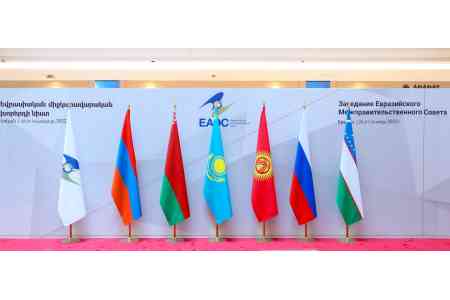
ArmInfo. In January-July 2026, the EU's share of Armenia's foreign trade increased to 19% (from 12.3% a year ago), while the EAEU's share decreased to 29% (from 36.1% a year ago). According to data from the Statistical Committee of the Republic of Armenia, foreign trade turnover with the EU accelerated in year-on-year growth from 9.6% to 57.2%, reaching $2.2 billion, while with the EAEU, it slowed in decline from 51% to 18.4%, amounting to $3.3 billion. Moreover, among the EAEU countries, a decline in volumes was recorded only in the Russian Federation, while most EU countries chose to increase volumes.
These are Germany, Bulgaria, Italy, France, Belgium, Poland, Spain, Austria, Lithuania, the Czech Republic, Cyprus, Slovakia, Denmark, Greece, Sweden, and Portugal, and many of them significantly.
In particular, the share of the EAEU in exports increased from 38.3% to 38.6% (with an insignificant change in the share of the Russian Federation - from 35.7% to 35.6%), as well as the share of the EU - from 7.9% to 14.7%, while the share of the EAEU in imports decreased from 34.7% to 23.8% (due to the Russian Federation - 33.9% to 22.4%), and the share of the EU increased from 15.1% to 21.3%. The share coverage of the remaining countries, representing the leading five, changed as follows: China increased its share in exports from 8.3% to 16.2% and maintained its share in imports at 15.4%; the UAE significantly reduced its share in exports from 28.2% to 8.1% and further reduced its negligible share in imports from 0.6% to 0.4%; Germany increased its share in exports from 1.4% to 1.6% and in imports from 2.9% to 3.6%. Bulgaria significantly increased its share of exports from 0.7% to 4.5%, compared to its share of imports (from 0.2% to 0.7%). The United States continued to increase its share of imports from 2.7% to 3.6%, while slightly decreasing its share of exports from 0.7% to 0.6%. Iraq increased its share of exports from 4.6% to 5.1%, while only increasing its share of imports by a mere 0.02%. Iran decreased its share of imports from 5.2% to 5.1%, while slightly increasing its share of exports from 1.2% to 1.3%.
The top five exporters are Russia, China, the UAE, Iraq, and Bulgaria, with a total volume of $2.8 billion. The top five importers are Russia, China, Iran, Germany, and the United States, with a total volume of $2.99 billion. Both exports and imports to Russia and the UAE are declining. In China, exports have returned to significant growth, accompanied by a sharp slowdown in import growth. In Germany, export growth has slowed sharply, while imports have returned from a recession to strong growth. In the United States, the acceleration of the export decline has been accompanied by imports returning from a recession to strong double-digit growth. In Bulgaria, both exports and imports have jumped significantly. In Iraq, significantly slower export growth has been accompanied by a sharply accelerating import growth. A slowdown in the decline in exports and a slowdown in import growth are observed in the direction of Iran.
The share of Armenia's top five trading partners—Russia, China, Iran, the UAE, and Germany—decreased from 64.6% or $7.4 billion in January-July 2025 to a combined 52.5% of total foreign trade turnover, amounting to $6.1 billion in absolute terms. Two of them, Russia and the UAE, continued to decline by 20.5% and 72.1%, respectively (compared to 52.1% and 67.9% last year). Meanwhile, foreign trade volumes with China and Germany grew by 25.6% and 28.7% (from a decline of 12.5% and 4.2% a year ago), while growth with Iran slowed slightly from 6.3% to 6.1%.
Note that among EAEU countries, foreign trade turnover between Armenia and Kyrgyzstan has increased significantly, with impressive growth observed in both imports and exports. Armenia's growth in foreign trade with Belarus and Kazakhstan is supported by a significant increase in imports from these countries. Armenia's foreign trade with the CIS countries has significantly increased with Turkmenistan and Uzbekistan, with both exports and imports increasing with Turkmenistan, and exports increasing with Uzbekistan. Strong growth in foreign trade is also observed between Armenia and Ukraine, driven by a significant increase in both exports and imports.
Overall, Armenia's foreign trade turnover for January-July 2026 exceeded $11.5 billion, with the year-on-year trend returning to 1.7% growth from a significant 42% decline. In particular, imports improved, rising from a 35.8% decline to 7.7% growth, and the decline in exports slowed significantly from 49.6% to 7.9%, reaching $7.5 billion and $4.04 billion, respectively.
It should be noted that, according to the June 2026 update, According to the Central Bank of Armenia's forecast, the dynamics of exports and imports, after accelerating the decline in 2025 from 11-3.2% to 29.5-32.7%, will remain in decline in 2026, with growth rates slowing to 5.9-5.1% (for exports) and 4.2-5.8% (for imports). The previous March forecast expected a resumption of growth in both exports to 25.5-28.5% and imports to 36.7-34.9%. The Central Bank now expects a resumption of growth in foreign trade in 2027: exports by 2.6-4.3% and imports by 1.1-0.8%. In its June forecast, the International Monetary Fund indicated a modest improvement in Armenia's export and import dynamics in 2026, expecting a recovery from a double-digit decline to very weak and almost flat growth of 0.9-0.7% (versus the previously projected 2.2-2.1%). However, the IMF significantly improved its forecast for export and import growth in 2027, to 5.5-6.3% (versus the previously projected 3.4-3.7%).