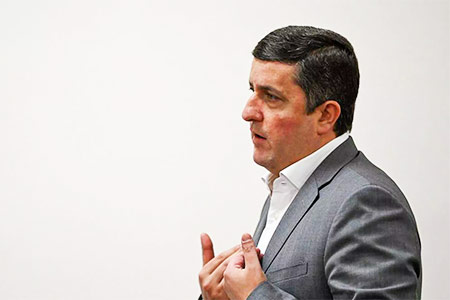



ArmInfo. A round table on the topic of was held in Yerevan. One of the invited guests was Kasym Nurbekuly Majen, founder of the Qazaq Open Source Initiative (QOSI), a non-profit organization promoting open-source and cloud-native approaches, and director of the Open Source Solutions Department of JSC (NIT), a subordinate organization of the Ministry of Artificial Intelligence and Digital Development of the Republic of Kazakhstan.
Despite a busy schedule, an ArmInfo correspondent managed to meet with one of Kazakhstan's leading experts in digitalization and AI technologies and discuss how Kazakhstan is building its digitalization and AI implementation path, the methods and solutions it uses, and the potential for technological cooperation between Kazakhstan and Armenia.
eGov and AI in Kazakhstan
Kasym Mazhen said that Kazakhstan has made significant progress in developing e-government. Systematic work in this area began in the mid-2000s, and the eGov.kz portal was launched in 2006. Today, approximately 90% of government services are available online, and for most of the most popular services, citizens no longer need to physically visit a government agency or public service center.
With the introduction of AI approaches, he said, not only service delivery channels are changing, but also the processes within the government. As one example, the expert cited eOtinish—a system for submitting and processing citizen and business inquiries.
Public inquiries create a very heavy workload. Here, AI is of enormous help: the system can automatically summarize inquiries, prepare preliminary responses based on a knowledge base and regulations, determine the category and tone of the inquiries, and generate analytics. But, of course, all of this occurs under human control, he noted.
eGovernment is also developing in parallel. While the first AI-based solutions primarily helped people quickly find the right government service, Kazakhstan is now moving toward an agent-based approach, in which the system not only provides information but also guides users through the necessary steps to obtain the service.
Will AI replace humans?
Kasym Majen noted that artificial intelligence has been generally well received in Kazakhstan. The country is building data centers, and the national supercomputer complex Alem.Cloud has been created, making it into the global TOP500 ranking and ranking 104th in the latest ranking for June 2026. But behind all this infrastructure are people, and as computing power grows, the need for specialists capable of operating it grows.
In his opinion, this is why it's necessary to focus as much as possible on training people. AI shouldn't be used for its own sake: it's important for specialists to apply it where the technology truly enhances complex or routine work. According to the founder of QOSI, he interacts with approximately 20 specialized AI agents in his daily work.
"For example, our department is small—only seven people—but I alone have a large group of agents," he shared. Comparing AI to a tool for enhancing human capabilities, the expert drew an analogy with a talented artist performing in front of an audience of thousands: even they need a microphone. "Artificial intelligence is nothing more than an amplifier," Kasym Majen emphasized.
At the same time, the expert noted, it is especially important to properly integrate AI into education. Instead of using it to identify and fill knowledge gaps, students often use the technology to complete homework or find ready-made answers to tests.
According to the expert, clear rules and methodology for using AI in education are needed—taking into account the role of the teacher, academic integrity, data protection, and the need to preserve students' fundamental knowledge.
Today, the fundamentals of artificial intelligence are already being integrated into the school curriculum in Kazakhstan. AI is not being introduced as a separate subject: in grades 1-4, "Digital Literacy" has been renamed "Digital Literacy and Artificial Intelligence," and in grades 5-11, "Computer Science" has been renamed "Computer Science and Artificial Intelligence."
A separate project is being developed for small rural schools. A pilot project using AI technologies was launched in 10 schools in the Pavlodar and Kyzylorda regions on September 1, 2026. The pilot program is expected to cover 500 small schools, and by 2029, the most effective solutions are planned to be scaled up to all 2,600 such schools in the country. AI tutors are expected to expand access to personalized learning and help close the gap in educational quality between urban and rural areas.
Similar approaches are already being used globally, but scaling up such solutions at the national level could be one of the first major cases for Central Asia.
According to the expert, if the current technological trend continues and global geopolitical tensions subside, the region's prospects look positive. Initiatives already underway—construction of data centers, development of computing infrastructure, training of specialists, community development, and cooperation between countries—are laying the foundation for the widespread adoption of AI.
In his speech at a roundtable in Yerevan, Kassym Majen discussed the idea of transitioning from Digital Crossroads to Digital Commons – the creation of shared digital resources, open standards, and technological approaches that can be used and developed by different countries. "I think there is very good scope for cooperation here for Armenia and Kazakhstan," he noted.
The QOSI founder explained that this primarily concerns open standards, reference architectures, and approaches to creating platforms for orchestrating AI workloads and related applications. Armenia and Kazakhstan can cooperate in these areas both at the national level and at the level of their engineering and scientific communities.
It is especially important that, by using common global standards and a cloud-native approach, solutions created in one country can be further adapted and used in another. "Therefore, it makes sense to think together to ensure that the solutions created do not remain exclusively domestic products but have the potential for further scalability," the expert emphasized.
At the same time, Digital Commons does not mean that one country gains access to the other's infrastructure. It is about the joint use of open standards, open-source technologies, architectural approaches, and accumulated engineering expertise while maintaining the independence of each party.
After participating in the event and discussions with his Armenian colleagues, Kasym Majen noted Armenia's great technological potential. Large data centers are developing here, there is government support for the technology sector, and programs are being implemented to attract IT specialists from various countries. Taken together, these initiatives could provide a significant boost to the development of the digital sector.
Furthermore, he noted the country's strong scientific and human resources potential. Even before the launch of Alem.Cloud, Kasym Majen and his team spoke with Armenian specialists working with the supercomputer infrastructure at one of the capital's universities. He was particularly impressed by the level of problems they were solving.
Open source and cloud-native: where to begin digitalization?
If the digitalization process had to be started from scratch, the expert recommends first embedding modern standards and technologies at the system's basic architecture level.
If Armenia is to create new government digital systems or thoroughly modernize existing ones, the expert believes it is important to immediately embrace open standards, open-source components, API-first, and cloud-native architecture.
According to him, a good technological foundation allows for the subsequent modification of individual components without rewriting the entire system from scratch. With a properly designed cloud-native architecture, individual services and workloads can be migrated or scaled, if necessary, between in-house infrastructure and public cloud platforms such as AWS, Microsoft Azure, or Google Cloud.