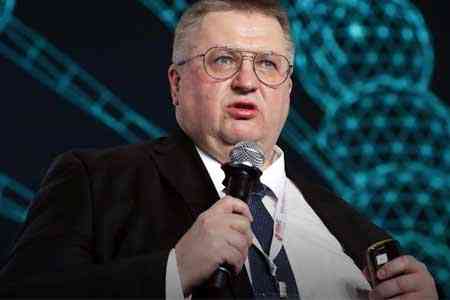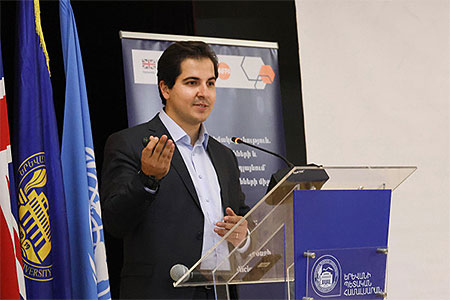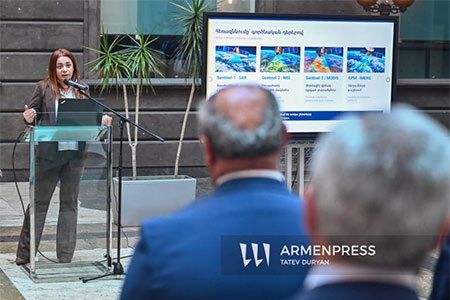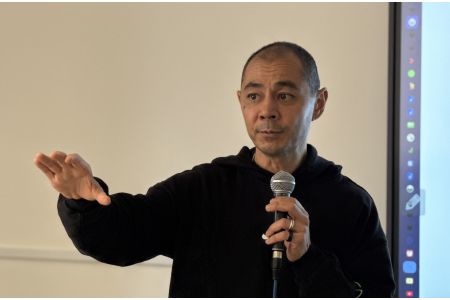
ArmInfo. A master class by David Yan, one of the well-known entrepreneurs and pioneers in the field of artificial intelligence, was held at the Russian-Armenian University.
According to the RAU press service, drawing parallels between artificial intelligence and human capabilities, David Yan noted that free will is something AI does not have. AI cannot be Parajanov or Tarkovsky: only humans possess the ability to “become a magician and wave a wand.”
The expert also shared with the participants his concept of the “three magic crystals.” This is a rule for creating a successful business project or startup, according to which an entrepreneur must have an intersection of three key competencies.
The first crystal is knowledge of the problem (the customer’s pain point): a deep understanding of the consumer’s real “pain,” market needs and the essence of the problem itself that you intend to solve. The second crystal is knowledge of technology: possession of a technological advantage or the ability to actually create a quality product that solves this problem. The third crystal is knowledge of distribution channels: a clear understanding of exactly how to deliver the product to the customer, and how marketing, sales and audience acquisition channels work.
According to the founder of ABBYY and Yva.ai, if at least one of these “crystals” is missing, the project’s chances of success approach zero.
A key part of the meeting was David Yan’s predictions about the future development of AI over the coming decades.
“My first prediction: in 2030, scientists will prove the first signs of consciousness in AI agents. In 2035, the first country will legalize marriage to non-biological agents. In 2040, the first street protests will appear under the slogan Robots Lives Matter. In 2045, the first hybrid members of society will appear: people will have non-biological implants, while non-biological entities will have biological implants linked to genes or sensors. And in 2025, the first country will grant some rights to non-biological entities,” Yan predicted.
According to the expert’s estimates, by 2030–2035, around one billion humanoid robots will be produced on Earth each year. In other words, their number will become comparable to the number of biological humans.
“I don’t know what the population will be by then — 10 or 12 billion, — but another approximately 4 billion humanoid robots will live among us. This will become a new era of our unification. We will read fairy tales to robots, and robots will read them to us. We will have to align our understanding of good and evil,” David Yang said.
He is convinced that it is impossible to reverse the technological revolution.
“It is impossible to put atomic energy back into uranium, just as it is impossible to remove electricity or the steam engine. We must accept the fact that an alien brain has appeared on planet Earth. Nubar Afeyan, our compatriot and the inventor of the Moderna vaccine, once said at a conference: "AI is not Artificial Intelligence, AI is Alien Intelligence." And I absolutely agree with him. An alien intelligence has indeed appeared on Earth, and this is inevitable. We cannot stop it. To live in harmony, we simply need to learn to coexist with it,” the entrepreneur concluded.
As part of the lecture, David Yang and RAU students created and tested their own AI agent, Emily, which also spoke Armenian. In addition, the participants saw what David Yan’s AI home in Silicon Valley looks like — with moving walls and robotic dogs.
The event was organized by the RAU Department of Management and Business.