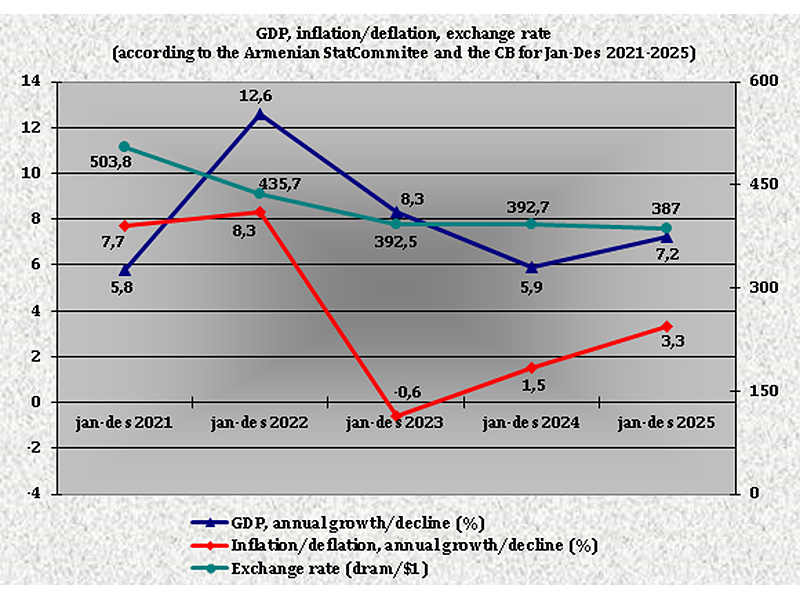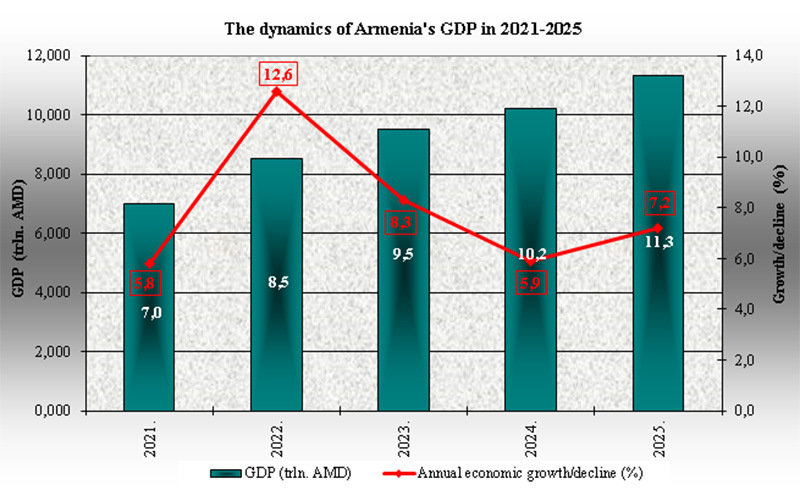



ArmInfo. In Armenia, economic activity growth slowed to 6.9% per annum in January-September 2026 (from 7.6% in the same period of 2025). Moreover, the industrial sector has returned to growth, once again becoming one of the drivers of economic growth. According to the final data of the RA Statistics Committee, this is accompanied by a reversal in the foreign trade trend from a significant decline to growth, primarily due to improved import dynamics.
According to statistics, the slowdown in economic activity growth in January-September 2026 was largely due to weakening annual growth in the dominant trade sector – from 3.5% to a near-stagnation of 0.6% – as well as a deterioration in the agricultural sector’s dynamics, from 6% growth to a 4.8% decline. At the same time, the industrial sector's performance improved, rising from a 5.7% decline to 5.8% growth. The services sector, which ranks second by volume, accelerated its annual growth from 9.9% to 13%, while the construction sector, which leads in growth, accelerated further, from 20.7% to 24.9%. The energy sector's annual growth slowed slightly, from 8.2% to 6.4%.
According to statistics for January-September 2026, the trade sector remains the leader in absolute terms, with a volume of over 5 trillion drams ($13.5 billion). The services sector ranks second, with 3.5 trillion drams ($9.3 billion), and the industrial sector ranks third, with 2.4 trillion drams. AMD ($6.4 billion), fourth place was the agricultural sector - AMD 677.1 billion ($1.8 billion), and fifth place was the construction sector - AMD 583.8 billion ($1.6 billion). Electricity generation in January-September 2026 amounted to 7,827 million kWh, of which 800 million kWh in September alone.
A slowdown in economic activity growth was also observed in September 2026 compared to September 2025 - to 5% (from 10.5% a year earlier), and in September alone, growth accelerated from 4.5% to 9.1% (versus a similar acceleration in growth in September 2025 from 5.4% to 9.8%). Moreover, in September 2026, industrial sector growth accelerated from 1.9% to 4.2%, while a year earlier, it slowed from 10.7% to 5.1%. At the same time, growth in the construction sector slowed in September, from 16.9% to 8.5%. In the services sector, growth improved in September, from a 1.3% decline to 1.3% growth, while in the trade sector, conversely, it worsened, from 1.3% growth to 1.4%. However, the energy sector's performance worsened more sharply in September, from 3.8% growth to a 15.7% decline.
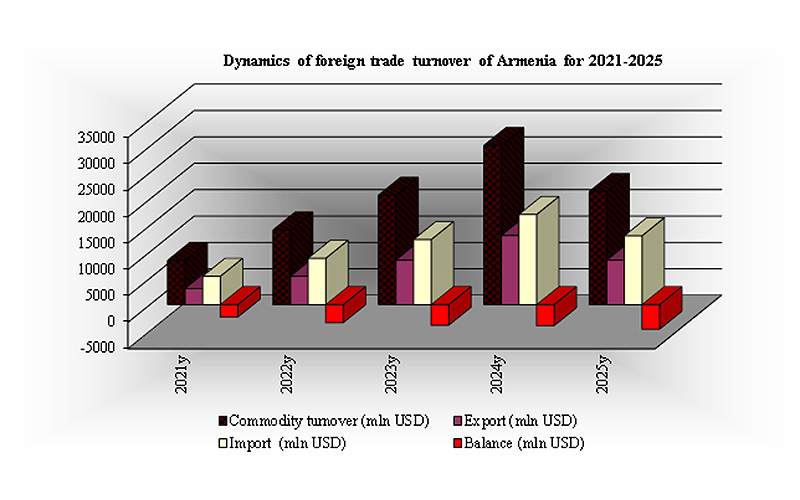
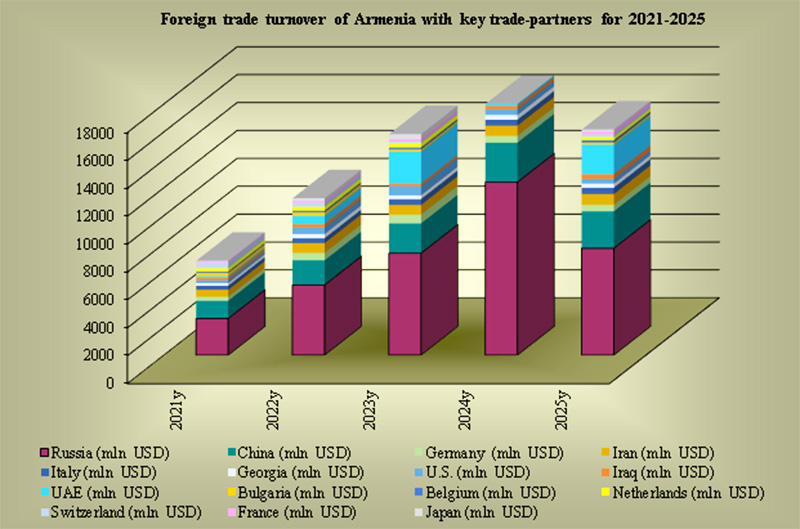
On a year-over-year basis (September 2026 to September 2025), not all sectors demonstrated an upward trend. Specifically, declines were recorded in the energy sector and industrial sector—by 5.6% and 4.5%, respectively—while the trade sector stagnated. For example, the construction sector showed annual growth of 25.9% and the service sector of 15.1%. A year earlier, in September 2025 compared to September 2024, all sectors showed growth: construction by 22%, energy by 17.1%, industrial sector by 10.1%, services by 7.9%, and trade by 0.9%. Against this backdrop, Armenia's foreign trade turnover in January-September 2026 exceeded 5.5 trillion drams (almost $15 billion), with the annual trend returning to 2.7% growth from a 39.3% decline. This was driven by improved import dynamics, rising from a 33.4% decline to 9.5% growth, as well as a noticeable slowdown in export declines from 46.8% to 8%. As a result, the absolute value of exports for January-September 2026 amounted to 1.9 trillion drams ($5.2 billion), and imports - 3.6 trillion. AMD ($9.8 billion).
In September 2026, compared to September 2025, the decline in foreign trade turnover slowed significantly to 3% due to import growth of 7.2% and a slowdown in export decline to 18.6%. A year earlier, in September 2025, compared to September 2024, the significant double-digit decline in foreign trade turnover of 21.6% was due to a decline in exports of 24.4% and imports of 19.5%.
It should be noted that, starting in 2023, the methodology for calculating the volume of generated electricity in statistical reports has changed; in particular, the volume of electricity generated by autonomous generators has now been included. For the agricultural sector, data is published only in quarterly and annual statistical reports. (The average exchange rate for the dram in January-September 2026 was 371.32 drams/$1)