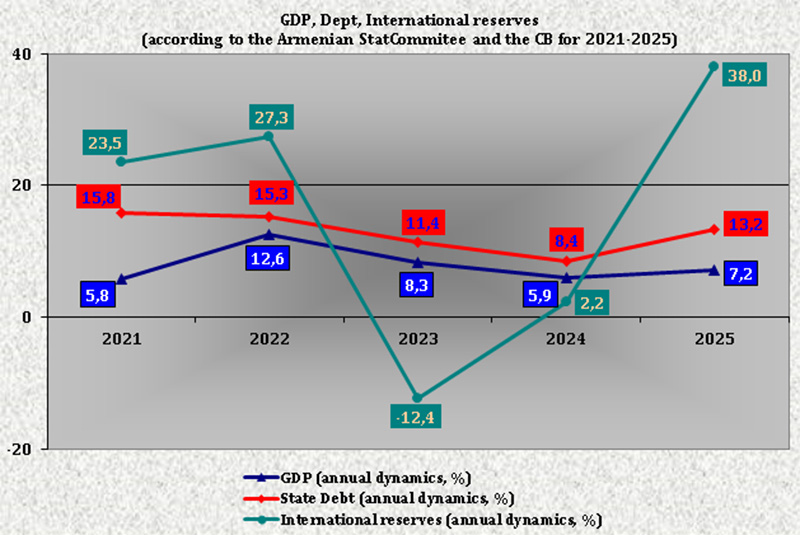



ArmInfo. In Armenia, economic activity growth slowed to 6.4% year-on-year in January-October 2026 (from 8.1% in the same period of 2025). At the same time, the industrial sector emerged from decline into growth, once again becoming one of the drivers of economic growth. According to preliminary data from the RA Statistical Committee, this, in turn, is slowing a more noticeable recovery in foreign trade, whose weak growth is mainly driven by improved import dynamics.
According to the statistics, the slowdown in economic activity growth in January-October 2026 was largely due to weakening annual growth in the dominant trade sector—from 3.2% to nearly stagnant 0.5%—as well as a slowdown in growth in the energy sector, from 7.9% to 3.4%. At the same time, the industrial sector’s dynamics improved, emerging from a 3% decline into 3.1% growth. The services sector, which ranks second in terms of volume, accelerated its annual growth from 10.8% to 11.5%, while the construction sector, the growth leader, accelerated further, from 20.6% to 24.8%. The statistical report for this period does not include data on the agricultural sector.
According to statistical data for January-October 2026, the trade sector retained its lead in absolute terms, with a volume exceeding 5.6 trillion drams ($15.2 billion). The services sector ranked second in terms of volume, at over 3.8 trillion drams ($10.3 billion), followed by the industrial sector in third place, at 2.7 trillion drams ($7.3 billion). The construction sector ranked fourth, due to the absence of data on the agricultural sector, at 697.2 billion drams ($1.9 billion). Electricity generation in January-October 2026 amounted to 7,696.6 million kWh, of which 738.6 million kWh were generated in October alone.
A more noticeable slowdown in economic activity growth was observed in October 2026 compared with October 2025, to 3.5% (from 10.1% a year earlier), while in October alone, the dynamics shifted from 9.1% growth to a 4.7% decline (against a similar deterioration in dynamics in October 2025, from 9.8% growth to a 4% decline). At the same time, in October 2026, industrial sector growth accelerated from 4.2% to 11.6%, as had also been observed a year earlier—from 5.1% to 20.8%. At the same time, October saw a deterioration in the dynamics of the construction sector, from 8.5% growth to a 0.1% decline, and of the services sector, from 1.3% growth to a 1.5% decline, while the trade sector, on the contrary, improved from a 1.4% decline to 2.4% growth. However, the energy sector’s dynamics improved more noticeably in October, from a 15.7% decline to 7.1% growth.
Year-on-year (October 2026 compared with October 2025), not all sectors demonstrated an upward trend; in particular, a decline of 12.9% was recorded in the industrial sector, while the trade sector was almost stagnant (0.1%). Thus, annual growth was recorded in the construction sector—24.2%, the services sector—8.5%, and the energy sector—1.8%. A year earlier, in October 2025 compared with October 2024, not all sectors also showed growth; in particular, excluding the energy sector, which fell by 5.5%, growth was recorded in construction—2.01%, the industrial sector—17.9%, the services sector—12.8%, and trade—1%.
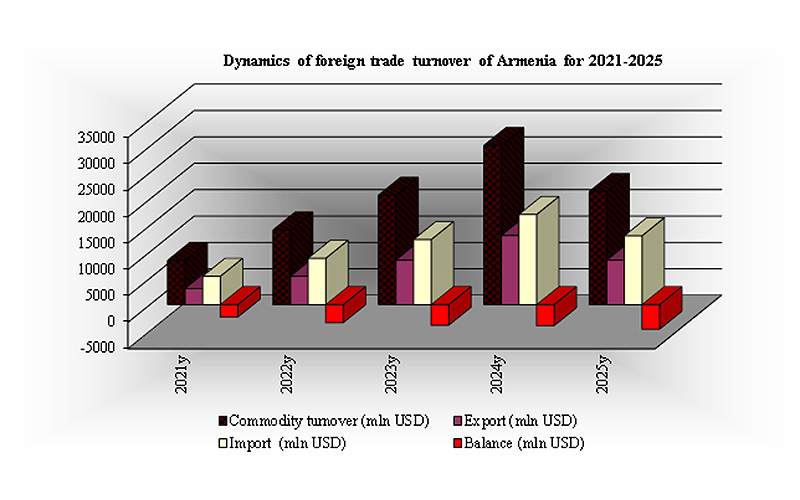
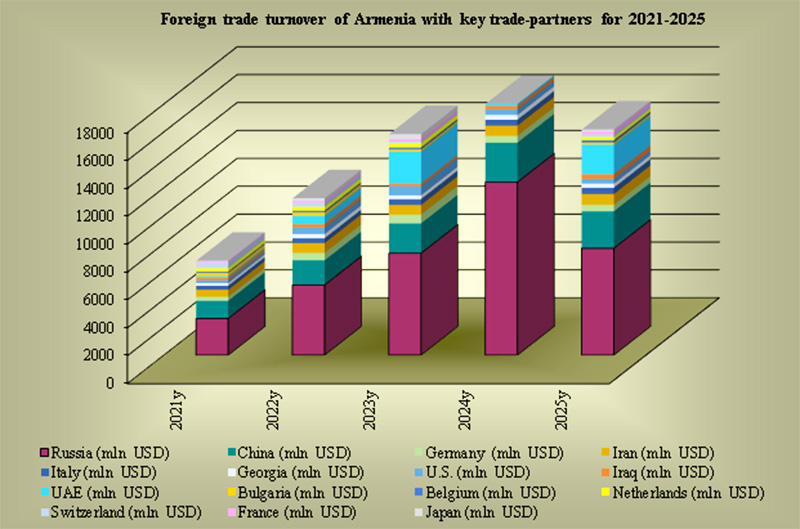
Against this backdrop, Armenia’s foreign trade turnover in January-October 2026 amounted to 6.2 trillion drams ($16.7 billion), with annual dynamics moving from a 37.1% decline to 1.2% growth. This was due to improved import dynamics, which moved from a 31.2% decline to 8.2% growth, as well as a significant slowdown in the decline in exports, from 44.7% to 10%. As a result, the absolute value of exports in January-October 2026 amounted to 2.1 trillion drams ($5.7 billion), while imports amounted to 4.1 trillion drams ($10.97 billion).
In October 2026 compared with October 2025, a 12.3% decline in foreign trade turnover was recorded as a result of declines in both imports, by 4.1%, and exports, by 25.4%. The same was observed a year earlier, in October 2025 compared with October 2024, when a 16% decline in foreign trade turnover resulted from reductions in exports and imports of 21.8% and 11.9%, respectively.
It should be noted that since 2023, the methodology for calculating electricity generation volumes has changed in statistical reports; in particular, electricity generated by autonomous producers is now also included. Data on the agricultural sector are published only in quarterly and annual statistical reports. (The average calculated exchange rate of the dram in January-October 2026 was 370.34 drams per $1).