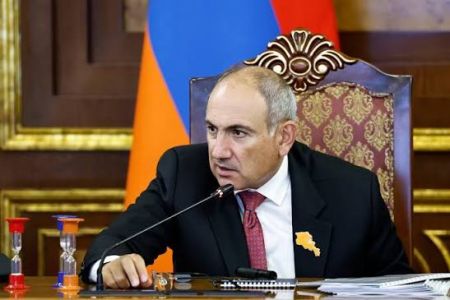


ArmInfo. The new historic record for the number of jobs registered in Armenia was predictable. Prime Minister of the Republic of Armenia Nikol Pashinyan stated this at a government meeting on November 26.
According to him, based on data on income tax and social insurance payments submitted by taxpayers for October 2026, the number of income-generating jobs amounted to 849,741, which is 39,667, or 4.9%, higher than the figure for the same month last year, and 320.9 thousand more jobs than in 2017.
The prime minister linked this healthy trend to the introduction of the universal health insurance system and the laws adopted. In particular, the head of the Armenian government pointed to the inclusion in the system, starting January 1, 2027, of persons with salaries of up to 200,000 drams. Thus, practically all citizens of the country will be included in the universal health insurance system. The prime minister noted the need to resolve the issue of rural residents who cannot yet be included in the system. In this regard, it will first be important to resolve the issue of their work record. "In this case, it is necessary to explain to citizens what a work record is. It consists of income tax payments. According to the government’s decisions, the residents of farming households themselves will regulate relations related to their work record, but in this matter it is necessary to create mechanisms so that this process is as accessible and feasible as possible," the prime minister of the Republic of Armenia said.
Let us recall that the universal health insurance system has been operating in Armenia since January 1, 2026, and is being introduced in stages; full coverage of the population is planned by 2031). The system includes employed citizens with salaries starting at 200,000 drams, including the threshold of up to 500,000 drams under the first stage, and individual entrepreneurs with a turnover of 2.4 million drams, as well as privileged and socially protected groups for whom the state pays 100% of the contributions: children under 18, citizens aged 65 and older, persons aged 18-65 with Group I, II and III disabilities, and socially disadvantaged families (from 28 points). The basic monthly insurance contribution is 10,800 drams, or 129,600 drams per year. Under the amendments adopted in November 2026, of the 10,800 drams, 4,400 drams will be paid by the state, 4,400 drams by the employer, and 2,000 drams by the employee. Planned treatment and examinations are provided through primary care (a family doctor, general practitioner or pediatrician at a polyclinic/outpatient clinic), who issues referrals to specialists and inpatient facilities.
Emergency care is provided immediately through an ambulance or any specialized medical facility.
Starting January 1, 2-27, it is planned to additionally enroll approximately 350,000-400,000 people. The system is also expected to include taxi drivers working through electronic platforms, provided they meet the established work-record/work-condition requirements.
Employed citizens will have the opportunity to insure family members depending on their salary level (for example, with an income of 200,000 to 500,000 drams, one family member).