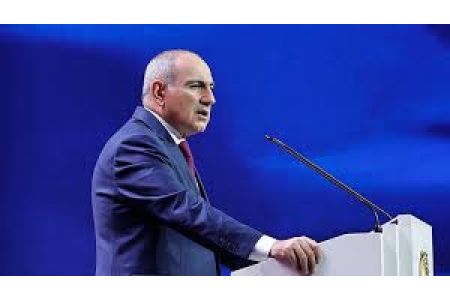



ArmInfo. Armenia intends to appeal to the Eurasian Court regarding Russian restrictions on supplies of Armenian goods. Armenian Minister of Economy Gevorg Papoyan told journalists this during a briefing on November 26.
He noted that the postponed meeting of the EAEU Collegium on this issue never took place. It has now been postponed until December 1. However, the Minister of Economy said that, on his instructions, a different strategy had been chosen - appealing to the Eurasian Court for an advisory opinion.
In this context, he explained that lifting Russian restrictions on the export of Armenian goods requires securing 7 out of 10 votes in the EEC Council. Armenia is currently supported by 6 participants, and the court’s advisory opinion, according to Papoyan, could strengthen the Armenian side’s position.
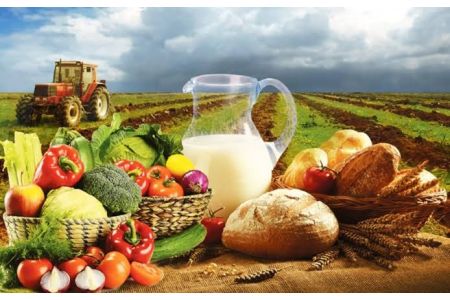
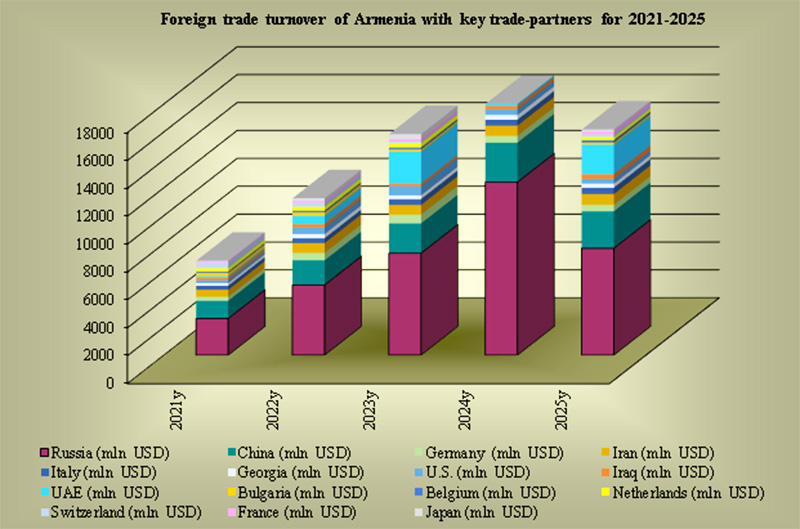
It should be recalled that relations between Moscow and Yerevan have become strained against the backdrop of Armenia’s integration course toward the EU. Thus, since the end of May this year, Russian authorized bodies - Rospotrebnadzor and Rosselkhoznadzor - have gradually imposed restrictions on supplies from Armenia to Russia and the EAEU market of fresh agricultural products, flowers, fish, fish products, as well as dairy products. At the same time, Armenia traditionally directed approximately 80- 90% of the export volumes of these product groups to the Russian Federation. In view of the difficult situation faced by Armenian producers and exporters, the government is developing support programs to stimulate exports to the EU and other countries. In particular, this involves covering transportation costs and customs duties to enter new markets. Thus, the following picture emerged in mutual trade with Russia in January-September 2026. Trade turnover decreased by 19.4% to $4 billion. Exports amounted to $1.8 billion, down 11.3% year-on-year, while imports amounted to $2.2 billion, declining by 25.2% year-on-year. Trends with the EAEU countries are also not encouraging. The volume of mutual trade during the reporting period decreased by 17.4% to $4.3 billion. At the same time, exports fell by 10.7% to $2 billion, against a 22.4% decline in imports, which amounted to $2.3 billion.