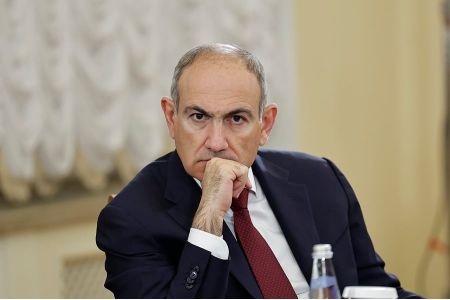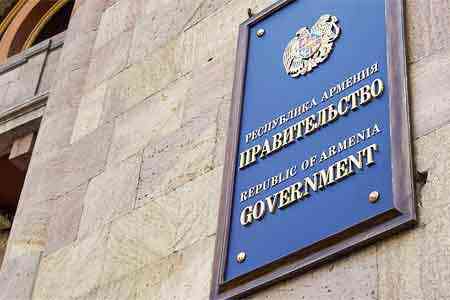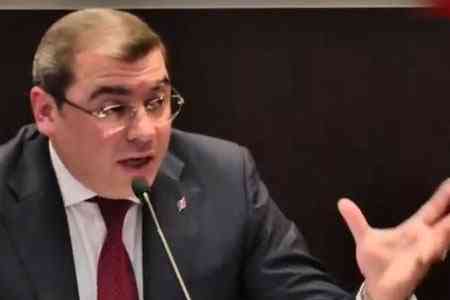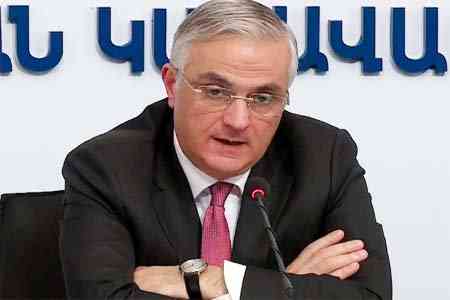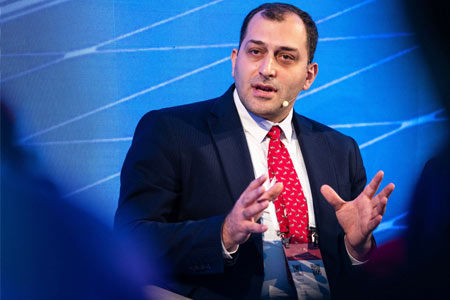


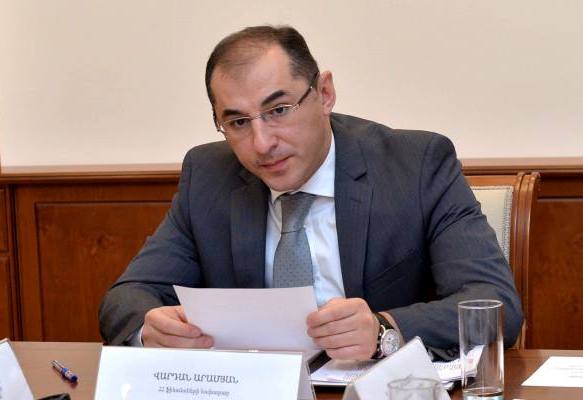
ArmInfo. "We are yet in the limits of scenario assuming 3,2 economic growth by the end of 2017 and we have targeted to provide the growth of GDP in upcoming years for 4,8 and higher up to 5,7%". Vardan Aramyan, thie Finance Minister of Armenia, in his interview to ArmInfo comments on the plans on budget capital expenditures , talks about those being justified and notes the positive signals in the economy of Armenia within the activities of Armenian Government led by Karen Karapetyan. According to the minister, sometimes positive expectation, including those in economy, play a much more essential role than it was supposed.
Mr Minister, the Gvernment goes for AMD 50 bln increase of capital expenditures set forth by the budget. Meanwhile, the 2017 budget was presented by the Government as a conservative one, aimed at the sustainability of foreign debt and keeping the state budget at the level less than 3%. At the same time, based on the results of Q, an economic activity at the level of 6-6,6% was fixed, and the state budget incomes exceeded the expectations, and due to this the Government thinks about new loans and about capital expenditures increase. Does it contradict the principles of state budget formation declared earlier?
There are no any contradiction at all. While planning the budget, we are oriented not only at economical indicators inside the country, but also to the tendencies and forecasts of global economy growth speed in average - term prospective. Based on that, we form our expectations in respect to certain future economic processes. It is obvious, that if in trade-partner countries of Armenia the forecasts regarding the economic growth change many times, than we have to review our initial estimations as well. Russian Federation, which is the main trade partner of Armenia, has reviewed its 2017 forecasts several times, reviewing it from 0,8% up to 32%, while in August, when we were planning our budget, the economic growth was forecasted in the limits of 1%. Accordingly, we were aimed at 1% growth, too. The indicators were also the factors of international situation - Presidential elections in USA and the prices dynamics at the stock markets, particularly, a 10% growth of copper prices is fixed for today. And that is very important for us.
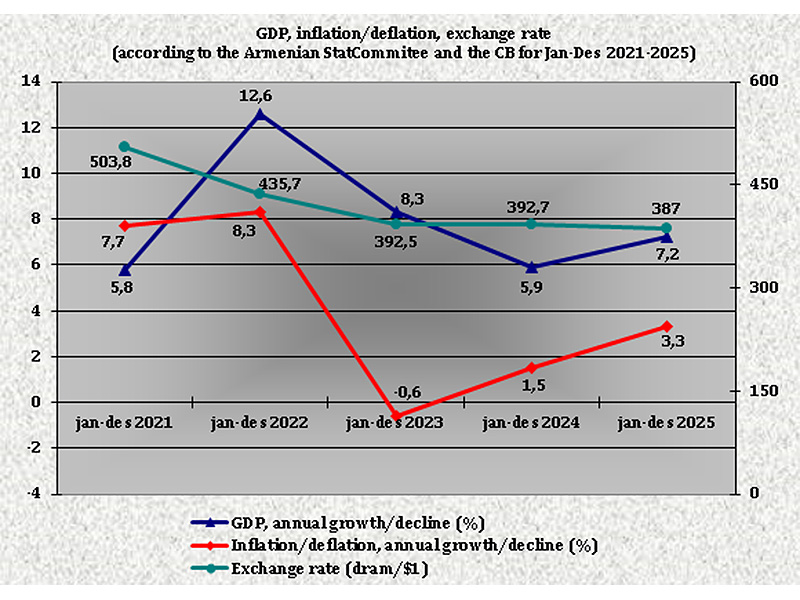
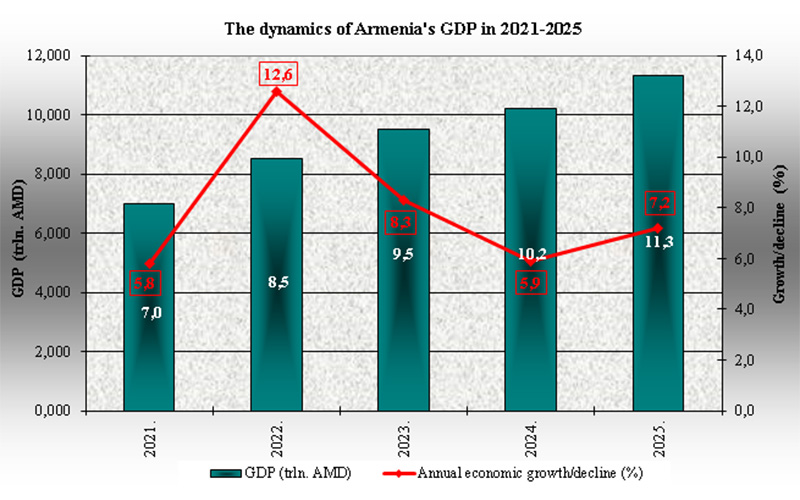
Besides, the economic growth has also an inert character, and the steps of the Government, taken in the past, make a certain impact on the economic activity today. For the first look, in this respect it seems more feasible to forecast lower indicators based on key developments of the past, particularly , in respect to investments, which demonstrated slow dynamics during recent several years. That is why it would be of a very high risk to forecast any higher growth, and the 3,2 % growth assumed by the budget is the minimum we are targeted to reach. In average-term prospective we are aimed at indicators much higher - form 4,8 to 5,7%. We should not also forget that beside main basic factors in economy, the reforms and changes implemented to capsulate positive expectations of the public, are very important as well. Yet in 2006, American Edmund Phelps was awarded a Nobel prize in Economy for his macroeconomic studies of interconnection of unemployment and inflation, and the key stone of his concept became the theory of "national expectations revolution". Which claimed that inflation expectations also affect the process.
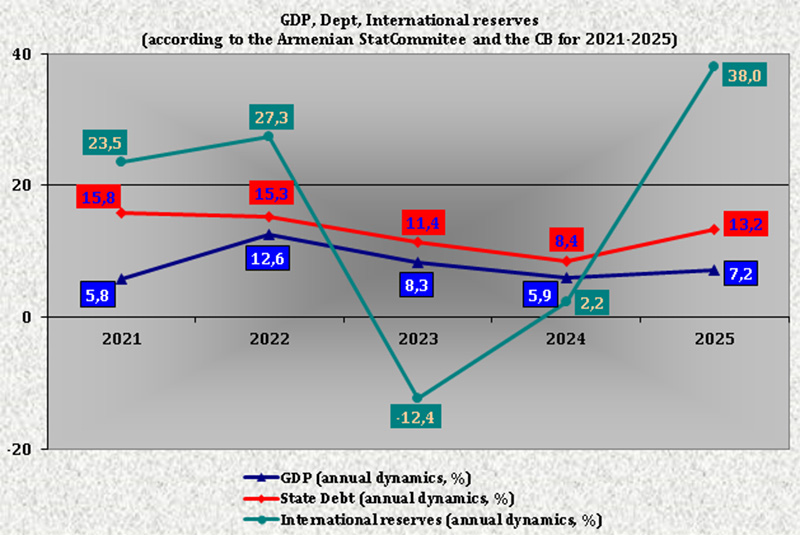
Hence, in our case, we got more positive signals for our activities than we expected. At the same time, we never forget about the sustainability of tax-monetary policy and debt tranquility, not to allow the exaggeration of the foreign debt. In this respect, I would like to mention, that the result of the literate management of state debt is that today the profitability of sovereign state bonds decreased, and they became more expensive than they were at the moment of their placement. It turns that international investors are ready to purchase Armenian securities within the consideration of their lower profitability, which states the trust of international market players to our country. Will the appreciation of American currency affect the Armenian economy in the context of state debt management?
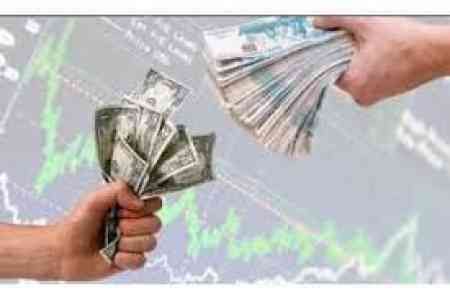
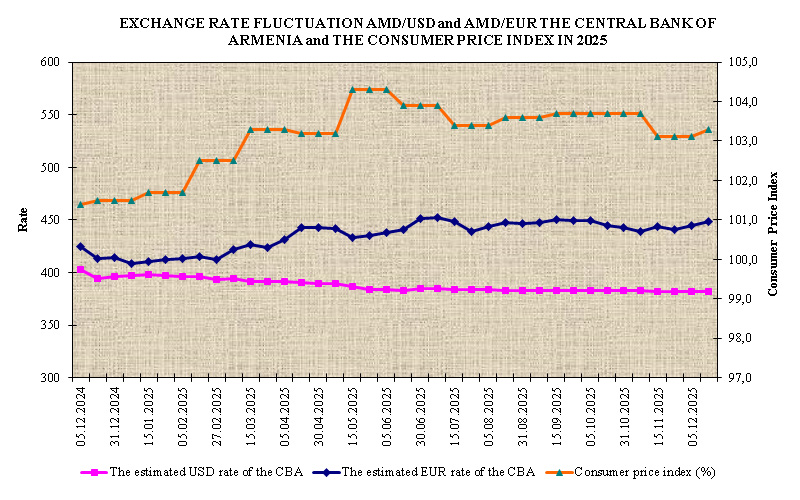
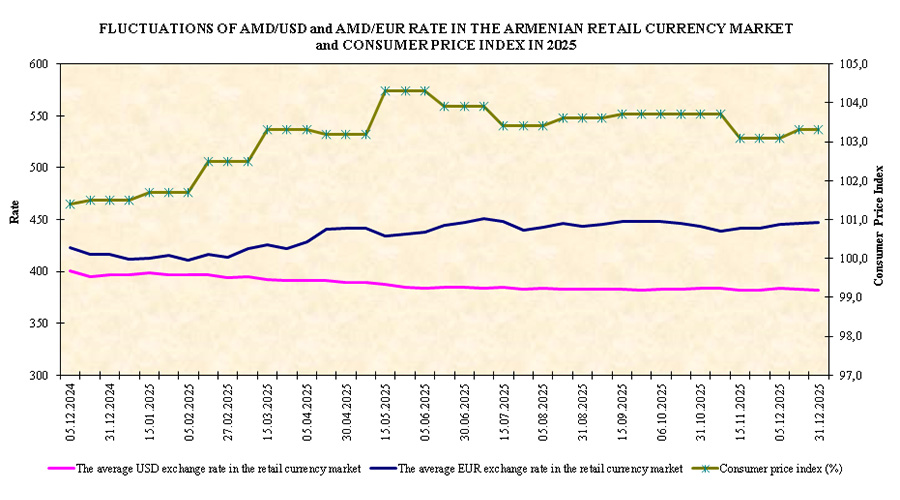
The depreciation of Armenian dram to US dollar, almost up to AMD 600/USD 1, according to the stress- tests of the Ministry of Finance, could hardly cause problems for the tax-budget system of Armenia. Of course, we see some threat and the sharp dropdown of national currency, for instance, 30%, down to AMD 650/USD 1, could become something like Rubicon, but such a prospective is almost zero. But in this case also we will never pass threshold of state budget manageability.
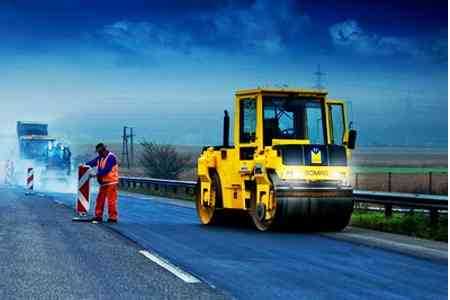
The Government reviewes the capital expenditures to the side of their increase. What the additional expenditures will be allocated for? First to infrastructure projects - roads and irrigation systems. This strategy also has its philosophy - for today, it is very hard to motivate people to invest in economy under the conditions of absence of roads and communications. Does it mean You think the profitability of this approach is much higher than if AMD 50 bln additional expenditures were allocated for the particular funding of state deficit formingAMD 150,1 bln, or to particular covering of foreign debt? Yes, for sure. I think it would be more justified to invest these resources and to generate added value in economy, which, in its turn, will be aimed at state debt maintenance in the future.
In three first initial months of 2017 the Government has overfilled the quarterly plan in respect to taxes collection, and the economic activity has also exceeded the expectations, reaching the point of 6-6,6%. Menawhile, the similar increase has been fixed in the first semester of 2016, after which a period of economic slow down came. At the same time, You have stated many times that the economic activity indicator could slow down a little proceeding from the basic effect of its growth from the middle of last year. In this context, have you any scenarios developed, so called "B-plan", for any force majeure situation?
Armenian economy has a traditional "postponed" effect depending on Russian one, and negative tendencies there impact the local economy with a certain delay. " Let's suppose for a moment that international market shows a sharp dropdown, which is reflected on export, financial flows and, as a result, we get lower speed of economy growth. In this case, within the framework of anti- cycle policy, when the demand has already fixed its natural dropdown, the Government has to go in other way - reasonably increasing the capital expenditures through involving new loans, allowing with that some increase of budget deficit.
Mr. Aramyan, the forecasts of Armenian Government and International Monetary Fund and World Bank in respect to Armenian economic growth use to be very different. What it could be described with? If we consider the average indicator of Armenia's economic growth since 2009, it can be noted that a relatively high growth of 7.2% was recorded only in 2011. Then we permanently hold in the areas of 3% growth, and the 2016th was closed with 0.2-0.3% GDP, and economic activity was 0.5%. Against this background, it would be unrealistic to forecast a 4-5% GDP growth, since all econometric models are based on backward-looking (orientation to past results, ed.). In this connection, it is not surprising that the forecasts of international structures on the rates of Armenia's economic growth range from 2.7% to 3.2%, in keeping with the principles of conservatism.
Meanwhile, setting the 3,2% GDP in the budget, we have stated many times, that this is the minimum we plan to reach. This indicator is not related to our team's ambitions, and the ambitions are much higher, so we expect for higher indicators in the middle-term prospective.