


ArmInfo. An enlightened Armenia MP Mane Tandilian proposed exempting Armenian banks from bad credit taxes on February 11 at a plenary meeting of the country's parliament.
According to Tandilyan, the proposal arose because the tax service required to pay income tax even on bad loans, for which there are no payments. "We suggest not calculating taxes on such loans, so as not to force banks to pay on profits that they did not receive from these loans," the deputy said. According to her, at present in commercial banks and credit organizations the total amount of bad loans has approached the mark of 11% in the portfolio, of which 8% are on their balance sheet. Often banks are ready to write off bad loans, however, the presence of a provision of the Tax Code that in this case, these structures must pay income tax makes this process impossible. In this regard, it was proposed to exempt the financial institutions of the country from paying income tax on bad loans.
Tandilyan also announced a proposal by the faction for protection against fraudulent schemes when implementing this proposal. Deputy noted that this mechanism should begin to operate "only when both parties have taken everything possible: the bank - to collect the loan, and the debtor - to pay off." Confirm the fulfillment of these criteria, in accordance with the proposal of the party, the court must. At the same time, it was proposed to limit the use of this opportunity only to bad loans issued before December 31, 2019.
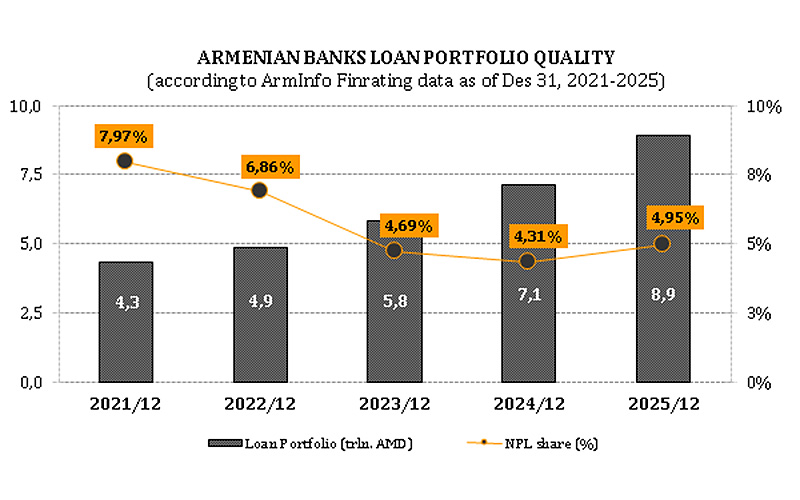
However, this initiative did not meet with the understanding of the parliamentary majority, which, with 40 votes in favor, 62 against and 10 abstentions rejected the inclusion of the bill in the big agenda of the RA National Assembly. According to the deputy from the ruling faction "My Step" Tsovinar Vardanyan, the amendment could be a serious opportunity for abuse: false bankruptcy and other falsifications. In addition, the proposal was regarded as creating unequal conditions for bona fide customers of financial institutions. Recall that earlier on his Facebook page, Prime Minister Nikol Pashinyan talked about 0.85% of bad loans, which, according to the head of the government, testified, on the one hand, to the good condition of the banking system and, on the other, to the solvency of citizens. In response, Manet Tandilian on her Facebook page emphasized that the Prime Minister of Armenia once again resorted to manipulation. In particular, the parliamentarian noted that it is painful to think that the Central Bank, which is accurately informed about the real volume of overdue loans, is also part of this manipulation. "Bankers know that overdue loans are written off off balance after 270 days, and are not reflected in the reports. In fact, the volume of overdue loans is more than 10 times the volumes indicated by the Prime Minister in his publication. If the banker is Deputy Prime Minister Mher Grigoryan and The Central Banks cannot provide the Prime Minister with accurate information or refrain from publishing manipulative information, I advise the Prime Minister to check narrow professional information with other specialists in this field, "said Manet Tandilian. According to the Financial Rating of the Banks of Armenia as of October 1, 2019, prepared by IC ArmInfo on the basis of published reports and indicators requested by credit risk, the share of NPL in the loan portfolio decreased in annual terms from 11.5% to 9%, and in assets - from 7, 5% to 5.8%. Moreover, in the structure of overdue loans, the most risky groups continue to dominate - dubious and hopeless, whose share in total exceeds 66% (against about 70% a year earlier). Their dominant mass continues to accumulate in consumer loans (incl. Mortgages), and the rest of the volume is mainly settled in loans to the trade sector, the agricultural sector and the industrial sector. According to the results of 9 months, the real trend of profit, namely, a sharp slowdown in annual growth from 81.5% to 18%, with a quarterly stagnation of this indicator, suggests an assumption of write-offs of toxic loans from the balance sheet, rather than improving the portfolio due to the return of accumulated debts . According to the results of 12 months, the annual profit growth slowed down from 62% to 38%, with a quarterly decline of 16%, which confirms the assumption of continuing write-offs of toxic loans from the balance sheet. According to the analysts of the National Rating Agency AmRating, the transition of Armenian banks to a new format for presenting credit risk (according to IFRS9) completely blurred the picture about the real quality of the loan portfolio and the presence of toxic loans (NPL).