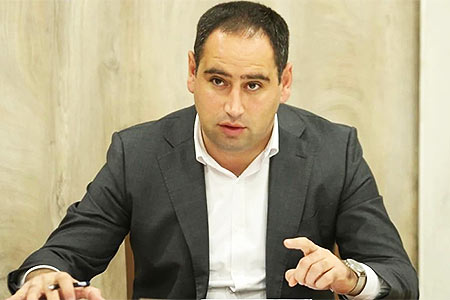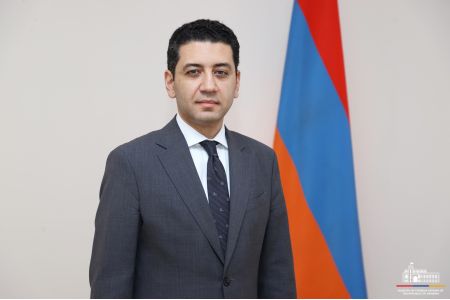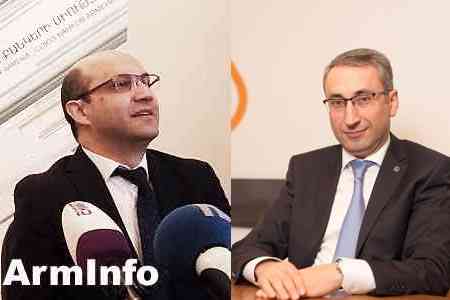
ArmInfo.2019 was successful not only for the banking system of Armenia, but also for the country's economy as a whole. As Mher Abrahamyan, Chairman of the Union of Banks of Armenia (UBA), IDBank Chairman of the Board, stated at a press conference on February 14, the economic growth recorded by the end of the year had a very favorable effect on the main indicators of banks and development trends.
"Almost all indicators demonstrated growth. Moreover, an unprecedented increase in the loan portfolio was observed for mortgages and consumer loans, which was due to a number of objective reasons, for example, with regard to mortgages, portfolio growth was related to the tendency for real estate prices to increase over the past 2 years. Capital, profit and ROE also grew, which indicates an increase in the efficiency of the banking system. For example, over the past 3 years, ROE has shown a steady growth trend, and this is the result of more effective risk management, " M.Abrahamyan noted. And to ArmInfo's question regarding the level of non-performing loans, he noted that 5% of NPL in assets is an controllable level. Regarding the change in interest rates, he suggested that in 2020 the decline will continue, but will be insignificant, explaining this trend by fierce competition between banks.
In addition to the above, UBA Executive Director Seyran Sargsyan presented the results of 2019 in numbers, which related to the financial indicators of the banking sector, the payment system, and money transfers of individuals. Thus, the total capital of banks increased over the reporting year by 9.5% to 844.8 billion drams, assets - by 17% to 5.8 trillion drams, total liabilities - by 18.3% to 4.96 trillion drams, credit investments - by 10.1 % up to 3.6 trillion drams. It is noteworthy that at the end of 2019, the currency and dram components were equal in the loan portfolio, i.e. de-dollarization is evident, while the foreign exchange component in the deposit portfolio exceeds 57%. The banking system completed 2019 with a profit of 78 billion drams, increasing it by 25.4% over the reporting period. Asset profitability (ROA) and return on equity (ROE) at the end of 2019 amounted to 1.34% and 9.24%, respectively. And the fact that the 2019 ROE level turned out to be lower than in 2011 and 2012, when profit and capital were significantly lower than current ones, is explained by economies of scale.
Speaking about the payment system, S. Sargsyan drew attention to the fact that the variety of plastic cards circulated in Armenia stimulates an increase in inbound tourism (these are Visa, MasterCard, American Express, Diners Club, JCB cards - Ed. note). By January 1, 2020, the number of active cards increased by 18.1% per annum to 2.4 million units, the number of plastic transactions - by 34.5% - to 64 million units, and the volume of transactions - by 21.3% to 2.3 trillion drams. S. Sargsyan drew special attention to the fact that there is a tendency to move from cash to cashless transactions and confirmed this with figures. A significant increase in the number of cashless transactions - by 72.9% per year to 31.1 million units was accompanied by a modest increase in cash operations - by 11.5% to 33.6 million units, the share of which in the total number of transactions was 48% and 52%. Non-cash plastic transactions are ahead of cash and in terms of volume growth - 52% versus 13.4%, amounting to 602 billion and 1.7 trillion drams, respectively, according to the results of 2019. In the context of a larger growth in cashless transactions, he also informed that the growth in the number of POS terminals in 2019 was 19.4% to 10503 units and was accompanied by a decrease in the number of ATMs by 6.8% to 1,400 units.
Regarding money transfers of individuals, S. Sargsyan noted that the increase in inflow was more modest than the outflow - 22.4% versus 9.7%, which formed a net inflow in the amount of $ 504 million. "I'll draw attention to the fact that in Armenia 2019 was marked by a boom in car imports, which affected transfers, " the UBA Executive Director said.
To note, according to the Central Bank of the Republic of Armenia, the inflow of money transfers from individuals in 2019 amounted to $ 1.959 billion, and the outflow - $ 1.455 billion, which reduced the net inflow by 15.5% to $ 504 million. Russia's share in the inflow decreased in 2019 from 58, 8% to 53.9%, and in outflow - from 39.7% to 29.3%. Moreover, a minuscule increase in 0.6% of the inflow of transfers from Russia was accompanied by a decline of 9.7% in the outflow of remittances to Russia.
According to the Statistical Committee of the Republic of Armenia, the growth of economic activity in Armenia in 2019 accelerated to 7.8% from 5.8% in 2018, and the service sector, industrial sector and trade sector acted as drivers.