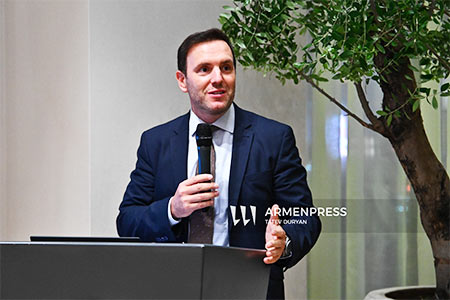


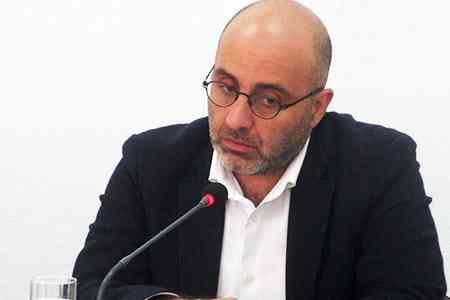
ArmInfo. The most serious cause for concern in the field of small and medium-sized businesses is the lack of readiness of the latter for long-term investments. Head of Ameria Management Advisory Tigran Jrbashyan told reporters on March 10, referring to a study of the SME market of Armenia, prepared for the second time by Ameria CJSC (the first study dates back to 2013 -ed.note).
In this vein, Jrbashyan said that in comparison with 2013, overall, a decrease in SME investments is observed. He clarified that according to the data of 2018, the share of investments by SMEs fell to 39%, in addition, the quality of the SME investment portfolio deteriorated. According to him, today SMEs are increasingly investing in working capital, the formation of reserves, against the background of a decrease in investment in development and innovation. <We are faced with the task of correcting this through public policy. Because investments should primarily be aimed at increasing productivity>, he stressed. The expert emphasized that in comparison with 2013, micro-business reduced the volume of innovative investments from 28% to 24%, small enterprises- from 43% to 37%, and medium ones- from 60% to 54%.
Jrbashyan, by and large, associates such dynamics with the uncertainty of state-led economic policy. <The business was waiting for changes in tax legislation in order to begin more active investment activities, "he said. In this regard, he drew attention to the fact that micro-businesses occupy predominant share in the structure of SMEs, which delayed investment activities, waiting for tax benefits.
According to Jrbashyan, SMEs will begin more active investment activities when the state's economic policy aimed at developing SMEs becomes more targeted. "Unfortunately, the approach that was used earlier continues to be applied today, while SMEs require a targeted relationship," he emphasized.
Among the key problems of small and medium-sized businesses, Jrbashyan mentioned the lack of a clear definition of the concept of SMEs. Due to the fact that different state institutions, including SRC, banking, insurance, have a different understanding and definition of the SME sector, the state, according to him, is finding it more difficult to pursue a development policy in this area. <Our task is to have a general idea of small and medium-sized enterprises. SMEs should be brought to a single framework. And serious work lies ahead in this regard'', he said.
It should be noted that the study of Ameria CJSC was conducted in March-May 2019, which focused on 729 SMEs in five large cities of Armenia - Yerevan, Gyumri, Vanadzor, Armavir and Echmiadzin, of which 93.8% are micro-businesses, 5, 1% small and 1% is medium business.
To recall, according to the data of the Ministry of Economy of the Republic of Armenia as of the end of 2019, the share of SMEs in the structure of the GDP of the Republic of Armenia is 25-26%. 50% of SMEs work in the capital. As for regions, Lori, Kotayk and Ararat regions are the most active in terms of business development, and Vayots Dzor and Aragatston are considered the most passive.Trade, processing industry and construction are the dominant sectors in the regions.