

ArmInfo. World Bank (WB) forecasts for Armenia's GDP for 2020 look better than those for its neighboring countries and EAEU. According to the WB economic report "Combating COVID-19. Economic Perspective in the Europe and Central Asia Region" (Fighting Covid- 19. ECA Economic update), in 2020 in Armenia GDP growth will reach 1.7% (according to the baseline scenario) , while in Georgia GDP is expected to grow by 0.1%, in Turkey - GDP growth by 0.5%, and in Azerbaijan GDP is projected to decline by 0.2%.
According to the WB report, in EAEU countries the expectations for GDP for 2020 are as follows: the recession will be in Belarus - by 4%, in Russia - by 1%, in Kazakhstan - by 0.8%, and in Kyrgyzstan growth is projected to be 0.4% .
Foreign trade expectations are also pessimistic. In neighboring countries, the WB expects a slowdown in foreign trade growth in 2020: in Georgia - for exports up to 1% and imports up to 1.1%; in Azerbaijan - before stagnant growth of 0.4% and 0.7%, respectively, in exports and imports; in Turkey - imports out of recession by 2% growth with a reverse turn of export dynamics - from a significant growth by 3% decline. At the same time, in Armenia, the WB forecasts for 2020 a decline in both exports and imports - by 1.5% and 2.6%, respectively. In EAEU countries, the WB forecasts for 2020 regarding foreign trade are as follows: in Russia, the decline in exports will accelerate to 3%, and import growth will drop to 8%; in Kyrgyzstan, export and import growth will slow to 1.8% and 1.3%, respectively; in Kazakhstan, exports will change dynamics from growth by a 2.3% decline with a strong slowdown in import growth to 1.7%; and in Belarus, exports and imports have turned the dynamics towards a significant decline - by 13.6% and 11.7%, respectively.
Inflation will jump up
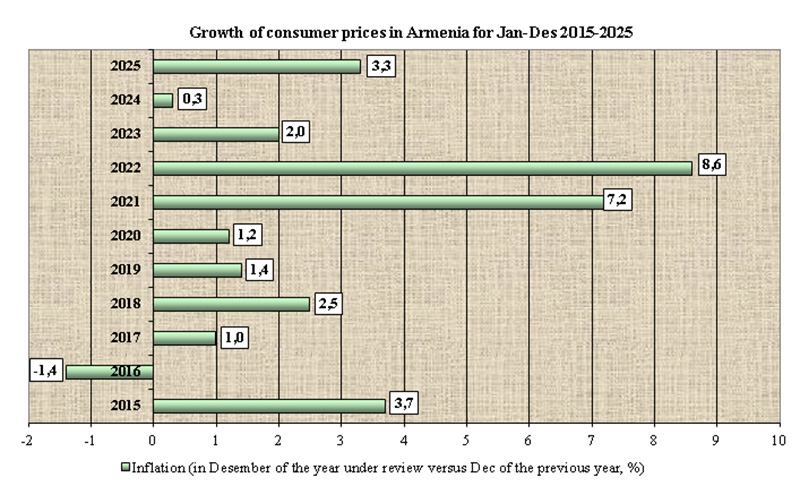
The WB report also provides an inflation forecast for 2020 for EAEU countries: expected at 11.3% in Belarus; in Kyrgyzstan - at the level of 10.6%; in Kazakhstan - at the level of 7.8%; in Russia - at the level of 5.5%; in Armenia - at the level of 3%. In countries neighboring with Armenia, high inflation is expected in Turkey at 11%, while in Georgia and Azerbaijan it will be at 5% and 3.3%, respectively. The likelihood of a pessimistic scenario is growing.
The World Bank does not exclude another scenario, according to which, if measures are prolonged (the probability of which is growing every day) to prevent the spread of coronavirus, the economy will slow growth or go into decline. And in this scenario, economic recovery is expected to begin after 2020, when the shock disappears. The likelihood that this scenario will come true is growing, given the worsening medical, economic and financial indicators worldwide, in which case the poverty rate will increase.
World Bank Response to COVID-19.
The WB has provided over $ 1.4 billion to mitigate the effects of the coronavirus pandemic in Europe and Central Asia (ECA). Since April 2, 2020, nearly $ 490 million in approvals for new rapid response programs have been approved. In addition, within the framework of existing projects and credit programs, including through additional financing, up to $ 925 million is redistributed / used / provided to assist ECA countries in counteracting COVID-19. This funding is aimed at acquiring medical equipment (including tests, ventilators), strengthening the capacity of health systems (including retraining of health workers), as well as social protection of the most vulnerable segments of the population affected by coronavirus. A number of countries in the ECA region are discussing with the World Bank about future programs and the assistance that will be needed to mitigate the effects of the pandemic.
The World Bank is taking comprehensive and swift steps to help developing countries strengthen their capacity to respond to the pandemic. Over the next 15 months, the World Bank in the form of financial assistance of up to $ 160 billion will help countries to protect unsecured and vulnerable segments of the population, promote business and stimulate economic recovery. This will also include new resources from the International Development Association (IDA) worth $ 50 billion (in the form of grants or on purely preferential terms).