ArmInfo. In June 2020, the Public Services Regulatory Commission of Armenia will make a final decision on gas tariffs.
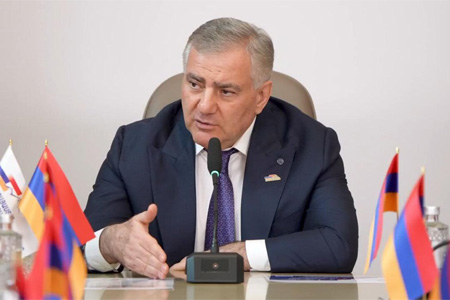
Head of the Commission, Garegin Baghramyan, previously noted that the cost of gas at the border, which currently amounts to $ 165, largely affects the size of the tariff. He emphasized that any gas agreement could be amended, the question is only in the political will of the parties of Armenia and Russia.
The Armenian side has repeatedly noted the need to change the price of Russian gas, taking into account strategic relations, the coronavirus pandemic and the fall in world prices for both oil and gas. The Belarusian side agrees with this. However, as subsequent events showed, Moscow does not intend to compromise for partners from the Eurasian Economic Union.
<As for the single tariff proposed by our Armenian and Belarusian friends for gas transportation and transit services, we believe that a single tariff can only be implemented on a single market with a single budget and a single tax system, "Russian President Vladimir Putin said on May 19 . According to the Russian leader, such a deep level of integration in the Union has not yet been achieved.
Meanwhile, President of Belarus Alexander Lukashenko urged the summit to find a consensus on the issue of pricing gas transportation services, since "the urgency of an issue is constantly growing". Moscow insists that, in accordance with international practice, gas prices should take into account market conditions, costs and investments of suppliers, as well as "provide a reasonable rate of return on capital invested in production>.
Putin suggested discussing ways to implement these parameters later at the level of the EEC and national experts. A similar position is held by Kazakhstan and Kyrgyzstan.
Meanwhile, Gazprom, which supplies Russian blue fuel, predicted that the average gas price from $ 211 per thousand cubic meters in 2019 would drop to $ 133. Thus, the monopolist himself notes a change in market conditions.
According to the report of the International Energy Agency, in 2020 a strong drop in gas demand is expected. World demand, according to the IEA, could fall by 4%, or 150 billion cubic meters - this will be the largest drop in the history of the natural gas market. Gas consumption was influenced by warm winters in the Northern Hemisphere, as well as restrictive measures in connection with the coronavirus pandemic.
<Although restrictive measures are gradually being lifted, our forecasts do not imply a quick economic recovery. As a result, global consumption of natural gas, according to our estimates, will decrease by 4%.
This will affect all regions, including the developed markets of Europe, North America, Asia and Eurasia, which account for 75% of gas consumption in 2020>, the report says.
Experts believe that in 2021 gas demand will begin to recover gradually, but COVID-19 will have lasting effects on the market. According to the IEA, by 2025 the volume of annual gas demand will decrease by 75 billion cubic meters. However, by 2025 gas demand is expected to grow by an average of 1.5% per year due to industry, which will account for up to 40% of additional demand.
The IEA previously forecasted a drop in demand for all but renewable energy sources. According to the IEA forecast, energy demand will fall by 6%, which is seven times more than during the 2008 crisis. Against the backdrop of COVID-19, oil demand is also falling.
It is curious that Russia agreed to lower prices for Georgia, Greece, and a number of other states. As of the Q1 of 2020, the average price of Russian gas supplied to Europe (at the border) is about $ 87. And on the Armenian border, as we have already noted, the gas price is $ 165 (almost twice as much as in Europe). At the same time, the devaluation of Russian gas in Europe began even before the coronavirus pandemic. In the Q3 of 2019, Russian gas in Europe was already much cheaper than in Armenia, and in April 2020 the price was about $ 59 per thousand cubic meters. However, all these factors, judging by the data given (including Gazprom itself) indicate Russia's intentions to squeeze the maximum possible out of its EAEU partners. This is evidenced by statements about the possibility of starting negotiations with Belarus only in case of repayment of the last debt, the presence of which Minsk categorically rejects. It is possible that a well-known formula will be applied to Armenia, we will reduce prices, and in return- your one or two interesting enterprises.