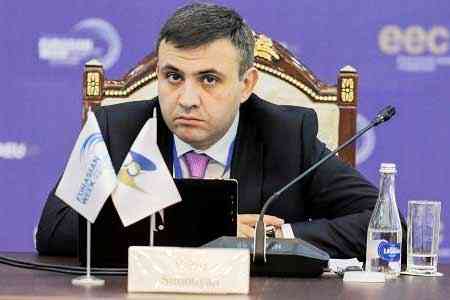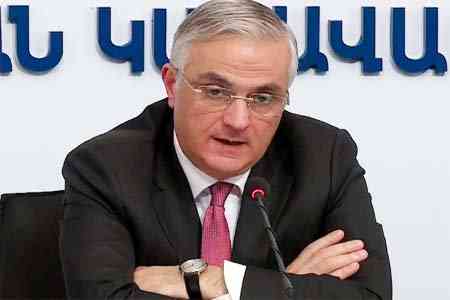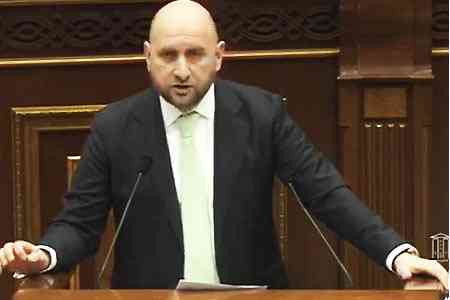
ArmInfo. According to the assessment of the Central Bank of Armenia, the growth of the Armenian economy in 2020 will be negative. This was announced during the meeting of the RA NA Standing Committee on Financial and Budgetary Issues, presenting the report of the Central Bank of the Republic of Armenia on the implementation of monetary policy, newly elected Central Bank Chairman Martin Galstyan said. In this regard, he emphasized that the recession would be lower than expected.
In particular, according to him, the pandemic will negatively on the sectors of public catering and accommodation, the tourism industry, the services sector and construction, while the agricultural sector will hardly feel any influence. At the same time, the newly elected head of the Central Bank noted that in the face of continuing uncertainty, a decrease in private consumption and private investment is expected.
The decrease in supply, which in turn was caused by a reduce in the supply of labor due to the spread of the pandemic, according to a Central Bank study, will recover at a slow pace. Such a situation, according to Galstyan, will be determined by the dynamics of the restoration of external demand and the continuing uncertainty.
However, earlier, according to the baseline scenario, it was expected that as a result of the implementation of stimulating fiscal and monetary policies, along with a reduction in uncertainty, in the second half of the year, the Armenian economy should begin a recovery trend. As a result, the Central Bank expected the economic growth of the Republic of Armenia following the results of 2020 at the level of 0.7%, whereas without taking into account the coronary crisis, growth was forecasted up to 5.3%.
At the same time, the volatility of the financial market has grown significantly in Armenia and in other countries of the region, which was accompanied by the devaluation of the Russian ruble and the currencies of other countries. According to Galstyan, there was also deflationary pressure in Armenia, which nevertheless turned out to be less than in other countries of the region. This is due to the low inflation policy of the Central Bank of the Republic of Armenia implemented over many years.
Taking into account the low inflation environment and the possible impact of the uncertainties of the global economy, the Central Bank twice (in March and April) revised the refinancing rate downward, which is now at 5%.
He explained that the interest rate cut, which was already an orthodox step, was aimed at ensuring price stability in Armenia in the medium term. Meanwhile, as Galstyan noted, other countries in the region, under conditions of a higher level of financial stability, were forced to either increase the refinancing rate or leave it unchanged.
In this regard, the head of the Central Bank announced the preservation of the necessary stimulating monetary position in the medium term. At the same time, he noted that in the current conditions the role of monetary policy was limited, since the available tools do not allow influencing the economic uncertainty caused by health problems.
And in this regard, the head of the Central Bank emphasized the importance of maintaining macro-stability in the country, which will increase the effectiveness of programs implemented by the government under the current conditions. Summing up, Galstyan noted that the Central Bank continues to analyze and monitor the situation. The regulator will be consistent in its policy and will develop various possible scenarios, with the development of one of which it will be able to ensure price stability in the country.
To recall, according to the Statistical Committee of the Republic of Armenia, economic activity in January-April 2020 decreased by 1.7% per annum (compared to 7% growth a year earlier). According to new (June) forecasts of the World Bank, the decline in Armenia's GDP in 2020 will be 2.8%. In its April forecast, the IMF expected a 1.5% drop in GDP in Armenia for 2020. According to forecasts of the RA Government for 2020, the decline in GDP will be 2%.