

ArmInfo. In the banking system of Armenia, deposits have always grown in parallel with loans, however, in the conditions of the coronavirus crisis, the growth of deposits has slowed down somewhat. Chairman of the Central Bank of Armenia Martin Galstyan announced this on September 8 during a press conference.
In particular, he noted that in March-April there was an outflow of deposits, mainly on the funds of non- residents. "Now there are no downward trends, deposits are at a stable level," M. Galstyan stressed.
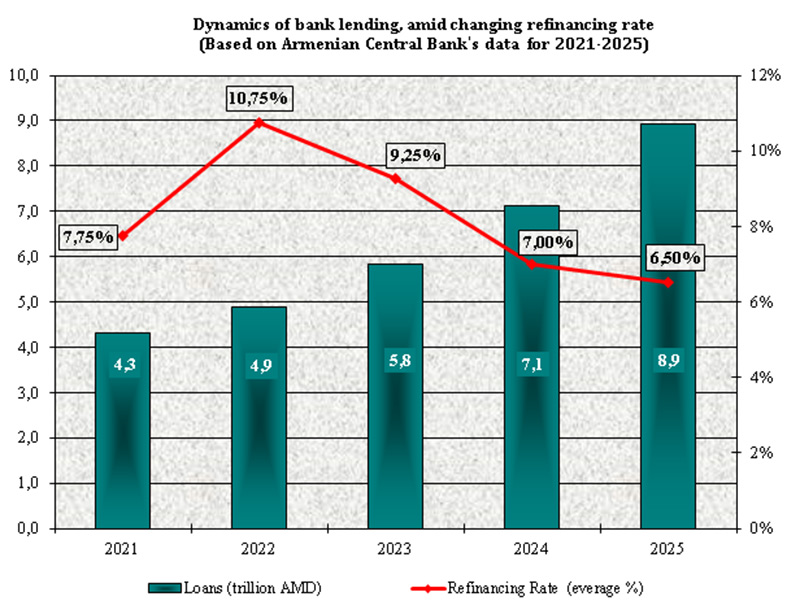
Regarding loans, the head of the Central Bank of the Republic of Armenia noted that the growth rates have been preserved. However, according to him, there are fears that the current situation in the healthcare system will last longer than expected, and incomes of households and companies will not resume, and then a slowdown in lending growth should be expected.
"As of today, the total loan portfolio of the banking system of Armenia is 3.6 trillion drams. At the same time, in the conditions of the coronavirus crisis the portfolio of agricultural loans and loans provided to businesses demonstrates outstripping rates, which is also due to the anti-crisis state assistance programs to mitigate the economic consequences of the coronavirus crisis," M. Galstyan, noting that the government directed 80 billion drams for loans to support this group of borrowers. He also noted that loans granted to business from 360 billion drams in 2008 reached 2.2 trillion drams by the end of the first half of this year, showing an average ay-o-y growth of 16.9%.
Mortgage loans, the average y-o-y growth of which is 15%, from 84 billion drams in 2008 reached by 417 billion drams on July 1 of this year, and consumer loans, showing an average y-o-y annual growth of 15.9%, from 175 billion drams in 2008 reached by 957 billion drams on July 1 of this year.
According to the Central Bank of Armenia, the total liabilities of the banking system reached 5.1 trillion drams by July 1, 2020, with an increase of 2.9% in the first half of the year, with a quarterly growth of 1.2%. The volume of deposits amounted to almost 3.5 trillion drams, with a decline in the first half of the year by 3.1%, and only in the Q2 - by 2.1%. In the structure of deposits, residents' funds account for over 71% or 2.5 trillion drams, and non-residents - 26% or 915 billion drams, and the decline came from the latter - by 12.6% over the half year (with a 7.5% quarterly decline), while deposits of residents showed growth.
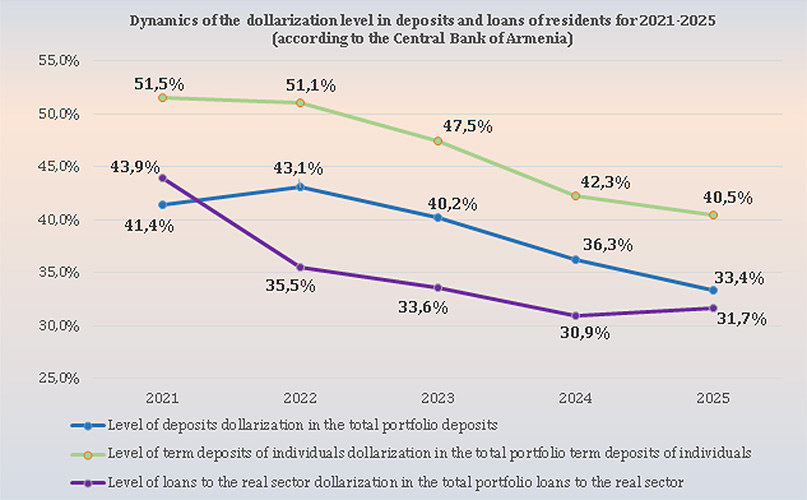
By August 2020, the total portfolio of deposits (demand and term) exceeded 3.5 trillion drams ($ 7.3 billion), in particular, the volume of foreign exchange amounted to 1.9 trillion drams ($ 3.9 billion), and drams reached 1.6 trillion drams ($ 3.4 billion). Y-o-Y growth of foreign currency deposits slowed from 16% to stagnant 0.9%, while similar loans showed much higher growth rates (15.4%) after the decline recorded a year earlier. On the other hand, for AMD deposits, there was a significant acceleration in growth from 18% to 28%, which turned out to be higher than the growth rates of similar loans (24.2%). This kept the overall portfolio of deposits growing by 12%. It is noteworthy that in term deposits the volume of attracted AMD funds increased by 28% with a stagnant 0.5% growth of foreign currency attracted, and in the portfolio of demand deposits the impressive growth in the volume of AMD funds by 29% was accompanied by a 6% decline in foreign currency attracted.
By the results of the first half of the year, the structure of deposits, broken down into dram and foreign currency components, fixes the smallest gap over the past 10 years - 46% and 54%, respectively (against 27% and 73% in 2009). The dramization of deposits continued in July, which narrowed the gap to 46.5% and 53.5%. At the same time, since April 2020, the dominance of the dram component over the currency component began to be observed in the total loan portfolio, but the subsequent monthly volatility narrowed the gap by August 1 to 50.3% and 49.7%, respectively.