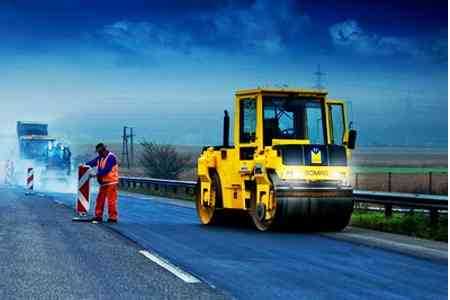
ArmInfo. The amendments to the law "On highways" submitted to the National Assembly of Armenia are rather ill-considered, and can significantly and senselessly increase the costs of transport companies and severely hit the efficiency of a number of industries, and first of all, the mining industry in Armenia. Gagik Aghajanyan, Executive Director of the large forwarding company "Apaven", expressed this opinion in an interview with an ArmInfo correspondent.
As Aghanjanyan informed, the bill submitted for consideration to the National Assembly, which provides for the introduction of a transport payment of up to 50 AMD per kilometer for heavy vehicles with a tonnage of 12 tons and above, will lead to the fact that dump trucks carrying mining concentrate from the Zangezur copper-molybdenum company (ZCMC) will have to pay, according to rough estimates, up to 5 million drams per year. And this is a huge amount, which is unjustifiably high, and in fact unaffordable for transport companies. According to the expert, the authors of the amendments did not take this industry into account at all when drawing up the amendments. They did not take into account the fact that in comparison with the same Russia, with which Armenia has the most intensive cargo traffic, this tariff of 50 AMD per 1 km is totally inadequate. According to the experts' estimates, the travel of a heavy truck to the Armenian- Georgian border and back will cost about $ 40, while travel through the territory of the Russian Federation of 1,500 km and back will cost 80 dollars using the 'Platon' system. "At the same time, our officials ignore this circumstance and refer to the experience of Germany, which is too funny for words," Aghanjanyan stressed.
According to the expert, the provisions of the law on permissible loading rates also have major drawbacks. These are restrictions allegedly aimed at maintaining roads and road surfaces. It is proposed, in particular, "taking into account international experience", to introduce a restriction on the passage of vehicles weighing more than 44 tons with a maximum load of 11.5 tons on one axle. At the same time, a separate permit will be granted for all cargoes that exceed this weight, as well as for indivisible cargoes exceeding the stipulated tonnage. The axle load should be no more than 16 tons, which is absurd for modern large- sized road transport. If we follow this logic, it is more efficient to transport goods in the country only with "KAMAZ" s of the Soviet model. "It turns out that the old Kamaz, which costs 5-6 thousand dollars on the market with 3 axles, can carry 18 tons, while companies that purchase modern trucks for 150 thousand euros weighing 16 tons can only load them with 16 tons of cargo. Isn't it absurd?, the head of Apaven. notes.
According to him, if the new regulations are followed, the cost of transporting a ton of concentrate cargo will rise from $ 30 to $ 35, while half a million tons are exported. Moreover, the lion's share of forwarding costs is already spent on expensive fuel. In fact, fuel consumption will increase by 87%, the wages fund will increase by 47%, companies will be forced to almost double their car park to meet contractual obligations with the customer. Traffic on the roads will increase, and it will be unprofitable to modernize the fleet with modern large-scale environmentally friendly vehicles.
According to Aghajanyan, these truly absurd provisions are revealed, unfortunately, not before, but after the government submits its draft law to the parliament, and even after the parliament adopts them. The same can be said about other amendments to this law already adopted in February of this year. The expert believes that the problem is that government departments do not bother to hold serious consultations and hearings with professional market participants, and it seems that they are either rewriting some provisions from foreign (usually European) legal regulations, or, even worse - add fiscal provisions, being completely unaware of the specifics and real state of the country's transport market.
As Aghajanyan said, as a result of the belated meetings, the involved departments basically agreed that they had not taken into account a lot when preparing amendments to the law and promised to correct the mistakes. The head of the company expressed hope that the government will revise the new regulations and restrictions as soon as possible, excluding provisions that are absurd and harmful for the economy.