


ArmInfo. The portfolio of non performing loans of the Armenian banking system (NPL) may slightly increase in connection with the latest events of the current year, but this should cause concern. A similar opinion was announced by the founder of the Banking Management School Ashot Osipyan during a zoom conference organized by the Economic Journalists Club on December 9.
He explained that NPL of Armenian banks takes a small percentage and is within a manageable range in comparison with international banks. In this regard, Osipyan noted that as a result of daily work with clients and new credit processes, this indicator will decrease.
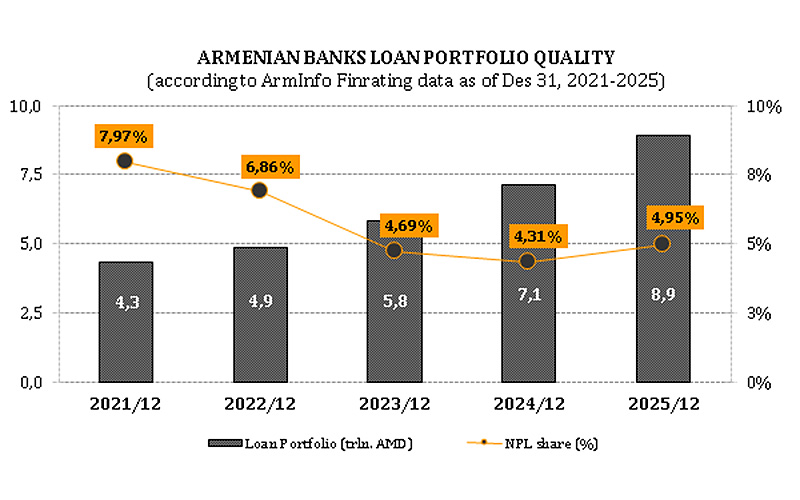
In turn, the executive director of the Union of Banks of Armenia (UBA) Seyran Sargsyan said that historically the NPL level of Armenian commercial banks has always been at a low level - within 4-5%. After the pandemic, he said, the number of problem loans increased slightly, but did not exceed the level that took place in Russia, Ukraine, other neighboring countries, as well as in Europe.
At the same time, he said that in connection with the outbreak of the coronavirus pandemic, loans of 30% of clients were revised in Armenian banks. "This means that loans to those customers who had problems with meeting their loan obligations are not classified as problematic today. We understand that everything can change. And nevertheless, we do not see any risks in this regard>, - stressed the executive director of the UBA.
Nevertheless, according to the experts of the national rating agency AmRating, the growth of non- performing loans in the banking system of Armenia has already accelerated. Thus, the share of NPL in the loan portfolio increased in Q3 from 8.3% to 9%, and in assets it reached 6.1%, against 9% and 5.9%, respectively, recorded a year earlier. This was observed against the background of the acceleration of the annual growth of credit investments from 13.5% to 21.4% and the growth of assets from 14% to 16.5%, with a sluggish acceleration of quarterly growth in both cases (loans - from 3.2% to 5, 9%, assets - from 1.5% to 4.8%).
As the analytical calculations of the agency's specialists show, the accelerated growth of toxic loans, in turn,has led to drop of profits. Thus, the net profit, amounting to 58.6 billion drams ($ 119.9 million) in 9 months, decreased by 0.9% per annum (against growth by 14.2% a year earlier), which was observed against the background of an increase in the volume of overdue loans by 20, 3% (while accelerating quarterly growth from 10.1% to 13.1). This was accompanied by a weak attempt to increase the amount of healthy (standard) loans for the reporting quarter by 3.5% (from a 0.5% decline in the II quarter) with a y- o-y growth of 9.1%, presumably largely due to renegotiation of contracts during the credit payment holidays (from March 13 to June) and active participation in the 1st and 2nd anti-crisis state programs. According to experts, about 55% of NPL falls on dubious and hopeless risk groups, and the latter group retains a tangible dominant. In a breakdown by industry, over 35% of overdue loans are consumer loans (including mortgages), with an annual increase in the volume of non-performing loans by 45.3%, while healthy loans increased by 19.7%. Moreover, almost half of non-working consumer loans have been registered in doubtful and hopeless groups, and the latter to a greater extent. The second place in terms of NPL share is occupied by the trade sector, where more than 20% of non- performing loans have accumulated, with an annual decline in their volume of 3%, but with an increase in healthy loans by 21.1%.
The third place in terms of the share of NPL is occupied by agricultural loans - over 11%, with an annual increase in the volume of non-performing loans by 7.8%, while the growth of healthy loans accelerates to 22.1%. Then, in terms of the share of NPL, loans to the industrial sector follow - about 10%, with an annual decline in their volume by 5.4% with a more pronounced decline in healthy loans (by 13.6%). The share of NPL in loans to the catering and services sector is slightly lower, with a 16.1% annual decline in their volume with a modest 6.5% growth in healthy loans. And after the share of NPL loans to the construction industry follow, with an annual decline in volume by 2.2%, while healthy loans jumped by 39.1%.
To note, the total loan portfolio of Armenian banks by October 1, 2020 reached 4.3 trillion drams ($ 8.7 billion), and assets - 6.3 trillion drams ($ 12.9 billion), and a more pronounced acceleration of the annual growth of the former with a less noticeable acceleration in the growth of the latter increased the share of loans in assets from last year's 65.1% to 67.8%.