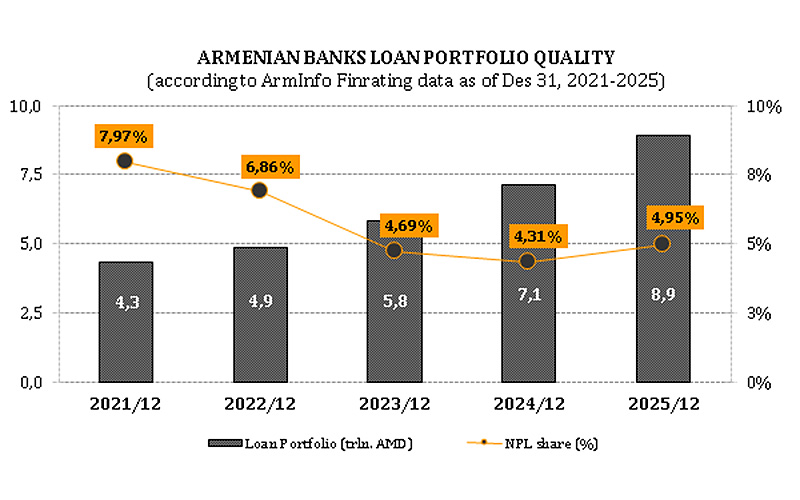



ArmInfo.According to the estimates of the Central Bank of Armenia, the share of non-performing loans in the total loan portfolio of the banking system may reach 10%. Chairman of the RA Central Bank Martin Galstyan announced this during a press conference on December 15.
In this vein, he stressed that such a forecast is the result of certain analytical studies. According to the latest data, as M. Galstyan noted, the share of non-performing loans in the total loan portfolio of the banking system is 6.7%.
"The year began with the coronavirus pandemic, which was followed by a war. Now we are in conditions of uncertainty, in connection with which there may be certain problems with loan defaults. There are concerns, but the Central Bank is monitoring the situation. However, we do not see significant risks from the point of view of financial stability, "he said, noting in this context that the amount of available capital is sufficient to absorb possible risks that may arise.
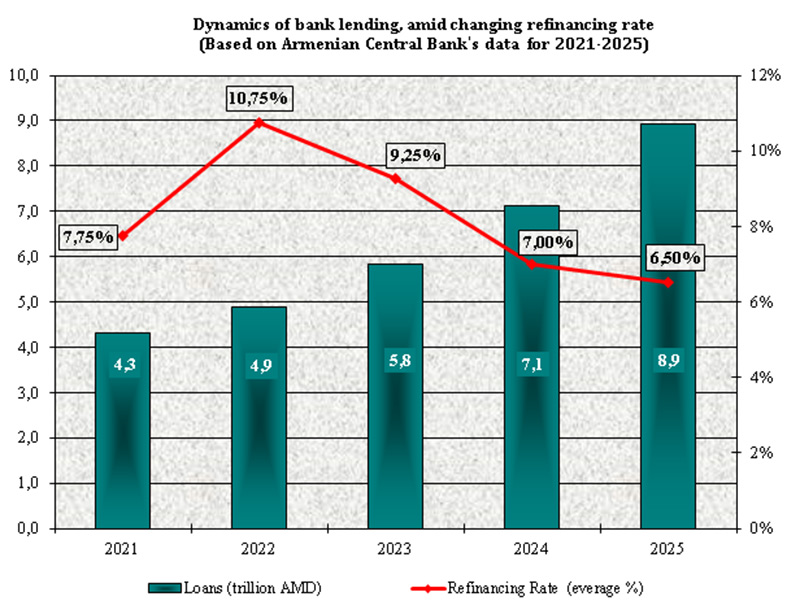
According to the Financial Rating of Banks of Armenia prepared by ArmInfo IC, as of September 30, 2020, the growth of non-performing loans has accelerated in the banking system of Armenia. Thus, the share of NPL in the loan portfolio increased in Q3 from 8.3% to 9%, and in assets it reached 6.1%, against 9% and 5.9%, respectively, recorded a year earlier. This was observed against the background of the acceleration of the annual growth of credit investments from 13.5% to 21.4% and the growth of assets from 14% to 16.5%, with a sluggish acceleration of quarterly growth in both cases (loans - from 3.2% to 5, 9%, assets - from 1.5% to 4.8%). The accelerated growth of toxic loans, in turn, sank profits. Thus, the net profit, amounting to 58.6 billion drams ($ 119.9 million) in 9 months, decreased by 0.9% per annum (against an increase of 14.2% a year earlier), which was observed against the background of an increase in overdue loans by 20, 3% (while accelerating quarterly growth from 10.1% to 13.1). And this was accompanied by a weak attempt to increase the value of healthy (standard) loans for the reporting quarter by 3.5% (from a 0.5% decline in the Q2) with a y-o-y growth of 9.1%, presumably to a greater extent secured for the account of the renewal of contracts during the credit payment holidays (from March 13 to June) and active participation in the 1st and 2nd anti-crisis state programs. By industry, the dominant part of overdue loans "stuck" in consumer loans, followed by trade, third by agricultural loans, fourth by industrial sector, and then followed by services and the construction sector. Moreover, in consumer loans, overdue debt showed a significant annual growth, and the same picture, but in moderate percentages, was observed in agricultural loans, while in other industries the volume of non-performing loans was in decline.