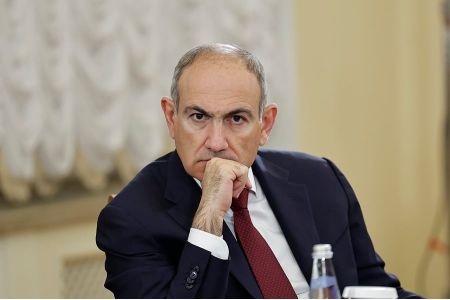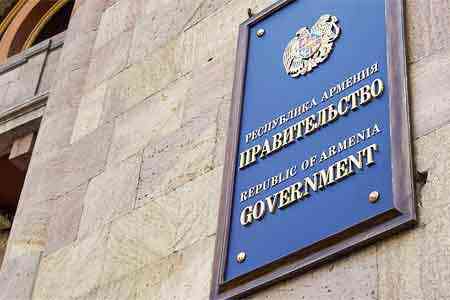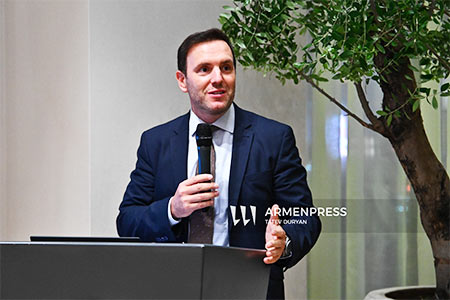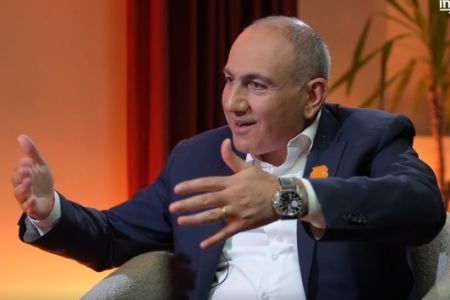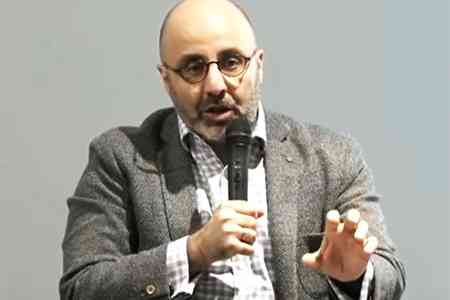
ArmInfo.Armenia, amid martial law and the second wave of coronavirus with a rapid spread, will sum up 2020 with a decline in GDP in the range of 8.5-9.3%. Such a forecast during an online press conference was given by the head of the "Ameria" consulting company, a well-known economist Tigran Jrbashyan, noting at the same time that a particularly large decline will be in imports, while the decline in exports will continue.
In his opinion, the public is not yet aware of the serious challenges that this year will have an impact on the economy and will continue in the medium and even long term.
"This will have a serious impact on the economic policy and the well-being of citizens, both in terms of the perception of the world and institutional structures. Since the challenges that Armenia faces and will face in the near future are more serious than we can imagine. Armenia is in conditions of " perfect storm " because there is a crisis in all sectors," he said.
Jrbashyan, at the same time, listed the specific challenges facing Armenia: These are problems with human capital, which was in critical condition even before the current situation, given the demographic hole in which Armenia found itself starting from last year. "And this was manifested by a sharp decline in the entry of young people into the labor market, which is why we had not only a quantitative, but also a qualitative decline in human capital ", he explained. At the same time, in 2022-2023, the population of retirement age will increase unprecedentedly, which, against the background of a decline in youth involvement in the labor market, will lead to a serious burden on the budget - there will be a significant deficit.
The demographic phenomenon also leads to an educational crisis, since in conditions of a drop in aggregate demand as a result of a demographic hole, the education system adapts supply to demand, thereby reducing the level of quality. And if we also take into account that it was the generation of this demographic hole that suffered serious losses during the war (those who died and became disabled), then this will be one of the main challenges.
Jrbashyan noted that the parameter characterizing the potential of the economy is the availability of capital, which is currently in a very difficult situation, especially in the expected difficult conditions, given the post-war and post-conflict state, when the country, on the one hand, has a limited volume of private investment and the growth of foreign investment, and on the other hand, uncertainty and the expected negative outlook will lead to the capital outflow.
Moreover, in such conditions, even a large increase in population migration is possible, which will further deepen the likelihood of an outflow of human resources and capital. "We need to rethink the budget and revise the medium-term programs in accordance with the current situation," he recommends.
"These are the factors that are problematic. And given the complex of situations that appear in the economy and society, the uncertainty, which the economic authorities call political, directly leads to the fact that the public and economic authorities cannot respond to the expected challenges.
Political uncertainty leads to fundamental difficulties in the economy, which in turn affect the exchange rate. I want us to understand: when the amplitude of political uncertainty is small, there may be a likelihood of impact on the economy in the short term, but when this uncertainty leads to the inability of the state to counteract serious economic problems, then this uncertainty turns into economic factors, " Jrbashyan concluded.