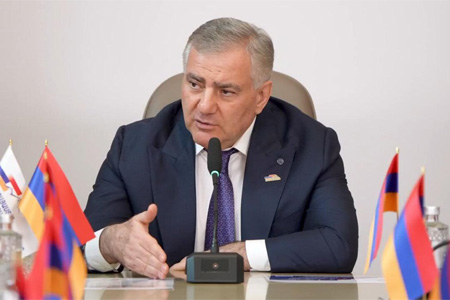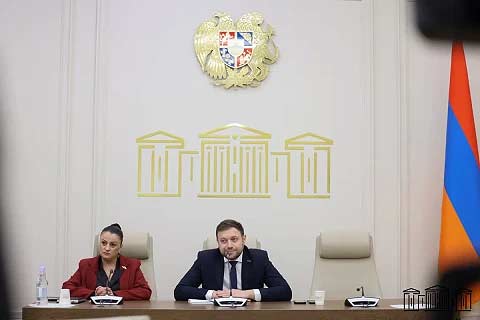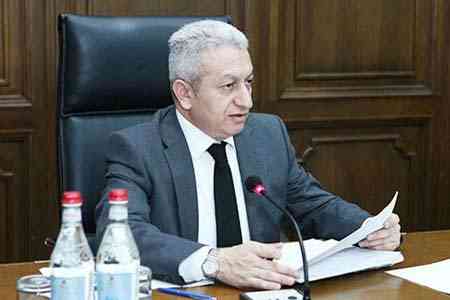
ArmInfo. In 2020, Armenia ensured macroeconomic stability with the application of institutional approaches to fiscal and monetary policy, Acting Head of the RA Ministry of Finance Atom Janjughazyan stated on June 1. Preliminary discussions of the annual report "On the execution of the state budget of the Republic of Armenia for 2020" began today in the Armenian parliament.
According to acting Head of the Ministry of Finance, Armenia, like the rest of the world, revised fiscal policy during the pandemic, bringing it in line with the period of economic downturn. That is, as Janjughazyan explained, it was called upon to play a stimulating role and take measures to mitigate the consequences of economic shocks at the expense of the reserves of accumulated "immunity". "It was with this" baggage "that Armenia moved into the 2020 financial year at the end of 2019. 7.6% GDP growth in the context of 2.9% growth in the world economy, the threshold of public debt to GDP below 50% allowed us to form similar reserves, "he said. In addition, in 2019, tax collections increased by 16% in nominal terms, which resulted in a 1.4 percentage point increase in the tax / GDP ratio. Capital expenditures, compared to 2018, in nominal terms increased by 30% or 2.9% of GDP.
The anti-crisis measures carried out by the financial authorities of Armenia in 2020, according to the chief financier, had a positive impact. Thus, according to him, during the year, following the results of the expanding fiscal policy, the "positive impact" of the fiscal impulse exceeded early expectations by about 2.5-fold.
At the same time, as Janjughazyan stressed, "everything has a price." "Its price is, in fact, a change in the level of national debt," he said. In particular, the deficit in 2020 exceeded the planned level of 2.3% of GDP or about 161 billion drams, reaching 334 billion drams or 5.5% of GDP. The government debt to GDP ratio reached 63.5%. This, as the minister pointed out, according to the logic of fiscal rules allowing growth of up to 60% of GDP, obliges the Armenian government to submit a draft macro and fiscal measures that will allow the republic to return to the permissible 60% within the next 5 years.
"The work on this strategic program is in the process and it will be presented in parallel with the medium-term expenditure program," Janjughazyan said. Referring to the main macroeconomic indicators, Janjughazyan said that by the end of 2020, the Armenian economy "fell" by 7.6%, amid a 3.3% recession in the world economy. In particular, industry declined by 1.5%, agriculture by 4%, construction by 6.6%, and the service sector by 10%. Consumption "fell" by- 10.2%, gross capital accumulation decreased by - 8.6%, imports by - 32.1%, and exports by - 31.4%. Average inflation for the reporting period was 1.2%, deflator - 1.9%. The average monthly salary (average earnings) was fixed at the level of 189 thousand 716 drams, while in the state sector - 170 thousand 264 drams, and in the private sector - 198 thousand 964 drams. The current account deficit amounted to 3.1% of GDP due to the outstripping reduction in imports.
The revenues of the Armenian state treasury amounted to approximately 1 trillion 560 million 655 thousand drams, expenses - 1 trillion 894 million 647 thousand drams. Capital expenditures accounted for about 12% or about 226 billion drams of the state budget expenditures. About 29.5% of total expenses were directed to cover social expenses - 560 billion drams (financing of pensions and benefits). Tax revenues accounted for 22.4% of GDP, current expenditures - 27% of GDP, and capital expenditures - 3.7%. "It is noteworthy that the ratio of taxes to GDP improved by 0.1 pp." minister noted. In general, taxes in nominal terms amounted to 1 trillion 385 billion drams. The costs associated with the pandemic amounted to 75.3 billion drams, while the costs associated with martial law were about 124 billion drams.
At the end of 2020, the state debt amounted to $ 7.968 billion, of which $ 7.509 billion is government debt (external debt - $ 5.593 billion, and domestic debt - $ 1.915 billion). To note, having started 2021 with a national debt of $ 7.968 billion, by the end of April 2021 the figure reached $ 8.772 billion, thus, in 4 months the debt increased by $ 804 million. According to the approved law "On the state budget for 2020", in conditions of 4.9% GDP growth, nominal GDP is set at 7.095.1 billion drams. The budget revenue item is fixed at the level of 1.696 trillion drams or 23.9% of GDP, expenditures - 1.855 trillion drams, a deficit of about 160.6 billion drams or 2.3% of GDP.
The deficit was planned to be financed in the amount of 211 billion drams from internal sources and another 50.5 billion drams is expected to be attracted from external sources. 12-month inflation was forecasted within 4% (+ / _ 1.5%), and tax revenues of the state budget (tax revenues and state duty) - in the amount of 1 trillion 602 billion 252 million 712 thousand drams or 22.6% of GDP.