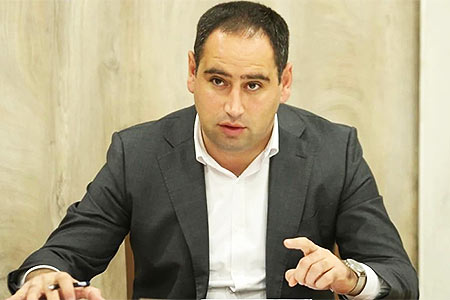


ArmInfo. The legislative initiative of the Central Bank of Armenia to create a Centralized Register of Bank Accounts of Individuals was approved by the Parliament on June 30 in the second and final reading. "The initiative is not a deviation from the norms of banking secrecy", - assured Deputy Governr oof the Central Bank of Armenia Nerses Yeritsyan, presenting the amendments to the law "On the Central Bank of the Republic of Armenia".
The Deputy Governor of the Central Bank once again emphasized that the purpose of the bill is to reduce operating costs when competent (authorized) bodies apply for data. In addition, thanks to the register of the Central Bank, more innovative solutions will be offered to customers of the banking system in the future.
It should be reminded that on June 9 the amendments to the Law "On the Central Bank of the Republic of Armenia" were discussed and approved at the sitting of the Standing Committee of the National Assembly of the Republic of Armenia on budgetary, financial and credit issues. "The draft law underwent a comprehensive discussion. During the period from the first to the second reading, only one proposal was received - from the Ministry of Justice, and that was of a technical nature," Nerses Yeritsyan stated during the discussion.
Earlier, Yeritsyan, presenting this legislative initiative in the parliament, noted that the need to introduce such a register proceeds from the global standards for combating money laundering and financing of terrorism. In the future, these changes, according to him, will allow developing innovative ideas related to the automation of bank accounts of citizens, the introduction of electronic money, etc. At the same time, Yeritsyan noted that the register does not contain information about the account balance or current flows of funds. He explained that the effectiveness lies in the fact that during various analyzes and communications with law enforcement agencies, not all accounts or banks will be questioned, but only those that are the subject of the dispute will be selectively collected. The deputy head touched upon the concern of representatives of the expert community that the bill violates the foundations of the institution of banking secrecy. This data, as he explained, at this stage is already available to a certain circle of persons within the framework of the Law on Bank Secrecy. "By creating a registry, we will only reduce operating costs in the course of these functions," he explained. In particular, if it is necessary to clarify certain data, for example, at the request of law enforcement agencies, the request will not be sent to 17 commercial banks operating in Armenia, but will "turn" directly to the Register. In addition, as the Deputy Chairman of the CBA emphasized, the law is by no means about providing data to the tax authority, which is protected by the same law "On Bank Secrecy".
Another goal of the legislative initiative, according to Yeritsyan, is the formation of appropriate infrastructures for the further development of the online services sector. Yeritsyan once again stressed that the initiative is important from the point of view of innovation. In the future, the Register will contribute to the implementation of the idea of forming a national identification system, within which every citizen will have an account. In this context, he noted that a centralized register will allow offering citizens various combined services, including outside the country.
As the representative of the Central Bank explained, information on opening a current account of an individual will automatically enter the system. As for the already existing accounts, then, according to him, the authors of the project "with the statute of limitations" have not yet been determined, but, perhaps, the system will cover a 5-year period.
It should be reminded that the initiative of the Central Bank of Armenia related to the creation of the Centralized Register of Bank Accounts is connected with the obligations of Armenia within the framework of the EU-Armenia Partnership Agreement (CEPA) that entered into force last month. It concerns the so- called "Fifth AML Directive (Anti-Money Laundering Directive)" of the European Union, which entered into force on January 10, 2020. This is a new measure to prevent attempts to launder money, including through the market of cryptocurrency services, exchange offices and exchanges.
According to some experts, this directive could scare off money laundering investors in developing countries. But on the other hand, from the point of view of the state of the economies and the investment environment, third countries that are in associative relations with the EU still need additional, albeit not entirely "legal", development incentives.