

ArmInfo.The International Development Association (IDA, a credit organization belonging to the World Bank Group) has prolonged the earlier decision to cancel the application of an additional interest rate (1.7% per annum) for a number of loans provided to Armenia for another year.
According to the information of the Ministry of Finance of Armenia, due to the deterioration of the socio- economic situation and the slow pace of economic recovery due to the coronavirus pandemic and the post- war situation, on April 30, 2021, the department officially applied to IDA with a request to extend the decision to abolish the additional interest rate of 1.7% per annum in relation to loans issued to the country.
On June 28, the World Bank informed that the appeal of the Armenian side was satisfied, and the interest rate will not be applied during the 2022 financial year (from July 1, 2021 to June 30, 2022).
"According to the data of the World Bank and the Ministry of Finance of the Republic of Armenia, as a result of the abolition of the additional interest rate of 1.7% for one year, the savings of the state budget of the Republic of Armenia will amount to about 12 million US dollars," the Ministry of Finance said.
As of June 30, 2020, the government's debt balance under IDA loans is reported to be $ 955 million, of which an additional interest rate is applied to $ 755 million.
A year earlier, it was reported that, taking into account the forecasts of a worsening economic situation in all countries of the world due to the coronavirus pandemic, international financial institutions are trying to support the efforts of national governments to overcome the negative consequences of the coronavirus.
As a result of the joint work of experts from the World Bank and the Republic of Armenia, the World Bank canceled its previous decision to apply an additional interest rate (1.7% per annum) on a number of loans provided to Armenia (canceled for one year - from July 1, 2020 to June 30, 2021).
According to the World Bank and the Ministry of Finance of the Republic of Armenia, as a result of the abolition of the additional interest rate of 1.7% for one year, the savings of the state budget of the Republic of Armenia will amount to about US $ 13 million.
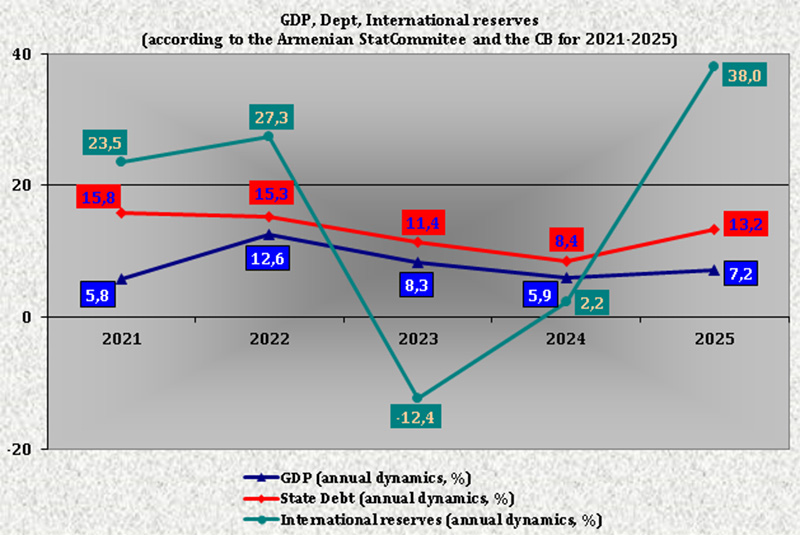
To note, at the end of 2020, Armenia recorded a decline in GDP at the level of 7.4%, and the public debt grew by $ 647 million - to $ 7.968 billion, of which $ 7.509 billion is government debt (external debt - $ 5.593 billion, and domestic debt - $ 1.915 billion). Thus, the government's debt rose to 63.5% of GDP, exceeding the legal threshold of 60%. Over the 5 months of 2021, the public debt of Armenia increased by $ 848 million, and over the past 3 years - by almost $ 2 billion. Meanwhile, the unclaimed balance of Armenia's external loans is $ 1.2 billion. That is, loan agreements for raising funds were concluded, but funds remained unclaimed. According to the Ministry of Finance, as of October 30, 2019, the indicator was at $ 1.43 billion, and it was planned to reduce the amount to $ 940 million by the end of 2020. Earlier, the Ministry of Finance did not specify to ArmInfo on which loans the fines are paid if they are not required. But the amount, as noted, is small - 0.025% of the loan amount.
At the same time, at the end of last year, only about 12% or about 226 billion drams of the expenditure side of the state budget were capital expenditures (about 84.6% of the adjusted plan, against 73.3% in 2019).
At the same time, underperformance is mainly associated with inadequate implementation of programs carried out on the basis of external assistance - the implementation of these programs in relation to the adjusted plan was only 56.7% (56.1% in 2019). Underperformance in capital expenditures is far from a new problem.
Experts have repeatedly warned that today's underperformance may have a negative impact on the country's economy in the long term. Thus, according to the calculations of the economic team of the Luys fund, the failure to fulfill capital investments in the amount of 1.1% "penalizes" the GDP growth potential by 0.3 percentage points.