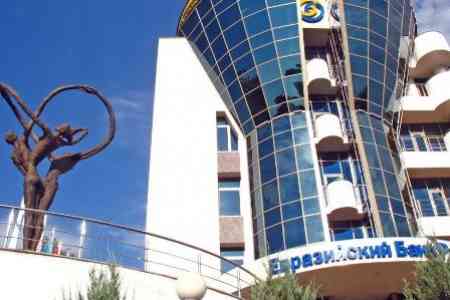
ArmInfo. The result of achieving the goals of the new Strategy for the development of the Eurasian Development Bank (EDB) in Armenia, Kyrgyzstan and Tajikistan by 2026 may be a fourfold growth in the Bank's project portfolio relative to 2020. This is stated in the Bank's Strategy for 2022 - 2026.
It is noted that separate strategies will be developed for each of the Bank's member countries, taking into account the macroeconomic characteristics of the region. To contribute to the Sustainable Development Goals and enhance project operations in the "smaller economies," it is planned to qualitatively reinforce the Bank's offices in the relevant countries. The Bank's aggregate investment in Armenia, Kyrgyzstan, and Tajikistan will reach US $500 million.
In the document, the EDB management acknowledged that the level of interaction with the authorities of the Bank's member countries is not effective enough. First of all, the Bank needs to qualitatively strengthen its presence in Minsk, Yerevan, Bishkek and Dushanbe with a focus on the work of representative offices, first of all, on the investment process and expanding the funnel of promising projects.
In the new strategy period, the EDB will focus on strengthening its unique role as one of the main development banks in its countries of operation, and on cultivating and implementing cross-border investment projects with a strong integration effect. Priority will be given to projects in the areas of end-to-end transport infrastructure, logistics, water balance, manufacturing, environment and resource efficiency, energy, and digital infrastructure. The Bank's investments over five years will total US $10.9 billion. An interesting fact is that the Bank has identified three main scenarios for economic development in the member countries. The first scenario is optimistic. This is an active recovery from the COVID-19 pandemic. Expectation of growth for each state-EDB participant on the retrospective dynamics of investments in fixed assets. For the period 2021-2026, the projected volume of investments in fixed assets of countries- members of the Bank will increase from 220 to 303 billion US dollars (an average annual growth rate of 6%). The second scenario is restrained, assuming moderate economic growth. Growth expectation for each member state based on real GDP growth forecast in 2022-2026. For the period 2021-2026, the projected volume of investments in fixed assets of countries- members of the Bank will increase from 220 to 251 billion US dollars (an average annual growth rate of 2.8%). And the third scenario is negative. According to it, the increase in the level of debt in the world and, in particular, in the states- members of the EDB, together with the growing demand for investment, will become a serious challenge to sustainable development by 2023 and a harbinger of a new global crisis. With the onset of the debt crisis in 2023, economic activity in the EDB's region of operations is expected to decline, which will be no less significant than during the 2015 crisis. In this case, for the period 2021-2026, the projected volume of investments in fixed assets of the countries-members of the Bank will decrease from 220 to about 140 billion US dollars, followed by a moderate recovery to 180 billion US dollars.
According to the strategic guidelines for the Bank's development for the period from 2022 to 2026, the EDB sets the task of developing the competence of "nurturing" and initiating projects throughout the entire life cycle - from the stage of developing project initiatives to implementing projects. EDB will act as an anchor partner for syndicating loans for such projects. Will the targeted transformation of project activities contribute to solving the development problems of all countries-members of the EDB and as such will be aimed at supporting mutual integration between the largest economies of the countries where the EDB operates and promoting the solution of national development objectives.
According to the assessment of targeted strategic effects for such countries with "small" economies as Armenia, the task is to facilitate the implementation of state programs, achieve the Sustainable Development Goals (SDGs) and improve the quality of the institutional environment. In Armenia, Kyrgyzstan and Tajikistan, new project financing is planned to be carried out mainly in euros and US dollars. At the same time, in order to solve the development tasks agreed with the member states, the Bank is ready to actively use its resources to increase the volume of lending in the national currencies of Armenia, Kyrgyzstan and Tajikistan. And nevertheless, a distinctive feature of the updated Strategy will be the focus on the growth of investments in countries with "small" economies. Considering that the period of implementation of the Strategy for 2022-2026 will precede the final stage of work to achieve the UN SDGs until 2030, the Bank intends to strengthen the component of assessing the effects of its activities on contributing to the implementation of the SDGs when setting project priorities. In countries with "small" economies, the EDB is transforming its role as a development partner institution. The Bank's work will be aimed at creating a base for the implementation of large infrastructure mega- projects, which are impossible without the involvement of countries with "small" economies. As the head of the Eurasian Development Bank Nikolai Podguzov said in an interview with ''Prime'', Armenia and Kyrgyzstan have not yet managed to reach pre-pandemic GDP volumes in the second quarter of 2021. The reason for their lag is mainly a noticeable decline in business activity. Armenia's GDP in 2020 decreased by 7.4%, and Kyrgyzstan's - by 8.6%. For comparison: Russia's GDP decreased last year by 3%, Kazakhstan - by 2.5%, Belarus - by 0.9%. Because of this, Armenia and Kyrgyzstan naturally need more time to recover. But, according to him, the process is moving forward. A significant support for Yerevan and Bishkek is provided by the growth of external demand and the increase in the volume of incoming remittances - the borders for labor migrants are gradually opening. The restraining factor in Kyrgyzstan in the first half of the year was the decline in gold production - this industry forms 9-10% of the republic's GDP. If the pandemic weakens, Kyrgyzstan and Armenia can catch up next year, Podguzov is sure.
The head of the Bank noted that according to the Development Strategy for 2022-2026, it is planned to invest $ 10.9 billion in new projects. This is primarily about projects with a pronounced integration effect, that is, creating lasting intercountry production cooperation chains. This is an increase in projects in the countries of minority shareholders of the EDB: Armenia, Kyrgyzstan and Tajikistan. A separate strategy will be developed for each country, taking into account its macroeconomic realities. We will respond more quickly to needs, form a flexible approach to the pricing of credit and investment products. As a result, the aggregate amount of investments in these three countries should reach $ 500 million. In countries with large economies, the volume of investments will reach $ 9.1 billion.
Meanwhile, as follows from the new Strategy, the EDB may need additional capitalization of $ 1 billion to achieve its goals for 2022-2026. The Bank expects that reaching the target annual investment of $ 1.5 billion will act as the additional risk in the period 2022-2023. As this target volume of investments is achieved, taking into account the expected start of work on the implementation of the first key investment mega-projects of the EDB by 2024, the bank may initiate phased measures to recapitalize the existing shareholders. Recall that the EDB is an international financial institution, whose shareholders are six states: Russia, Kazakhstan (as founders), as well as Armenia, Belarus, Kyrgyzstan and Tajikistan (as participants).