


ArmInfo.Analysts at the Eurasian Development Bank (EDB) have no assessment of the economic benefits that Armenia will receive from unblocking regional transport corridors.
Thus, on December 2, on the sidelines of the Second Eurasian Congress, in a conversation with journalists, chief economist of the EDB and EFDS Evgeny Vinokurov asked if analysts had any assessments regarding the benefits that Armenia could get from unblocking communications, including in the context of the international transport corridor North South, in particular, said: "We do not have such assessments. In our work on the International North-South Transport Corridor (INSTC), we investigated exactly the North- South INSTC, and its western branch goes through Russia to Azerbaijan and Iran.
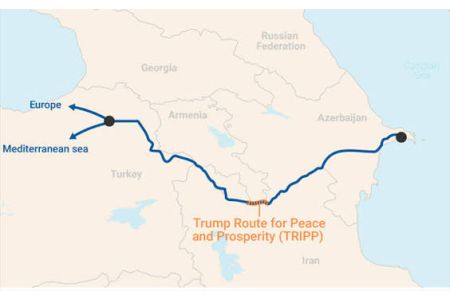
To clarify how Armenia can participate in the project, the analyst stated that there are several ideas. According to him, one of them is that the construction of the North-South road corridor will create the potential for transportation along the Iran-Armenia-Georgia axis through ports to the European course, or in the case of an improvement in relations between Russia and Georgia, Iran-Armenia and across the Georgian military road to Russia.
"That is, these two ideas are being discussed," he said, while agreeing that the main routes pass through Azerbaijan.
At the same time, he stated that it is believed that landlocked countries are losing up to 1.5% of GDP and up to 30% of their potential trade due to poor logistics.
Answering the question about China's declining interest in the North-South project, Vinokurov noted that the PRC has really stopped prioritizing the One Belt - One Road, as it was in the 2010s. However, according to him, all confirmed investments are being made - this is the first moment. "The second point, the PRC has not invested a penny, nor a cent, nor a yuan in container transportation along the axis " China-EAEU-EU-EAEU-China ". This is all done at the expense of Russia, Kazakhstan and Belarus. Our national railways are upgrading their networks and so on. But, since 2013, China has subsidized containerized exports from its central provinces. Subsidies are large. According to our calculations, they approximately zeroise the cost of transit of containers from their central provinces to the western border, that is, to the state union. This is about 30% of the total cost of transportation, "the analyst said, adding that this subsidy gave a powerful boost to container transport in 2013, which continues to this day. According to him, that is, China has invested in transportation along the "West-East", and not through investments, but through subsidies.
"The same is the case for North-South. This is more ours than Chinese. The axis goes Helsinki-Moscow- Astrakhan, then splits into three branches and converges in Iran and goes the Middle East-Pakistan- Mumbai. That is, this is a case that will most likely have to be solved without Chinese money, anyway. And there is already infrastructure there - let's say the Kazakhstan -Turkmenistan -Iran railway, it works, and ferries from Astrakhan to Iran carry up to 5 million tons of grain per year. The question now is to finish building the infrastructure. We are talking about the Rasht-Astara railway between Azerbaijan and Iran, and to achieve high-quality interstate agreements, that is, through tariffs, convenient for senders, as well as to ensure that railways and roads are fully engaged with each other, "he said. As an example, Vinokurov mentioned the testing of a train on the Helsinki-Mumbai route, which passed this route in test mode in 12 days. "If everything is adjusted at the intergovernmental level, then cargo from Northern Europe to India will pass in 15 days. This is absolutely real, "he concluded.