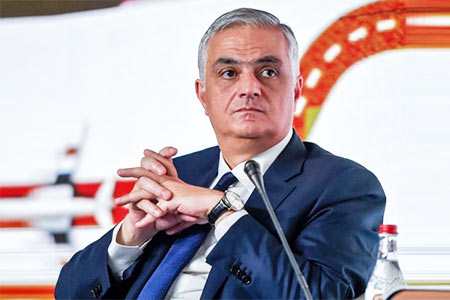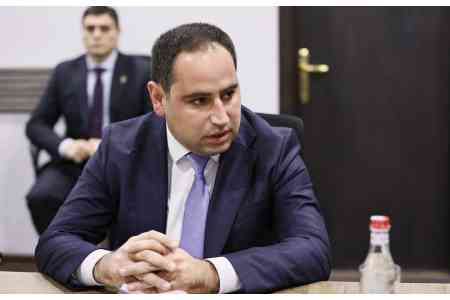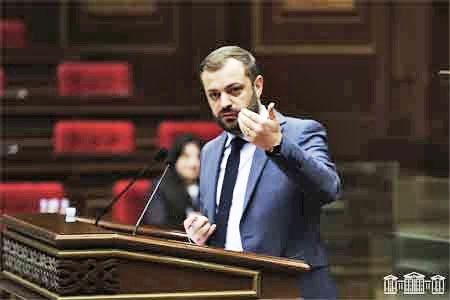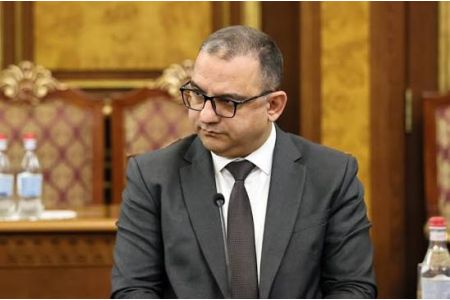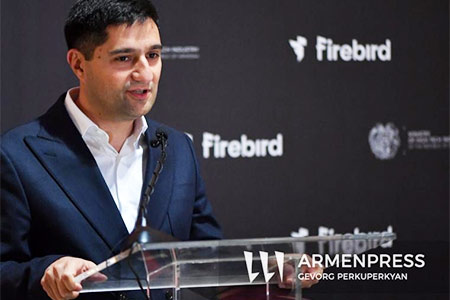


ArmInfo. "For 9 months of 2021, the fulfillment of capital expenditures in Armenia amounted to 68.3% alone or 163 billion drams. A reasonable question arises - how realistic is the implementation of capital investments in the amount of 357 billion drams or 200 billion drams more in 2022," opposition MP from "Hayastan" faction Artur Khachatryan asked on December 6 in the National Assembly touching upon the main macroeconomic indicators laid down in the draft state budget of the republic for 2022.
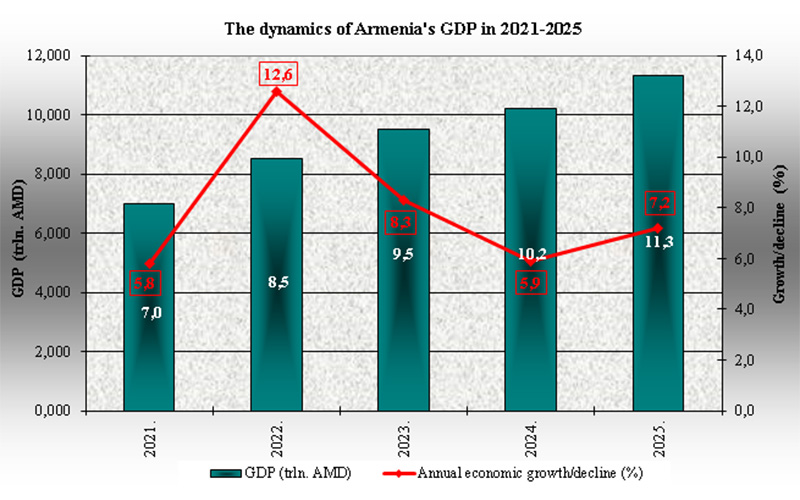
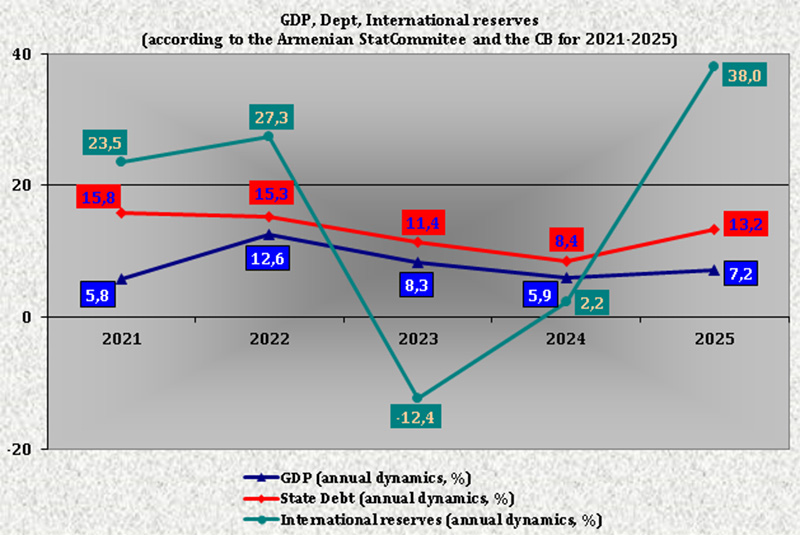
So, according to the draft budget for 2022, GDP growth next year will be 7%. State budget expenditures, instead of 28.2% expected at the end of this year, will decrease to 27.8% of GDP, and current expenditures will also decrease - from 25.1% to 23.45 GDP. In particular, expenses compared to the approved budget for the current year will grow by 18.2% or 337.5 billion drams - up to 2 trillion 188.4 billion drams, which is about 204 billion drams or 10.3% more than the adjusted expenditure budget for 2021 year, or about 340 billion drams more than the target for 2021. Of these, 1 trillion 843 billion drams, or 81 billion drams (4.6%) more than the indicator for the current year, will be directed to cover current expenses. Thus, as the head of the Ministry of Finance pointed out earlier, current expenses will not exceed tax revenues. At the same time, as Khachatryan assured, the borrowed funds will be used exclusively to finance capital expenditures for development. State budget capital expenditures for 2022 will amount to about 357 billion drams, or about 4.4% of GDP (3.2% this year, or 215 billion drams in the approved budget), which is 60% or more than 120 billion drams higher than the adjusted for 2021 year indicator.
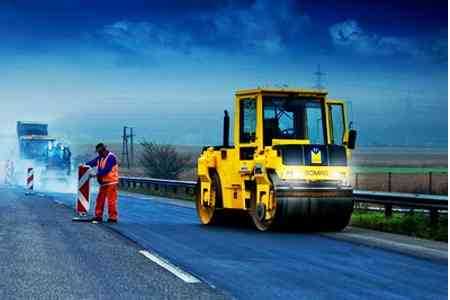
Artur Khachatryan recalled that the Armenian government plans to ensure a high level of GDP growth mainly through capital investments in road construction and the construction of new reservoirs. "In the meantime, the RA government is chronically underperforming capital investments. So, in 2017-2021 the fulfillment of capital investments averaged 78%. At the same time, for 2018-2019, the indicator was 74 and 73.5%, respectively," he.
At the same time, according to the MP, it is necessary to be able not only to carry out state investments, but also to do it with greater efficiency. Thus, the government plans to attract borrowed funds in the amount of 230 billion drams for road construction without appropriate calculations about the economic benefits of such investments. "This is very similar to an infrastructure trap, when you raise debt for infrastructure development, but then you cannot return the borrowed funds," Khachatryan said, adding that all those roads that can or could contribute to the development of the business environment have already been built or paved. To note, if during 2013-2018 the share of capital investments in GDP in Armenia averaged about 3.2%, and in 2017 the figure increased to 4.3%, then already in 2018 the "shortfall" in capital investments began to gain momentum - by the end of the year, having decreased to 2.5 %. Despite the fact that according to the budget for 2020, the ratio of the budget "capex" to GDP was planned to be increased to 5%, by the end of the year, capital expenditures amounted to 2.9% of GDP and about 84.6% of the adjusted plan (about 227 billion drams), against 73.3% in 2019. At the same time, underperformance is mainly, traditionally, associated with inadequate implementation of programs carried out on the basis of external assistance - the implementation of these programs in relation to the adjusted plan last year was 56.7% (56.1% in 2019). Meanwhile, the unclaimed balance of external loans to Armenia is about $ 1.2 billion. In the meantime, according to early calculations by the Luys economic team, a 1.1% failure to capitalize will "penalize" the GDP growth potential by 0.3 percentage points. In subsequent years, regardless of the level of capital investments made, annual GDP growth rates will be lower by an average of 0.3 percentage points.