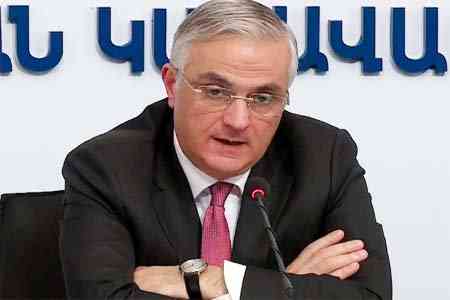
ArmInfo.According to the Central Bank's expectations, the inflationary impact from the external sector on the Armenian economy still remains. Head of the Central Bank of the Republic of Armenia Martin Galstyan stated this during a press conference convened on February 1 regarding the next increase in the refinancing rate.
He explained: "Economic recovery continues in Armenia's main partner countries. A high inflationary environment persists in international food and commodity markets due to the disruption of production chains and higher energy prices. The increase in international prices is also reflected in higher-than-forecast inflation in partner countries. For this reason, the central banks of partner countries are planning to tighten monetary conditions faster than planned."
In Armenia, another wave of coronavirus is spreading rapidly, but its impact on the country's economy is estimated to be mild. At the end of 2021, higher-than-expected economic activity was recorded in the construction and industrial sectors. The Board of the Central Bank is unanimous in its opinion that aggregate demand continues to be high due to external demand, which contributes to maintaining the inflationary environment. The latter, coupled with expected changes in regulated prices, are reflected in the behavior of inflationary expectations.
M. Galstyan in this context noted that since February this year, the increase tariffs for electricity and water will be reflected in inflation growth with an impact in the range of 1-1.5 percentage points, and this is already included in the forecast scenario for 2022. According to the expectations of the Central Bank, inflation at the end of 2022 will be at the level of 5-5.5%.
Giving the actual figures for 2021, M. Galstyan considered it appropriate to make a comparison: "In Armenia, the y-o-y inflation was 7.7%, which was lower than the inflation recorded in Russia - 8.4%, but slightly higher than the inflation in the United States - 7%.
At the same time, he also drew attention to the fact that in 2021 the actual inflation rate in Armenia turned out to be lower than the projected bar - 7.7% against 8.4%. And the balanced and well-thought-out policy of the Central Bank made it possible to contain inflation from greater growth. "But I want to warn you that the Fed's planned more aggressive increase in the key rate in 2022 (5-fold by 25 basis points each - up to 1.25-1.5% by the end of the year - ed. note), and with a start in March, instead of the previously indicated June, will have a significant impact on RA. Risk premium signals will be at the focus of our policy - we will closely monitor and respond adequately to possible capital inflows or outflows. However, I hope that 2022 will be better than 2021."
In these conditions, the CB Board finds it expedient to increase the refinancing rate, this time by 0.25 percentage points, from 7.75% to 8%. As a result of this policy, 12-month inflation will gradually decline, approaching the target threshold of 4% (+/- 1.5) in the forecast horizon.
The CB Board assesses the still high uncertainty associated with macroeconomic prospects in connection with geopolitical events. At the same time, the risks of inflation deviation from the forecasted vector are mainly increasing, and in case of their occurrence, the Central Bank is ready to respond properly to ensure price stability.
It should be noted that this is the seventh increase in the refinancing rate since 2021 to this day - in total from 5.25% to 8%, in accordance with which the Lombard facility repo rates and Deposit facility rates - reached 9.5% and 6.5%. %. The previous increase in the refinancing rate took place on December 14, 2021 by 0.5 percentage points - from 7.25% to 7.75%. And the Central Bank raised the refinancing rate in 2021 six times: in February (by 0.25 p.p. to 5.5%), in May (by 0.5 p.p. to 6%), June (by 0.5 p.p. .p. - up to 6.5%), in August (by 0.5 p.p. - up to 7%), in September (by 0.25 p.p. - 7.25%) and in December (by 0.5 p.p. n - 7.75%), in accordance with which, during these periods, the Lombard facility repo rates were also increased - from the initial 6.75% to December 9.25%, and Deposit facility rates - from the initial 3.75% to December 6.25%.
According to statistics, in December 2021, official y-o-y inflation in the consumer market of Armenia amounted to 1.6%, and y-o-y inflation (December 2021 to December 2020) reached 7.7%, against respectively inflationary 3.4% in December and 3.7% per annum in 2020. And the core inflation calculated by the Central Bank for December 2021 was 0.6%, and y-o-y inflation 7.3% (December 2021 to December 2020), against respectively inflationary 1.7% for December and 3.6% per annum in 2020. Meanwhile, the forecast of the Central Bank, updated at the end of December forecasted higher inflation of 8.4% for 2021, with a further decline in 2022 to 5.5%.