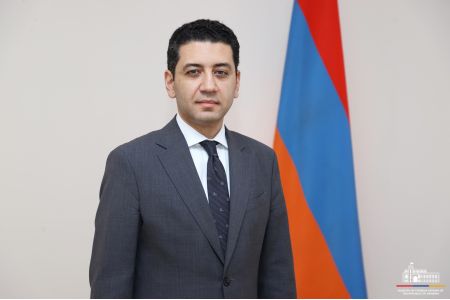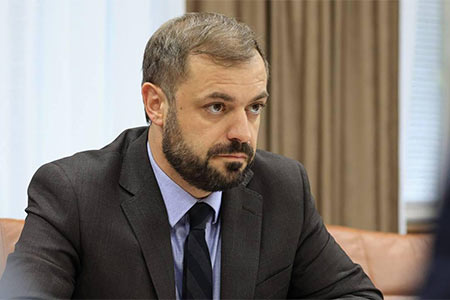


ArmInfo. The central banks of the (EAEU, ed. note) countries should create an appropriate environment for payments in national currencies with the visibility or predictability of the exchange rate to take place. Minister of Economy of Armenia Vahan Kerobyan stated this in an interview with RBC.
He noted in the interview that according to the Russian Central Bank, somewhere around 47% Russian exports to Armenia in 2021 were carried out in US dollars, and about a third of the transfers in Russian imports from Armenia, were in dollars. The minister was asked how the currency structure of these payments could change starting from 2022 and whether the transition, expansion of trade in rubles, in general in national currencies, would be a problem, taking into account that confidence in the ruble is not increasing now.
Kerobyan noted that the expression "in national currencies" is correct, because it is not necessary to exclude the Armenian dram or the Kazakh tenge from the possible payment methods. Of course, central banks initially say that their main goal is to control inflation, but it is trade facilitation that affects the price level. With the right tools to free trade, we can expect lower costs or lower prices . Answering the question that last year, according to trade statistics, Armenia received from Russia natural gas worth $414 million, oil products worth about $270 million. In what currency they are carried out and whether the parties intend to change it, Kerobyan said that the last payments (for gas, ed. note) were in rubles, but at the appropriate rate. "That is, pricing is in dollars, but payment is now made in rubles. As for further questions in the field of pricing or payment, I think there is such an understanding: we should make the transition to national currencies. And I think that there is progress in this direction on the Russian side as well," the minister noted.
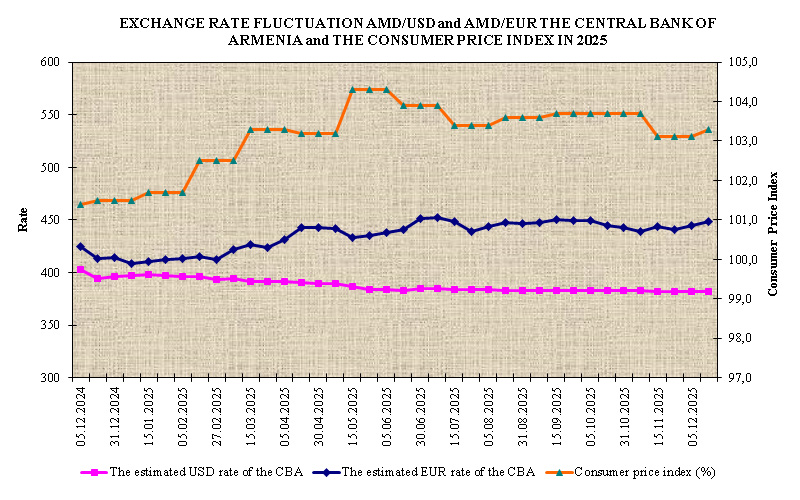
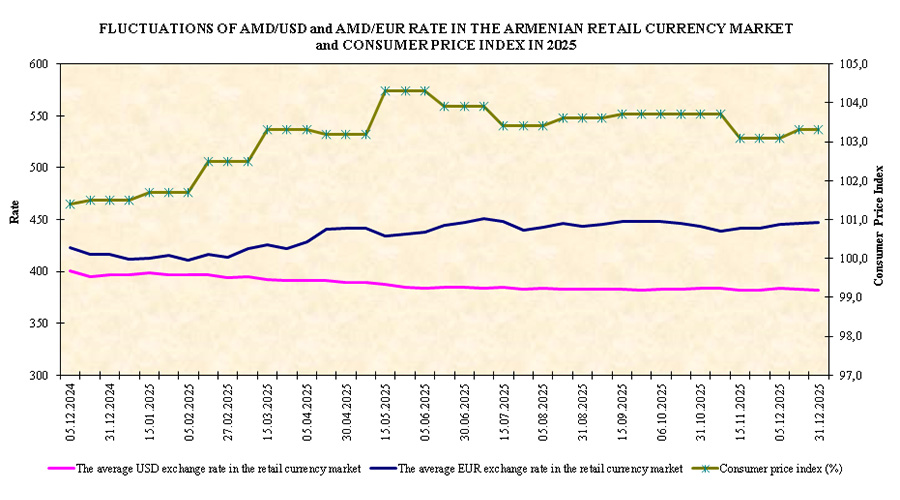
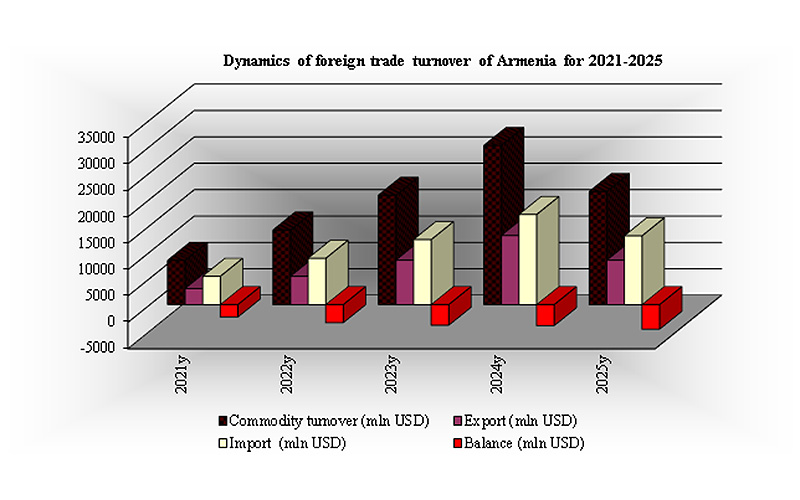
Noting the state of trade turnover with the EAEU countries, Kerobyan noted that last year there was good growth, trade turnover between all countries increased significantly. "And we expected this growth to continue this year. But, look, due to the fact that many Western companies or some Western companies have decided to leave the Russian market, part of this burden is transferred to partners in the EAEU. Initially, the forecast is that there should be no decline in mutual trade. But a big question arises here- the predictability of the ruble exchange rate. Because somewhere around 60% of export contracts from Armenia were concluded in Russian rubles. And we see that exporters are very worried about the uncertainty of the ruble exchange rate. Although in January-February we had a huge growth: imports from Russia grew by 70%, and exports - by about 50% over these two months. But in March, we see a strong deviation, that is, a decrease in sales. And therefore it is necessary to resolve this issue as soon as possible, which will give a positive impetus to the restoration of the previous level", the minister stressed.
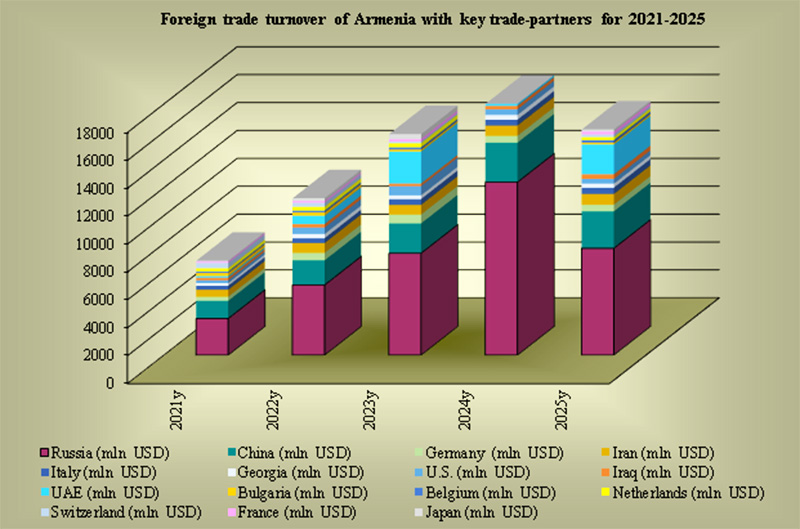
Speaking about the state of economic relations between Russia and Armenia, Kerobyan noted that Russia is Armenia's largest trading partner: according to 2021 data Russia accounts for 31% of the Armenian foreign trade turnover (China is in second place, 15%). According to the Russian Federal Customs Service (FCS), in 2021, Russian exports of goods to Armenia amounted to $1.89 billion- about 12% more than in pre-pandemic 2019 ($1.69 billion). However, according to the FCS, imports from Armenia to Russia in 2021 decreased to $712 million compared to $857 million in 2019. According to FCS, the dominant products of Russia's exports to Armenia are: natural gas ($417 million in 2021), oil products ($240 million), aluminum ($64 million), gold ($56 million). Imports from Armenia include spirits ($191 million), diamonds ($57 million) and tomatoes ($43 million).
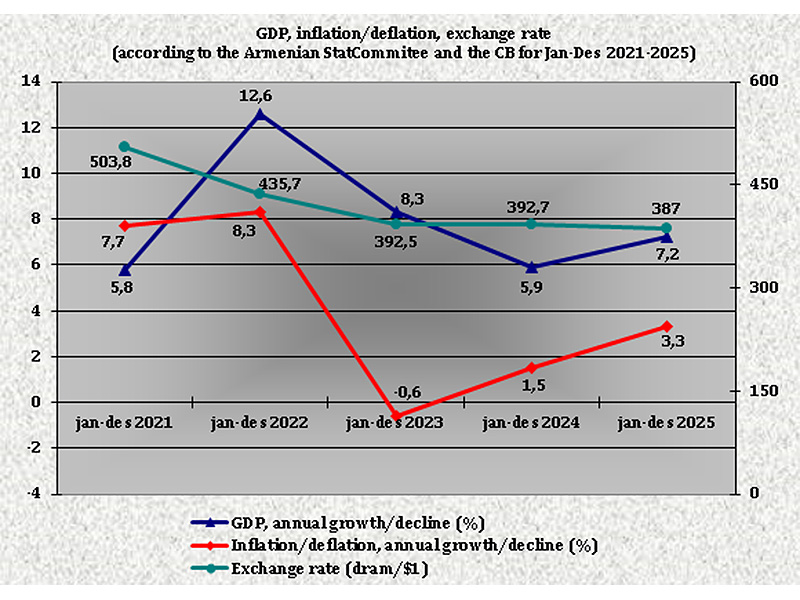
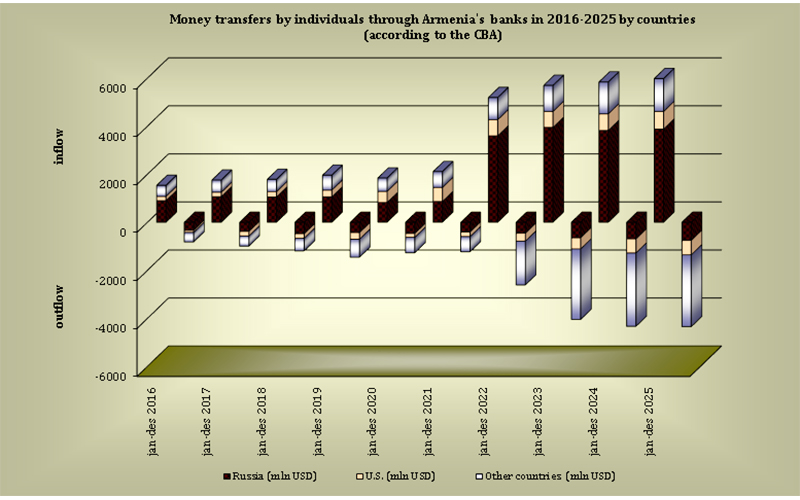
The balance of direct investments from Russia in the capital of Armenian companies at the end of Q3 2021 (the most recent data) amounted to just over $1 billion, follows from the data of the Central Bank of Russia. Meanwhile, according to Kerobyan, the Armenian economy is significantly dependent on transfers from Russia. According to the Moody's rating agency, these transfers are equivalent to about 6% of Armenia's GDP per year. According to the Central Bank of Armenia, in 2021, transfers from individuals from Russia amounted to $866 million - 41% of all such cross-border money transfers to the country (the second largest source is the United States, $580 million). According to Moody's, "the high level of economic integration between Armenia and Russia suggests that the downturn in the Russian economy will have serious consequences for Armenia" due to reduced exports to Russia and reduced remittances from Russia.
Answering the question whether sanctions against Russia can serve as a growth driver in some categories of trade, Kerobyan noted that the Russian market has become freer and less competitive, and this, of course, is a big opportunity. "Of course, there is a big problem to work with the companies that have been subject to sanctions."
However, the specific cases must be considered in detail to make sure that the risks do not become real. I think that we are doing everything to be as useful as possible and to achieve an increase in trade in general. Speaking about the indirect impact of sanctions on the Armenian economy, Kerobyan confirmed that the subsidiary bank of the Russian VTB, VTB Armenia, is under sanctions, and the Teghout copper and molybdenum mine which was transferred to the bank for debts, is also under them. According to the minister, the Armenian government is working on several development options, but there is one invariable factor in all of them - the company must work. "We are now in a situation where we cannot afford the luxury of closed mines. Therefore, we are ready to help shareholders and the company itself so that activities resume as soon as possible>, he stressed, adding that one of the options for resuming the work of the mine is to sell it to an unsanctioned person or company. Meanwhile, Kerobyan stressed that the VTB Armenia Bank continues to work, although not to the same extent as before.