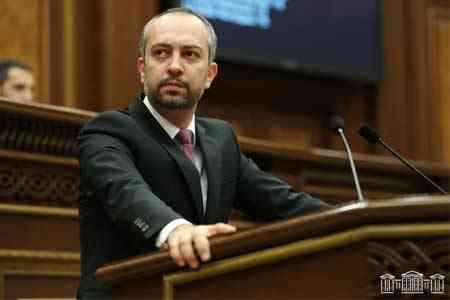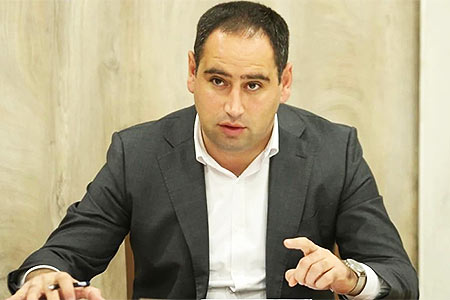
ArmInfo.Armenia still does not understand what economic diplomacy is and how important it is for a country whose industrial potential and services sector, due to the small scale of the domestic market, should be export-oriented. Tatul Manaseryan, Doctor of Economic Sciences, professor, head of the "Alternative" research center, expressed such an opinion in an interview with an ArmInfo correspondent.
Answering a question about possible scenarios for the development of the economic situation in the country and the degree of influence of sanctions against Armenia's main trading partner, Russia, Manaseryan noted that purely theoretically, Armenia can take advantage of this situation and find new approaches and new solutions. But in order to achieve that, it must seriously engage in economic diplomacy, which, according to Manaseryan, neither the former nor the current authorities of the country had any idea about.
"To ensure economic security, we need to think not only about the level of competitiveness of our products and services, but also about how to present them to the outside world, to which markets to promote them.
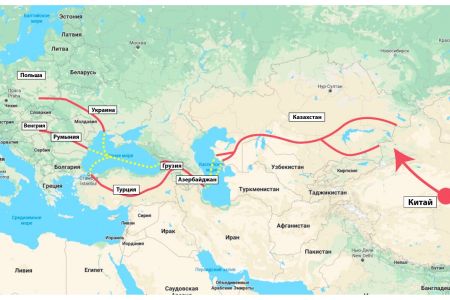
In addition to the entrepreneurial producers themselves, the state should also seriously deal with these issues and be a partner to the business community, actively using various tools, including serious economic diplomacy", the economist emphasized. On the one hand, we need to diversify the sales markets for our competitive products, look for logistical "paths" to new markets, and on the other hand, attract foreign investment and create joint ventures in the country. The latter circumstance is very relevant today if we are talking about partnership with Russia, about the creation of joint bilateral and even trilateral production facilities on our basis for further export of products to third countries, including European countries. "Economic diplomacy is designed to serve precisely such specific goals," said Manaseryan, emphasizing the importance of responsible "diplomatic work" aimed at finding partners around the world and at presenting Armenia's strong position as a country capable of serving as a productive bridge between Russia and the other world, not only Europe.
As a bad example, Manaseryan noted the problems that emerged in the Armenian economy when trying to impose an embargo on the import of Turkish goods after the 44-day Karabakh war. With the introduction of these sanctions by Armenia, the boomerang effect turned out to be so strong that it was virtually impossible to withstand it. Manaseryan sees the reason for this state of affairs in the low degree of diversification of both exports and imports. According to him, many Turkish goods could be replaced by goods from China, Russia, Iran, but the lack of alternatives seems to have played a bad joke and many companies and people are faced with a real risk of loss of income. The reason is the frivolous attitude of the state to issues of economic security, the lack of a connection between the state, entrepreneurs and the expert community in developing a diversified export-import policy.
Manaseryan considers the existence of an expert community in economic policy-making, as well as economic diplomacy, an equally important but missing link. Independent expert assessments based on alternative calculations, experimental experience, evaluating the effectiveness of a particular solution, studying foreign markets, and much more, should not only serve as an alternative and counterbalance to sometimes unreasonable, lightweight government decisions, but also be a program of action for the same economic diplomacy. It should be noted that according to the latest official statistics, direct trade between Armenia and Turkey in 2019 amounted to $270 million. According to independent estimates, taking into account re-export through Georgia, the real import of Turkish goods to Armenia can reach $400 million per year. Moreover, export volumes make up a hundredth of imports.