ArmInfo.Since April, due to the transport collapse that has formed on the territory of Georgia, more than 35 factories for the production of alcoholic beverages have actually been idle in Armenia. The reason is the impossibility to import a complete set from Russia, and, accordingly, it is impossible to export finished products there.
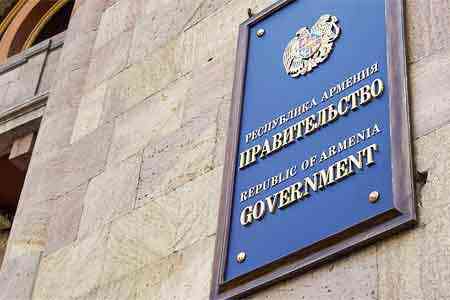
Marina Arakelyan, commercial director of the Van 777 wine and brandy factory (Ararat region), who initiated the exporters' action, expressed such an opinion in an interview with ArmInfo near the government building. She noted that Armenian export-oriented enterprises are currently experiencing a severe crisis - collapse.
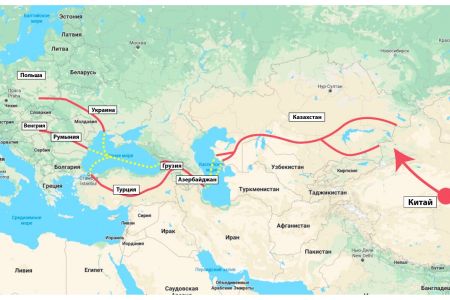
Arakelyan said that according to the situation today, there are more than 3 thousand heavy vehicles with Armenian, Russian and Belarusian license plates on the bypass road, starting from the Sadakhlo checkpoint to Kazbeki, which are not allowed to enter the Russian-Georgian checkpoint "Upper Lars". Moreover, according to her, there are many cases when vehicles with Armenian and Russian license plates are sent back. "Without explaining the reasons, two cars loaded with our products were returned back, one from Sadakhlo, and the second from the Kazbeki point," the entrepreneur said.
She indignantly stressed that the Georgian transport authorities do not want to get in touch, and customs officials refuse to give any explanation.
<I tried to talk with the deputy head of the Georgian Customs Service, with the shift supervisors. They just say they can't do anything. We also wrote to the customs attache of the Armenian embassy in Georgia. But since April 8, this issue has not yet been resolved. No one can answer anything>, Arakelyan said.
The specialist noted that due to the resulting transport collapse, Armenian producers may lose their sales markets. In this vein, she said that Armenian product manufacturers pay for the availability of their goods on the shelves of retail chains, and they are subject to penalties for delaying deliveries. <The question is who will compensate these fines?>, Arakelyan asked.
At the same time, Arakelyan stressed that such an outcome is beneficial for exporters of other countries, since they can take "vacant" shelves of manufacturers from Armenia, as a result of which Armenian alcoholic and other products can simply be expelled from the Russian market.
On top of all this, due to the collapse, Armenian exporters faced new logistical difficulties. Due to the lack of transport, transportation costs more than doubled. If last year at the same time a truck could be sent to Russia for an average of$1.7 thousand, then this year, according to her, tariffs have increased to $4-4.5 thousand.
Due to the absence of any response from the competent authorities, Marina Arakelyan initiated a rally near the government building, which was joined by several dozen exporters. "There is only one requirement for the authorities - to urgently solve the problem - to give Armenian cars the same green road as Georgian or Turkish ones. The government must understand that Armenia has no alternative to the Russian market, this is the number one market for us," she concluded.
It should be reminded that, according to various estimates, up to 3,000 heavy trucks from Armenia, Georgia and Turkey are waiting to be allowed to enter Russia through Georgia.
In connection with the situation, Minister of Economy Vahan Kerobyan made a statement, nothing that work is underway to open a separate corridor for Armenian trucks. In addition, the ministry recently announced the launch of a ferry service in June of this year that will link the railway system of Armenia with the Eurasian one.
In a conversation with an ArmInfo correspondent on May 30, the Armenian customs attache at the Upper Lars checkpoint, Aram Tananyan, noted that the accumulation of cars is due to the limited capacity of the checkpoint. He explained that due to a significant increase in the flow of goods from Turkey to Russia, Upper Lars cannot withstand the load.