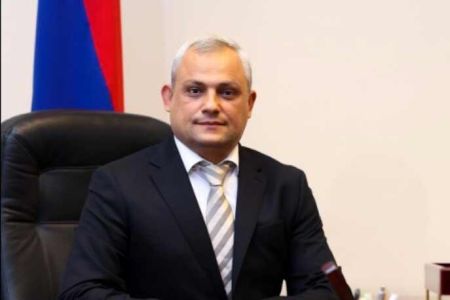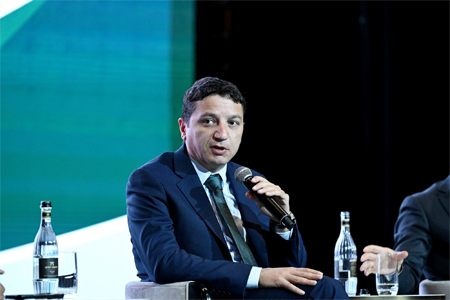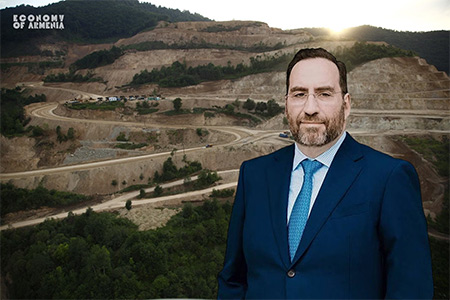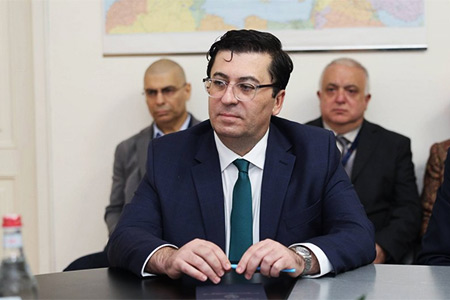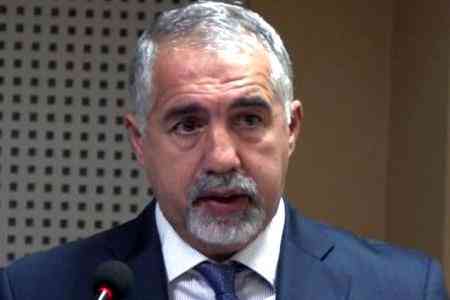
ArmInfo. Economically, the highway through the Caucasian Range which is under construction in Georgia now will be the shortest route for delivering Armenian cargoes to Russia, Gagik Aghajanyan, Executive Director of the Apaven foreign forwarding company, said in an interview with ArmInfo.
The construction of the highway means uninterrupted communication with the outer world for Armenia. In placing its communication lines at its neighbors' disposal, Georgia is well aware of its key role as a transit country, he said. And this highway is not being constructed in Armenia's interests.
"Armenian goods are insignificant for Georgia. Ensuring the necessary amount of Turkish and Russian goods is its top priority. Economies like Turkey and Russia with their great potential are of much greater interest to Georgia. And by ensuring cargo turnover in its territory Georgia can attract huge funds to its budget. This is the reason for Tbilisi being interested in retaining its role as a transit country. And it is not because of its 'political love' for Russia that country is doing so, as their relations are common knowledge. Rather, it is economic interests," Mr Aghajanyan said.
In this context he said that the railway via Armenia's Syunik, which Baku is calling the "Zangezur corridor", can by no means compete with the highway under construction in Georgia. "Theoretically, the railway can provide access to the Russian market. But a great number of issues arise in this context - from tariffs to a way round with a length of thousand kilometers. Bu the major problem is the cargo volume. Is Armenia with its 3-million-strong population is such a strong economy that it requires this railway? There is no such amount of cargoes. Even the Caucasus port, which operated earlier, stopped the operation of its ferry service for the simple reason that it lacked the necessary cargo flow to ensure its profitability," Mr Aghajanyan said.
Resolving the communication problems required constructing the North-South corridor -- rather than talking about it for 30 years -- which would have allowed Armenia to become part of the Persian Gulf- Black Sea corridor. Moreover, Mr Aghajanyan stressed that the North-South highway had not been properly designed. "I cannot understand the destruction of the Yerevan-Ashtarak highway, which was in a good state of repair. But the major problem is the direction of the road the Armenian side has chosen. This issue required an approach in the regional context rather than from the Armenian side's view point," the expert said.
In this context, Mr Aghjanyan said that Georgia's government once decided to launch the "East-West" project, with each of the neighbors to have separate highways leading to Armenia, Turkey, Azerbaijan and Russia. "Moreover, Georgia is constructing its section in the direction of Armenia's Bagratashen, but what is the direction of our section - Bavra?" Mr Aghajanyan asked. If the North-South corridor were in the same direction as Georgia's highway, Armenia could be said to have a chance of becoming part of the Transcaucasian highway.
"But we are constructing a road to nowhere. And if anyone believes that this route is aimed at developing the Armenian-populated region of Georgia, such a person must be shot dead," Mr Aghajanyan. According to him, the Armenian part of the corridor could be an exotic road for tourists - and no more. And no road from Gyumri to Bavra should be constructed, but one toward Bavra is required. "And this is the only opportunity for transiting Armenian cargoes via Georgia to Russia and Iranian goods via the country," Mr Aghajanyan said.
As regards the so-called "Zangezur corridor", Mr Aghajanyan recalled his position: this is a political project, which has nothing in common with economically-grounded calculations. This project means that the railway will pass by Armenia. In the west of Azerbaijan, the Baku-Tbilisi-Kars highway bypassing Armenia has been constructed, with the North-South corridor under construction in the east - from Russia's Derbent as far as Astara-Rasht, Iran, via Azerbaijan. On the north, Azerbaijan and Georgia has always had a road. "The south is the only point where Armenia has not yet been passed by, which makes a road via Syunik a necessity. And making a concession over the road will lead to a disaster for the Armenian side and will prove to be the final nail in the coffin," the expert said.
Mr Aghajanyan stressed that Yerevan should show an entirely different approach, which would be based on the national priority. This priority is, in fact, a railroad toward Nakhichevan via Yeraskh, with only 600 meters of railroad bed need repairing. That would allow railroad communication between Nakhichevan and the Georgian ports on the Black Sea and between Azerbaijan and Nakhichevan. The construction project will not require serious investments, whereas the construction of a new railroad could require over $200mln.
According to Mr Aghajanyan, figures are evidence of the political component of the so-called "Zangezur corridor" project. In this context he points out that just 1.5mln tons of cargoes have been transported on the Baku-Tbilisi-Kars railroad since it was constructed five years ago, whereas the designed capacity was 6mln tons a year. In this context, it would be na‹ve to claim that Nakhichevan with its 300,000-strong population can ensure the necessary volume of cargoes for it.
Azerbaijan's aims in the context of the "Zangezur corridors" are entirely different, namely, cutting Armenia off Syunik for the Turkic world to unite. Evidence thereof is both the statement by Turkish Minister of Transport and Infrastructure Adil Karaismailoglu, who noted that as son as the "Zangezur corridor" is constructed the Nakhichevan-Kars railway construction project will be launched.
"Do you understand what is in question? Implementing the project by the Armenian side will only mean betraying Armenia. We will not use the railway running in Azerbaijan for the simple reason it is uneconomic," Mr Aghajanyan said.