


ArmInfo.Keeping the counter-cyclical capital buffer (CBC) at 0% for more than two years, the Central Bank of Armenia, nevertheless considered it expedient to increase it to 1% of risk-weighted assets. This rule will come into force on May 1, 2023.
As noted on the official website of the Central Bank of Armenia, the purpose of increasing the "counter- cyclical capital buffer " is to support the stability of the banking sector to systemic risks, the likelihood of materialization of which remains high. The report states that the regulator made a decision on this on October 24 this year, based on a comprehensive analysis of the development of the macro-financial and credit market.
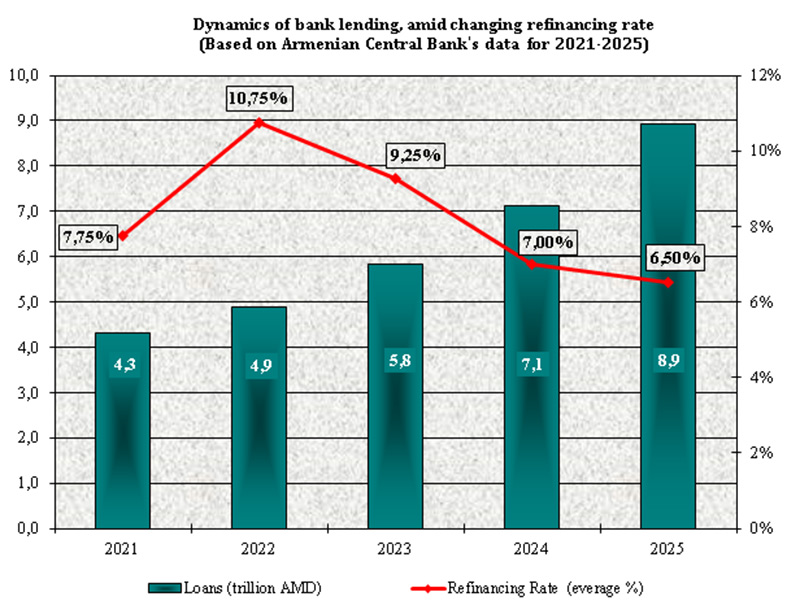
This analysis showed, firstly, that the growth trends observed since the beginning of 2022 continued in the credit market, with both the retail and corporate portfolios growing on a quarterly terms. However, the loan-to-GDP ratio declined to 67% in Q3 2022, but this decline is mainly driven by more progressive GDP growth. The deviation from the long-term trend (loans/GRP gap), calculated for this indicator using the Basel Committee methodology, also decreased by 6.7 percentage points.
The Central Bank has repeatedly stressed in its previous considerations that when making a final decision on the level of the counter-cyclical capital buffer, it attaches importance to the results of a comprehensive analysis of the development of systemic risks, and is not guided solely by the size of the loan/GFP gap calculated according to the methodology of the Basel Committee.
Secondly, the financial cycle index continued to grow both year-on-year and quarterly. Moreover, the financial cycle grew to a greater extent due to the high growth rates of mortgage loans, which was simultaneously accompanied by an accelerated increase in real estate prices. The Central Bank, taking into account the fact that the growth in the volume of financial debt on mortgages and the growth in real estate prices are considered, in fact, complementary and absorbing each other, estimates the duration of overheating risks in the real estate market.
Third, the banking system is currently considered to have a high level of profitability and capital adequacy. As a result, the costs of meeting the requirements for an increased CBC for participants in the banking system will be minimal, and the current level of capitalization of banks is more than sufficient to ensure normal rates of lending to the economy.
Fourth, in the context of the ongoing Russian-Ukrainian military confrontation and growing geopolitical uncertainty, the likelihood of materialization of systemic risks continues to be high, both in terms of the degree of impact and the speed of implementation.
In current conditions, the Central Bank attaches importance to increasing the ability of the banking system, through the accumulation of capital buffers, to withstand future possible shocks. Capital buffers also expand the ability of the banking system to provide uninterrupted credit to the economy in the face of the materialization of cyclical risks.
It was guided by the analysis of the abovementioned facts that the Central Bank considered it expedient to shift the bar of the counter-cyclical capital buffer from 0% to 1%.
According to the Central Bank of the Republic of Armenia, by September 2022, the assets of the banking system exceeded 7.6 trillion drams (with a y-o-y growth of 10.4%), loan investments amounted to 3.8 trillion drams (with a y-o-y growth of 3.9%), total liabilities - 6.4 trillion drams ( with a y-o-y growth of 7%), attracted deposits - 4.04 trillion drams (with a y-o-y growth of 16.7%), total capital - 1.2 trillion drams (with a y-o-y growth of 33.3%). Total capital adequacy increased by the market to 19.93%, total liquidity - up to 34.88%, return on equity (ROE) - up to 19.76%, return on assets (ROA) - up to 2.8%.
It should be noted that initially the decision to introduce the counter-cyclical capital buffer (CBC), was adopted by the Central Bank in 2020 on July 31, setting it at 0% of risk-weighted assets, with entry into force from August of the same year. Since then, the CBC bar has not changed, and in fact, until May 2023, it will remain at zero.
The CBC is necessary to cover the bank's losses in the event of systemic risk thresholds in the banking sector. According to the "Procedure for setting and calculating buffers above the capital adequacy ratio of banks", the regulator reviews the CBC threshold on a quarterly terms. When determining the CBC, the Central Bank is guided by the provisions of the document "General Methodology of the COUNTER-CYCLICAL CAPITAL BUFFER Threshold", according to which, when setting the threshold, the basis for the Central Bank is the gap in the credit/GDP ratio estimated by the Basel methodology and the financial cycle index considering the development of systemic risk, as well as other indicators of the so-called early prevention (early response).