

ArmInfo.Fitch Ratings has revised the Outlook on the City of Yerevan's Long-Term Foreign- and Local-Currency Issuer Default Ratings (IDRs) to Positive from Stable and affirmed the IDRs at 'B+'. According to the source, the revision of Outlook follows the recent similar action on Armenia's sovereign ratings (see 'Fitch Revises Armenia's Outlook to Positive; Affirms at 'B+' dated 10 February 2023 on www.fitchratings.com). It is also noted that the city's ratings as capped by the sovereign's.
Let us also note that the next scheduled review date for Fitch's rating on Yerevan City is 09 June 2023, but Fitch believes that developments for the issuer warrant such a deviation from the calendar.
According to the source, Under applicable credit rating agency (CRA) regulations, the publication of local and regional government reviews is subject to restrictions and must take place according to a published schedule, except where it is necessary for CRAs to deviate from this schedule in order to comply with the CRAs' obligation to issue credit ratings based on all available and relevant information and disclose credit ratings in a timely manner. "Fitch interprets these provisions as allowing us to publish a rating review in situations where there is a material change in the creditworthiness of the issuer that we believe makes it inappropriate for us to wait until the next scheduled review date to update the rating or Outlook/Watch status," they said
According to the report, the key rating drivers are linked to the caps on Armenia's sovereign rating.
"Yerevan's IDRs are capped by those of Armenia as our assessment of the city's Standalone Credit Profile (SCP) is unchanged at 'bb-' since the last review on 16 December 2022 (see 'Fitch Affirms Armenian City of Yerevan at 'B+'; Outlook Stable' on www.fitchratings.com)." Factors with a low weight is the risk profile with a rating of . "Yerevan's 'Vulnerable' risk profile is driven by five 'Weaker' key risk factors (revenue robustness and adjustability, expenditure adjustability, liabilities and liquidity robustness and flexibility) and one 'Midrange' factor (expenditure sustainability) in a country rated in the 'B' category or below. The assessment reflects Fitch's view that there is a very high risk of the issuer's ability to cover debt service with the operating balance weakening unexpectedly over the scenario horizon (2022-2026) due to lower revenue, higher expenditure, or an unexpected rise in liabilities or debt-service requirements."
Debt Sustainability: 'aaa category': In its rating case, Fitch assumes that Yerevan will continue to draw down its European Investment Bank loan to the limit of EUR7 million. However, the city's debt levels will remain moderate, with little impact on debt- sustainability metrics in 2022-2026. Fitch expects the city's debt payback ratio - the primary metric of debt-sustainability assessment for Type B local and regional governments (LRG) - will remain strong at under 5x, which corresponds to a 'aaa' assessment. The latter is also supported by prudent secondary metrics.
DERIVATION SUMMARY: Fitch classifies Yerevan as a type B LRG, which has to cover debt service from cash flow on an annual basis. Yerevan's 'bb-' SCP reflects a 'Vulnerable' risk profile and debt sustainability metrics assessed at 'aaa' under Fitch's rating case. The 'bb-' SCP also reflects peer comparison. The IDRs are not affected by any asymmetric risk or extraordinary support from the central government, but they are capped by Armenia's sovereign IDRs at 'B+'.
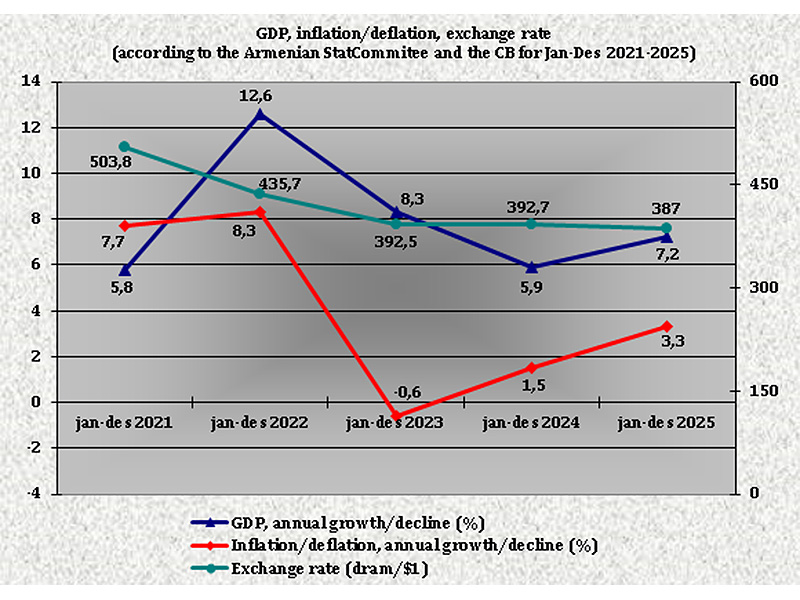
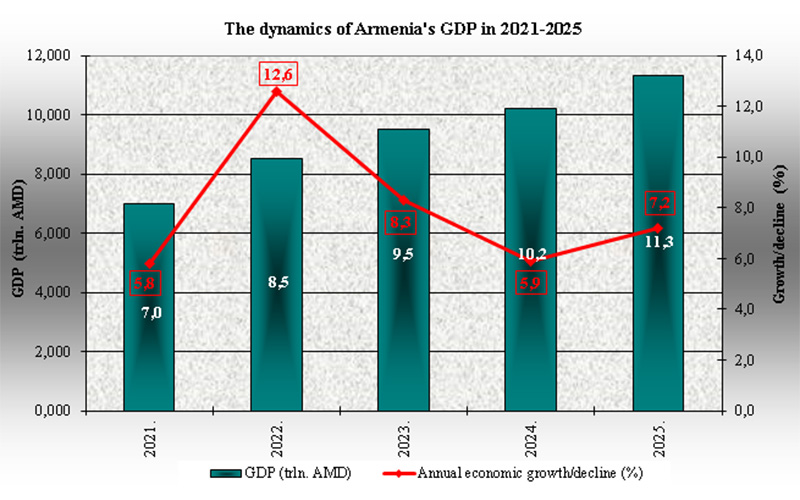
On February 10, Fitch Ratings improved the outlook on Armenia's Long-term Issuer Default Rating (IDR) in foreign currency from "Stable" to "Positive", confirming the IDR at "B+". This is noted in the Fitch report, which also provides an improved estimate of Armenia's GDP growth for 2022 to 11.6%, with a further slowdown in 2023 to 6.1% and in 2024 to 4.7%.