

ArmInfo. Armenia's gross international reserves (GIR) fell from a historic high of $4.112 billion in December 2022 to $3.689 billion in January 2023. In particular, gross international reserves decreased in January by 10.3% or by $422.6 million (after December's 17% growth or by $594 million). At the same time, the y-o-y dynamics remained in growth, but with a noticeable slowdown in rates from 31% to 18%, i.e. in absolute terms, last year's growth by $738 million has narrowed this year to $551 million. This is evidenced by the data of the Central Bank of the Republic of Armenia.
In particular, the January decline of the gross international reserves was due to a reduction in external assets in hard currency by 11% (after December's 17.5% growth) - to $ 3.658 billion, with an increase in the share of SDR in the IMF 5-fold (after December's 73.5% decline) to $30.6 million, which was also observed a year earlier in January at a much more restrained pace, when the decline in foreign assets in hard currency by 3.3% was accompanied by an increase in the share of SDRs in the IMF by 21.7% (after the December growth in foreign assets in hard currency by 7.8% and a decline of the share of SDRs in the IMF by 45.1%).
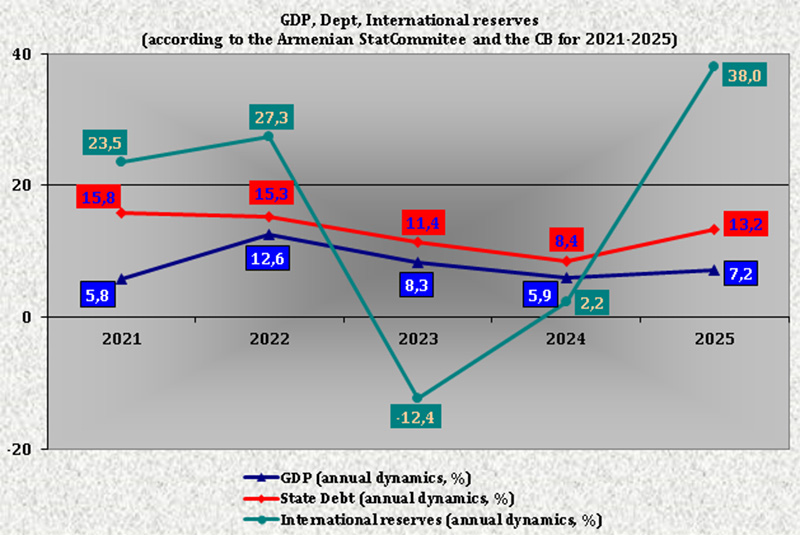
It should be noted that by 2023, Armenia's gross international reserves (GIR) reached a historic high of $4.112 billion, with a y-o-y growth of 27.3% or $881.8 million (against 23.5% growth in 2021). In their structure, external assets in hard currency also reached a historical maximum - $4.108 billion, having increased by 28.5% over 2022, with a decline in the share of SDR in the IMF by 81.3% - to $6.2 million, while a year earlier there was an increase in both external assets in hard currency and the share of SDR in the IMF 22.7% and 3.7- fold, respectively. It is pertinent to note that the share of SDRs in the IMF for 2022 has moved even further away from the August 2021 record level of $178.2 million.
As a comparison, let's cite the pre-Covid dynamics of 2019: the growth of foreign assets in hard currency by 26.2% and the share of SDRs in the IMF by 3.2% ensured the growth of the gross international reserves by 26.1%. The share of banking gold in Armenia's gross international reserves was set to zero back in December 2003.
In early May 2022, the Executive Board of the International Monetary Fund (IMF) decided to provide Armenia with 25.716 million SDRs (about $35 million) under the Stand-By Agreement (SBA), as a result of which the total amount of payments under the program will be 308.8 million SDRs (about $415 million).
The IMF report indicated that the Fund's Executive Board took the decision without convening formal discussions, completing the review of the sixth and final SBA reviews, thereby allowing the authorities to raise the abovementioned amount. The same report noted that the performance of the three-year standby agreement (SBA) remained high despite a number of internal and external shocks. Much later, on December 13, 2022, the IMF approved a three-year standby loan program for Armenia in the amount of about $171.1 million (128.8 million SDR), which is about 100% of the RA quota in the IMF. Since the approval of this program in December, $24.4 million has been immediately available to Armenia, and the rest of the amount will be provided after final reviews of six semi-annual periods. According to the Armenian authorities, this reserve program is considered preventive and will help insure the balance of payments against shock consequences, as well as stimulate the efforts of the authorities in terms of reforms.