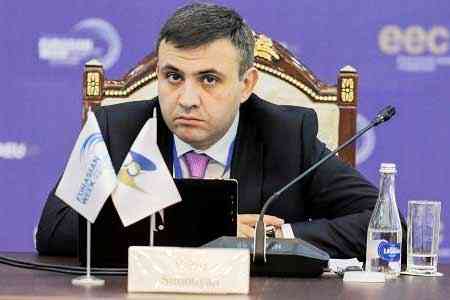



ArmInfo.Armenia's authorities are overpraising the GDP growth recorded in the last few years, whereas it is absolutely nothing in terms of long-term real economic growth, Doctor of Economy and Armenia's ex-premier Hrant Bagratyan said.
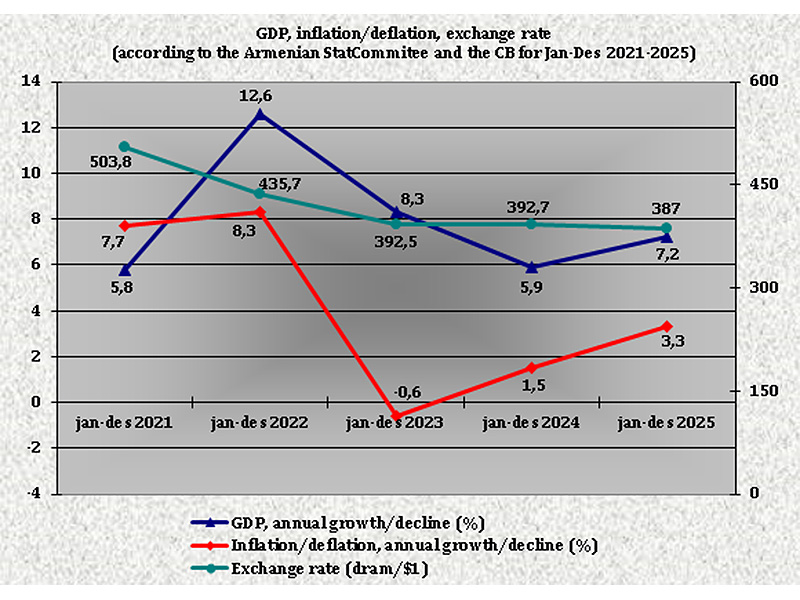
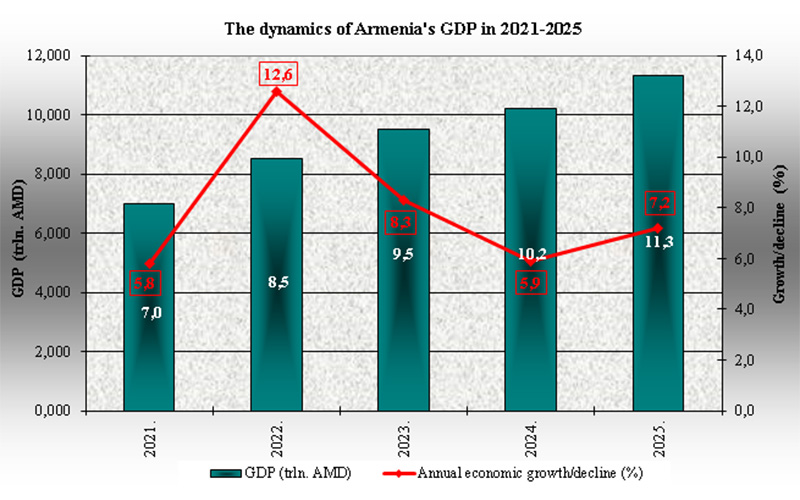
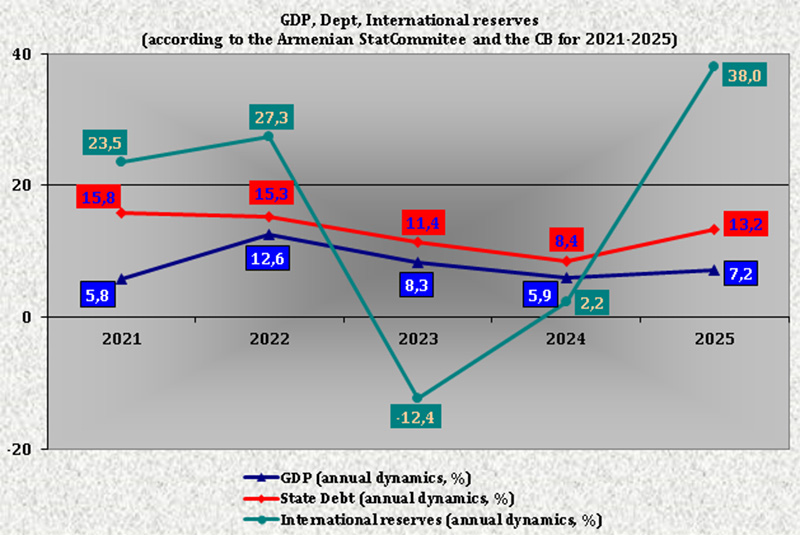
Last year, 14.2% economic growth was recorded in Armenia (5.8% in 2021 and 7.6% in 2019). 12.6% GDP growth was recorded against 5.7% in 2021 and 7.6% in 2019, totaling AMD 8,497bln ($19.5bln). The following sectors played the major role in the GDP growth: the services sector (28.2%), trade (17%) energy sector (16.1%), construction (12.5%) and industry (7.9%). Armenia's agricultural sector recorded a 0.4% growth. GDP per capita reached $6,569 in 2022 against $4,669 in 2021.
In commenting the macroeconomic results of Armenia's socio-economic development in 2018-2022, Mr Bagratyan notes that the officially recorded GDP growth was 26.5% in 2018-2022, with the average annual growth being 4.7%. Over the last 20 years, the average annual GDP growth was 13% in 2003-2007, 1% in 2008-2012, 3.5% in 2013-2017.
"So what progress are you talking about? Let is note that 2018 to 2022 (the years of Pashinyan's premiership) did not see any accelerating economic growth," Mr Bagratyan writes. He noted that the current economic growth rates in Armenia are lower than that in 2003-2007, with an insignificant advantage over the third 5-year period (2008-2012) - 4.7% against 3.5% - with huge resources spent to ensure 1% growth.
Secondly, the growth structure shows sectoral underdevelopment. The services sector, especially finance and insurance, mainly ensures economic growth (with an 8% share in the GDP, almost as much as that of agriculture and processing industry). The mining and gaming industries showed a boosting growth in the last five years (except for 2022), with their respective shares in the GDP being 3.8% and 2.7%.
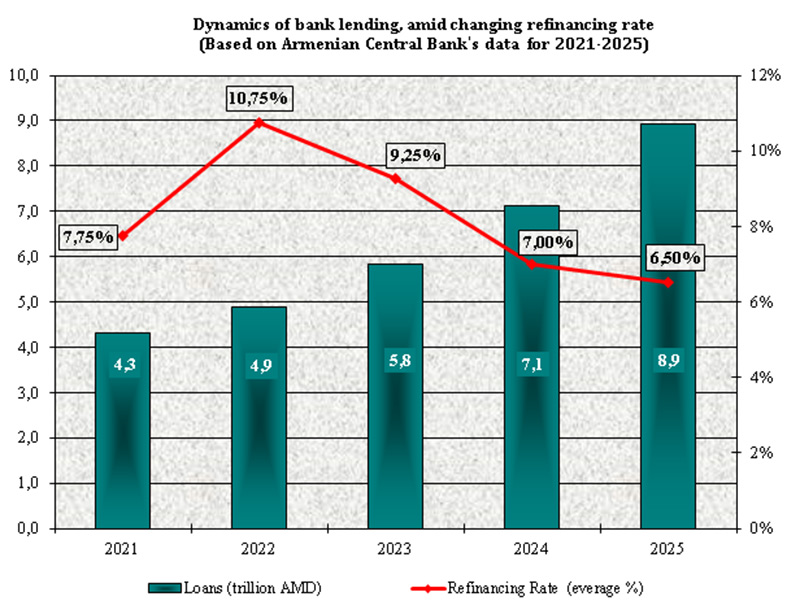
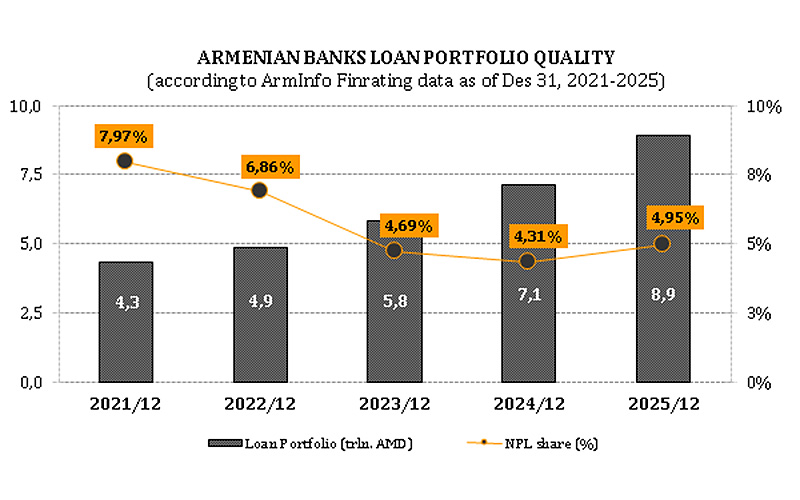
"In 2022, for the first time in Armenia's history, banks' total assets (normally issued loans) equaled the country's GDP. In 2018-2022, they almost doubled - from AMD 4,364bln in 2017 to AMD 8,390bln in 2022. But the loans have to be repaid. The services sector's share in Armenia's GDP totaled 64%. Not bad at first sight. However, such high growth rates in the financial and gaming sectors are the result of the wrong macroeconomic policy, not of natural dynamics. It is noteworthy that the government-praised growth in the construction sector does not reflect the facts. In 2022, AMD 578bln construction was recorded - more than in 2021, but much less than in 2007 (AMD 772bln) or in 2008 (AMD 903bln). With inflation considered, twice as much construction work was carried out in 2008 than in 2022," Mr Bagratyan wrote.
Thirdly, Mr Bagratyan points out low-quality growth amid instability. "Today we can see growth in the construction sector, tomorrow, in the IT-sector, the day after tomorrow, the mining industry and so on. Armenia's economic specialization coefficient is declining on the international market. Cutting the ribbon at the opening ceremonies of new plants is the favorite business of our premier and government members. But most of them close down some time later. But each growth consumes resources. As a result, such events produce GDP growth for particular periods, without doing so later," Mr Bagratyan writes.
International growth indicators are not in Armenia's favor. Specifically, according to Armenia's Statistical Service, Armenia's economic growth has always been higher than Georgia's and Russia's. In 1990-2022, Armenia's economic growth index was 243.8%, Georgia's, 118.4%. However, in 2021, according to the World Bank, the GDP per capita was $4,966 in Armenia, $5,023 in Georgia, $5,338 in Azerbaijan. Nevertheless, according to the USSR Journal of Statistics for 1990, the GNI per capita was 2,945 roubles in Armenia, 2,760 roubles in Georgia and 2,130 roubles in Azerbaijan.
"In terms of growth Armenia has left Russia behind. In fact, however, we cannot come close to Russia in terms of GDP per capita. All this is a serious ground to believe that Armenia's Statistical Service is now manipulating the growth rates, attempting to 'neutralize' them by its 'methodology' for reducing the long baseline economic growth value in the long term," Mr Bagratyan wrote.