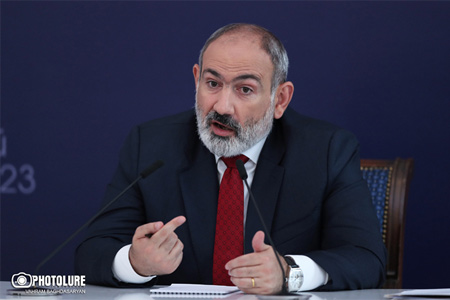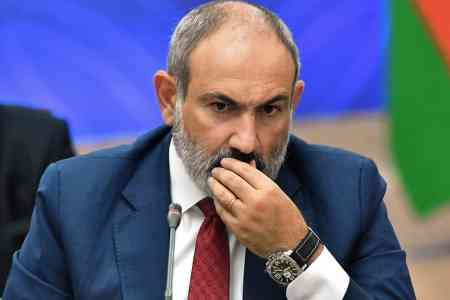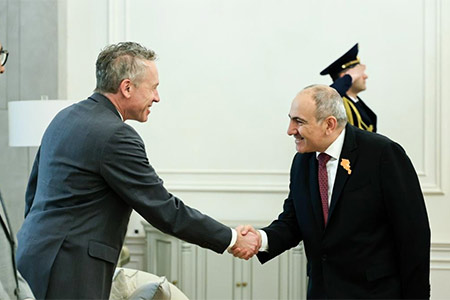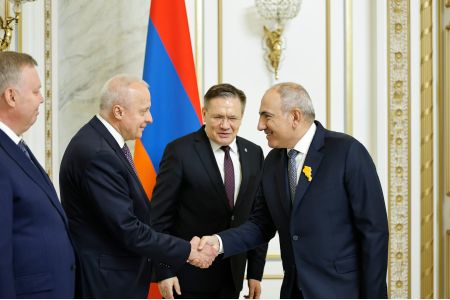


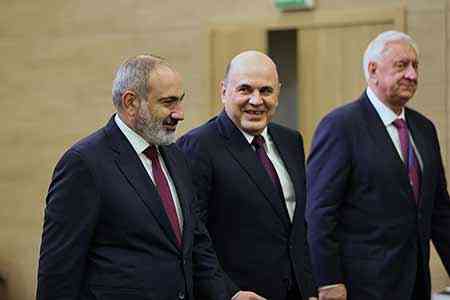
ArmInfo. During the visit of the heads of government of the EAEU to the "Eurasia is Our Home" exhibition, the head of the Russian government Mikhail Mishustin drew the attention of Armenian Prime Minister Nikol Pashinyan to the system of financing projects for the construction of new nuclear power units.
"Russia is ready to discuss with its partners in the Eurasian Economic Union the financial issues of building nuclear power plants on their territories, as well as parameters related to the capacity of the units," Mishustin said.
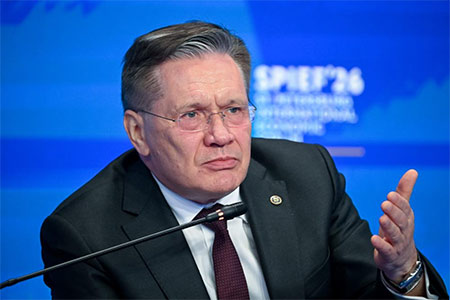
At the stand of the Rosatom state corporation, the heads of delegations were told about the youngest and most efficient plant in the world - the joint Russian-Belarusian nuclear power plant project. "This is a world bestseller, two powerful units of 1,200 megawatts each," said Alexei Likhachev, head of Rosatom. At the moment, the first unit of the Belarusian NPP has already been put into operation, and the second unit is being tested.
Mishustin, addressing Pashinyan, noted that the cost of the project "was mastered by a little more than 40% by Belarusian companies."
In this regard, Likhachev noted that "Rosatom" builds such projects "as it would do for itself". "We are responsible for all the most stringent regulatory standards of the Russian Federation and the IAEA for quality, efficiency and safety. After the commissioning, we continue it as we would if we were to do it for ourselves, we train specialists, including all our reserve activities in the work to improve the fuel and, of course, the training of personnel," said the Director General of Rosatom.
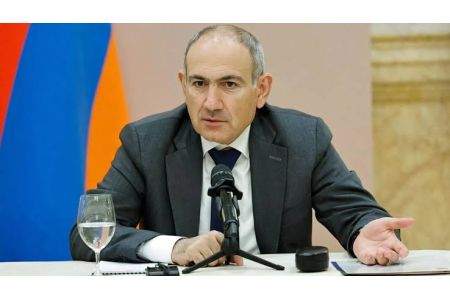
Pashinyan, in turn, noted that, as reported to him, Rosatom is proposing the construction of units with a capacity of only 1,200 megawatts, but no lower. "We also have units with a capacity of 1000 megawatts that we are building, we can make both 600 megawatts and 400 megawatts, but these will be flagship projects and a little more expensive," Likhachev said.
Mishustin suggested inviting Armenian partners and, among other things, to "talk about the price of performance." "Mr. Aleksey (Likhachev), today we need to discuss the price policy. We are ready to discuss, firstly. The same applies to our Kazakh partners, we are ready," said the Russian Prime Minister.
In addition, Mishustin drew the attention of the heads of delegations to the fact that scientists and technologists from countries to which Rosatom offers technologies could take part in research and design work in the implementation of nuclear power plant construction projects.
An interdepartmental working group is being created in Armenia to discuss issues related to the construction of a new nuclear power unit. The corresponding decision was signed by the Prime Minister of Armenia on June 6.
Earlier, a project was announced for the construction of a Russian-made nuclear power unit TOI with a capacity of 1200 MW.
Meanwhile, Coordinator of the Department of State's Office of the Coordinator for U.S. Assistance to Europe, Eurasia, and Central Asia Maria Longhi said the U.S. is considering building "small modular nuclear reactors" in several Eurasian countries, including Armenia. The goal of the project is to strengthen the energy independence of these states from both Russia and China. In this regard, RA Prime Minister Nikol Pashinyan noted that Armenia is negotiating the construction of a new nuclear power plant with Russia and the United States and third countries. "Armenia is looking for more profitable options from an economic point of view," the head of the Armenian government emphasized.
One of the leading US Electric Corporations, Westinghouse, has developed small modular reactors. In May, the company introduced the AP300 nuclear reactor with a capacity of 300 MW. It became a smaller copy of the flagship AP1000. The cost of one such unit is estimated at $1 billion, which is several times less than a full-fledged nuclear power plant, the cost of which is from $8 to $10 billion.