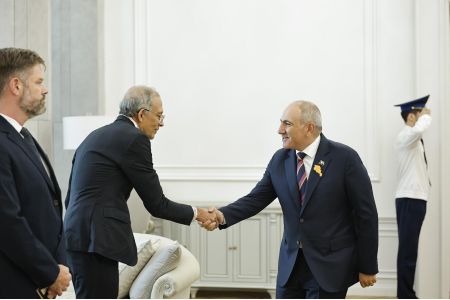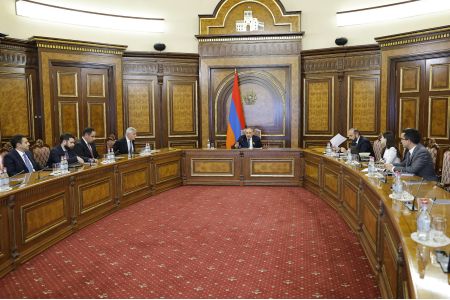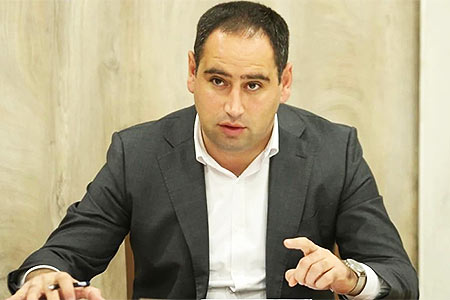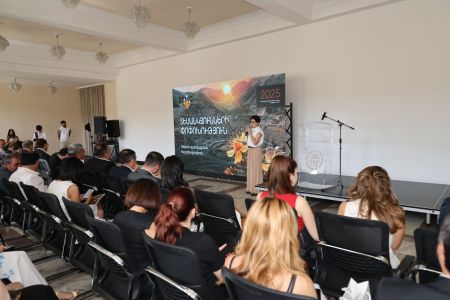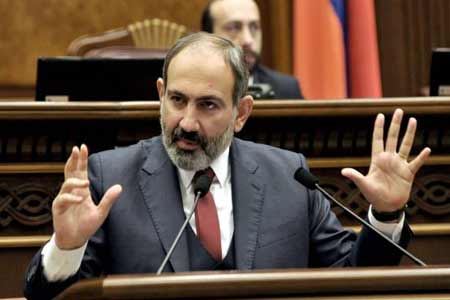
ArmInfo.RA Prime Minister Nikol Pashinyan participated in the Ministerial Meeting of Landlocked Developing Countries, entitled "Promoting equal, affordable and inclusive transport connectivity for stable and resilient economies", one of the largest events ever organized in Armenia jointly with the United Nations.
As the press service of the RA Government reports, the Prime Minister made a speech in which he stated:
"UN High Representative for Landlocked Developing Countries Ms. Rabab Fatima, Chair of the Landlocked Developing Countries Group, Mr. Lemogang Kwape, Dear Ministers,
Dear participants of the meeting of Landlocked Developing Countries under the theme "Promoting equal, affordable and inclusive transport connectivity for stable and resilient economies", I welcome all of you on the occasion of organizing and attending the most important event on this important topic in the Republic of Armenia.
I should note that in general, we also re-evaluate the role of transport communications over time in the sense that our first perception is usually that transport communications are important for the movement of goods and people. But in the recent period, also due to our agendas, we note the importance of the role of transport communications in the sense of regional stability, security and in general, for peace and establishment of peace, because it is our belief and we express this belief in all international platforms related to the topic that peace is first of all the possibility and presence of economic and cultural ties between peoples. And these ties obviously cannot be present without transport communications.
This is the reason why we have integrated our approaches to the very important topic of opening regional communications in the "Crossroads of Peace" project, which is essentially about opening regional communications and which is directly related to greater access to the sea.
You are probably aware that for more than 30 years Armenia's borders with Turkey and Azerbaijan have been closed, and today we are talking a lot about the possibility of opening regional communications. I consider it very important to record in this prestigious audience Armenia's readiness to take very concrete and effective steps regarding the opening of communications in our region, which is practically expressed in our project as follows:
The Republic of Armenia expresses its willingness to create and restore railway communication between Azerbaijan and Armenia, moreover, through the previously existing railways. The first is the northern route, which connects the Kazakh region of Azerbaijan with the Tavush region of Armenia, and the second is the southern route, which, among others, also connects the western regions of Azerbaijan with the Autonomous Republic of Nakhichevan. Moreover, we believe that the western regions of Azerbaijan can be connected with the Autonomous Republic of Nakhichevan and the outside world in general also through the northern route. We have expressed this willingness officially and we express it today.
The next is about the highways, which, moreover, can have a northern route, so to speak, a middle route and a southern route, which, as you can see, will open up new opportunities for our region. Basically, Armenia can connect and be connected to other countries through the "Crossroads of Peace" along the north-south and east-west axis.
In addition, we show the same readiness in terms of opening the Armenia-Turkey railway, reconstructing and reopening the two previously existing Armenia-Turkey roads, which, we believe, will have a significant impact not only on our region, but also on international economic relations and on cultural, political ties and global security issues in general.
It is very important to record the principles, which we believe should underpin the operation of Crossroads of Peace. Or rather, not only in our opinion, but they are internationally accepted well-known principles. The first is that all infrastructure, including roads, railways, airways, pipelines, cables, power lines, must operate under the jurisdiction and sovereignty of the countries through which they pass.
The next principle is as follows: each state, through its state institutions, ensures border control, customs control and security of all infrastructures, including the passage of citizens, goods and vehicles through those communications. Moreover, I would like to emphasize that in order to solve this task, including ensuring security, a special unit was created in the National Security Service by the decision of the Armenian government, the special goal of which is to ensure the security of regional communications.
The next principle is that all infrastructure can be used for both domestic and international freight and communication. Countries use infrastructure on the principle of equality and reciprocity.
Within the framework of the above-mentioned principles, some procedural simplifications may take place on the basis of the principle of reciprocity and equality.
Dear attendees, As you noticed, the Crossroads of Peace project, which expresses mainly railways and roads in this map, can also be useful for the construction and passage of power lines, cables, gas pipelines in the East-West and North-South directions. Of course, this is a much bigger process and project than the regional one, as I already said, it can have a significant impact internationally.
Related to the topic, this project essentially concerns two landlocked countries, the Republic of Armenia and Azerbaijan.
Even today, in fact, we have access to the sea through the friendly, fraternal Georgia and the friendly Islamic Republic of Iran. But we believe that the "Crossroads of Peace" project will expand the sea access of both Armenia and Azerbaijan, and also in general, will create wider opportunities for multi-modal cargo transportation, and also very significant opportunities for pipelines, cables and power lines in the mentioned directions can also be opened.
But, of course, all this is possible when peace is established between Armenia and Azerbaijan. The main question that is being asked is how possible is peace between Armenia and Azerbaijan and within the framework of what principles should it take place?
As mentioned in this slide, there are three main principles, one of which I actually already touched on, which is that the agreements on lifting the transport blockade should take place on the basis of the principle of sovereignty, jurisdiction, equality and reciprocity of the countries.
The first principle is that Armenia and Azerbaijan recognize each other's territorial integrity with the understanding that the territory of Armenia is 29,800 square kilometers and the territory of Azerbaijan is 86,600 square kilometers.
The next principle is that the delimitation process between Armenia and Azerbaijan should take place on the basis of the 1991 Alma-Ata Declaration. For those who may not be well informed, the Alma-Ata Declaration is a document that recorded two realities. The first is that the Soviet Union no longer exists and the second is that the Soviet republics, in this case, the 12 republics that signed the Alma-Ata Declaration, gain independence within the administrative boundaries of the Soviet republics. Consequently, administrative boundaries become state borders, and the signatory countries mutually recognize each other's territorial integrity within these borders.
It is very important to record that these three principles and agreements were recorded based on the results of the trilateral meetings held in Brussels, in particular, based on the results of the meetings between the President of the European Council Charles Michel, the President of Azerbaijan and myself on May 14 and July 15. And if Azerbaijan does not abandon these agreements and principles, signing a peace treaty with Azerbaijan in the near future becomes very realistic. For my part, I want to emphasize that the Republic of Armenia reaffirmed and reaffirms its commitment to the mentioned agreements. The main question that arises is how likely it is that a peace treaty will be signed between Armenia and Azerbaijan in the near future.
In general, there are several approaches to answering this question. one can focus on facts that indicate that the probability of such an event is not high, and one can focus on facts that indicate or speak about the fact that the probability of such developments is high. And it should be said objectively that both sets of facts exist.
But since a very important event happened yesterday, there was an exchange of prisoners between Armenia and Azerbaijan, and 31 representatives of Armenia and 1 soldier from Nagorno Karabakh were returned to Armenia by Azerbaijan, I would not like to focus on pessimistic facts.
And I would like to at least consider yesterday's event as a zero point from which we will be able to at least try and make efforts so that all future news will be more indicative of an increase in the probability of signing a peace treaty between Armenia and Azerbaijan and not the other way around.
Dear attendees, Once again, I welcome you all to the meeting under the theme "Promoting equal, affordable and inclusive transport connectivity for stable and resilient economies". I wish success to this important conference, because the topic under discussion is very important and, as I have already said, it has a context related not only to economic, but also to political, security, cultural and global stability. I am sure that the discussions and conclusions of today's meeting will contribute to the development, stability and security of our region, landlocked countries and the world in general. Thank you".
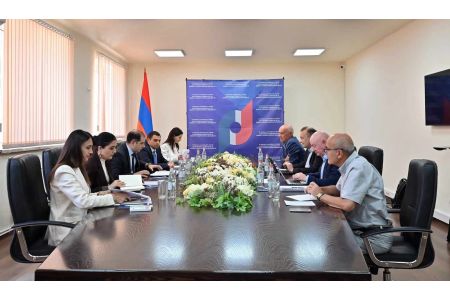
The event taking place in Yerevan is a formal thematic meeting organized ahead of the Third Conference of Landlocked Developing Countries (LLDCs) to be held in Kigali in June, 2024. The event is attended by more than 30 foreign delegations, including representatives of landlocked developing and transit countries, in particular, the Ministers of Foreign Affairs of Botswana and Nepal, the Ministers of Transport of Zimbabwe, Eswatini and Lesotho, the Minister of Tourism of Malawi, the Deputy Ministers of Foreign Affairs of Paraguay and Georgia, Deputy Ministers of Transport of Tajikistan, Kazakhstan, Turkmenistan.
The event is also attended by representatives of international organizations, such as UN Uder Secretary- General and High Representative for Landlocked Developing Countries Rabab Fatima, Executive Secretary of the UN Economic Commission for Europe Tatiana Molchan, TRACECA Secretary General Asset Assavbaev, Deputy Director General of the World Trade Organization.
The Secretaries General of Economic and Social Commissions of UN Africa, as well as UN Asia and the Pacific, the World Customs Organization and the Black Sea Economic Cooperation will deliver video messages.