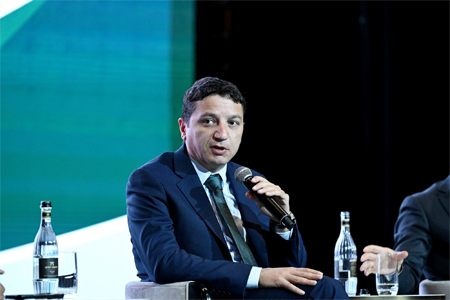
ArmInfo. Zaruhi Muradyan, President of the Vine and Wine Foundation of Armenia highlights more active diversification of sales markets for Armenian products.
In a conversation with ArmInfo, she noted that for Armenian wine exporters, in the context of relations with the Russian side, the unpredictability of the ruble exchange rate becomes problematic, which is why they often have to break existing contracts and build payment mechanisms to maintain profitable exports of Armenian wine products.
However, Muradyan believes that the high dependence of wine exports on the Russian market is fraught with risks and considers it necessary to begin serious work on diversifying export markets. According to her, if in 2022 Russia's share in the context of export directions of Armenian wine was 80%, then according to the results of January-October 2023. Russia's share increased to 86%. "These numbers are, frankly, scary," she said. At the same time, only 4.9% falls on the US market, 1% on France, 0.9% on Lithuania, 0.4% on Poland and 6.8% on other countries.
Touching upon the situation with the tightening of requirements from Rosselkhoznadzor for the quality of Armenian cognac, Muradyan noted that these requirements do not yet apply to Armenian wines.
Last December, export supplies of Armenian cognac to Russia were temporarily blocked by the decision of Rosselkhoznadzor, which identified many low-quality products at the border. According to the Russian side, only every 10th bottle of cognac that is imported into Russia complies with the State Standard - the most quality discrepancies were found in Armenian brands.
According to the head of the Union of Winemakers of Armenia Avag Harutyunyan, with whom he shared with an ArmInfo correspondent, what was happening was a consequence of the erroneous policy pursued by the Republic of Armenia over the past 15-20 years. "Instead of stimulating high-quality production of alcoholic products, the government constantly makes decisions to subsidize producers, including for the purchase of grapes, which allows these producers to produce inexpensive low-quality products, which are sold on export markets, often at a price below cost," he noted.
Referring to available information, Harutyunyan said that the Russian side will soon apply similar regulations to Armenian wine. He noted that Armenia is diversifying its wine export markets every year, reducing the share of the Russian market, but producers first of all need to think about improving the quality of their products.
Some experts believe that the growth in the production of alcoholic beverages, and primarily cognac, is in no way supported by the growth in the production of grapes and other local raw materials, and Armenian producers often use inexpensive imported alcohols in the production of drinks, which is reflected in the low price and quality of products.
According to the RA Statistical Committee, in January-November 2023. 12.5 million liters were produced in Armenia. wine, which exceeds the year-ago figure by 14.1% (versus a 2.7% reduction a year earlier). During 2018-2022, cognac exports from Armenia increased by 85% - from 29.3 to 54.2 million liters. About 80% of these products are supplied to the Russian market.