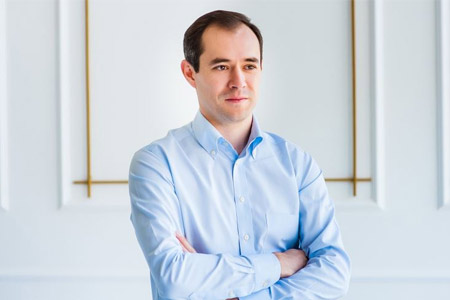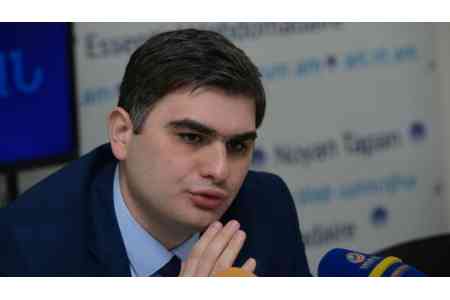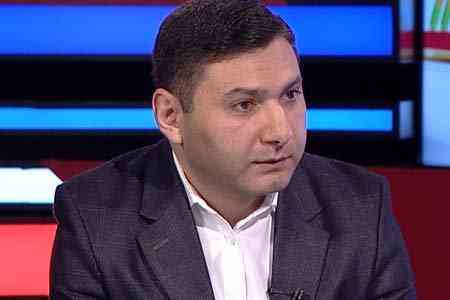
ArmInfo. The likelihood of attracting a new international brand to the Armenian financial market is quite low. Economist Haykaz Fanyan expressed a similar opinion on his Facebook page, commenting on the HSBC's withdrawal from Armenian market.
In this regard, he noted that the Austrian Reiffeisen has the largest representation in the region, but even Reiffeisen's assets in Kosovo exceed $1.3 billion, of which the loan portfolio is $900 million. "For comparison, here are only 4 banks in Armenia that exceed this indicator: Ameriabank, Ardshinbank, ACBA and Amio," the economist emphasized.
According to Fanyan, in order for large financial groups to enter Armenia, or acquire a local bank or establish a new one, either one needs to sit and wait until the country's banking system becomes more developed and attractive for large financial groups, or there should be consolidation in the banking system, perhaps even by uniting with banks from other countries in the region, because only the Armenian market is quite small.
"I am sure that these consolidation processes will take place in the coming years. "I would also like for the regulation of digital banks to be relaxed as much as possible and digital banks to be formed or gain access to our market," he emphasized.
At the same time, Fanyan noted that no matter how painful HSBC's withdrawal from Armenia was for our economy, it was not unexpected. He recalled that HSBC's entry into Armenia was determined by Vache Manukyan factor (British businessman and philanthropist, who owned 30% of the bank's shares, ed. note), and not by economic feasibility.
Meanwhile, as Emmanuil Mkrtchyan, head of the AmRating national rating agency, noted, the strategic decision to withdraw from Armenia was made by the international banking holding HSBC several years ago. And this concerned not only Armenia, but also other countries, "uninteresting" for global business.
We were talking, among other things, about Russia, where the bank was developing its corporate business, which was put up for sale, and which had already lost about $300 million. As a result, in recent years, the growth rate of the balance sheet currency of the Armenian subsidiary of HSBC was gradually decreasing, and analysts made conclusion about the gradual "winding down" of its presence in the country. According to the agency, in order to withdraw from the market, the banking holding company had to, firstly, buy out Vache Manukyan's 30% share, and, secondly, find a "fair" buyer, which, as is known, was the largest to by assets of the Bank of Armenia as of today, Ardshinbank.
According to Mkrtchyan, HSBC's withdrawal from the market, which instilled international banking standards and literacy among Armenian bankers in the late 1990s, can be called the worst case that happened in Armenia's economy in recent years. After all, before HSBC, other institutional banking investors gradually left Armenia, including the German ProCredit Bank, which continues to operate quite successfully in Georgia, Moldova, Ukraine and Eastern European countries, as well as Credit-Agricole Bank, which withdrew from the capital of Acba Bank. Such international financial donors as EBRD, which remained only in the capital of Ameriabank, as well as IFC, KfW and other smaller ones such as Incofin, greatly reduced or completely eliminated their presence in banking capital. "There is no need to unequivocally negatively assess the withdrawal of donor organizations from banking capital, since it was thanks to their help, financial and advisory support that the formation of the country's banking system took place. However, the withdrawal of strategic institutional financial and banking holdings is nothing more than a litmus test paper of the state of the national economy. After all, as a rule, such large banks do not operate in the consumer and pawnshop loan markets; they are interested in serious strategic medium- and long-term investments in the real sector of the economy, and as of today Armenia has nothing to boast about in this sense," the head of AmRating noted. And yet, for now, Russian VTB and Iranian Mellat continue to operate in the country, whose presence today is largely politically motivated.
The only representatives of international financial institutions in Armenia continue to be pension fund management companies (Amundi and C-Quadrat), with a rather low level of investment involvement in the development of the national economy.
According to Mkrtchyan, talk about the possible consolidation of the banking system is no longer relevant today due to the lack of fierce competition. Cash injections, which, although reduced, have not yet exhausted themselves and will act as an important factor until the end of international turbulence, have expanded the volume of the financial pie, which has become large enough for all banks present in the country. Moreover, for this reason, the number of banks has even increased during the last year.
On February 6, Ardshinbank announced that it had reached a binding agreement with HSBC Europe B.V, a subsidiary of HSBC Holdings plc, on the acquisition of its subsidiary banking company in Armenia.
According to the ArmInfo rating, the assets of HSBC Bank Armenia totaled $719.7 million at the end of 2023 (12th place). Total loan investments and other loans totaled 456.3 million dollars. The total capital of the bank is $149.8 million. Total liabilities are $569.9 million, of which $504.9 million are liabilities to clients. HSBC Bank Armenia completed 2023 with a net profit of $27.3 million, with a y-o-y growth of 38%.
Until 2022, the shareholders of HSBC Armenia were HSBC Europe B.B. with a 70% share in the capital and the Wings Establishment with a 30% share, owned by English businessman of Armenian origin Vache Manukyan. The latter sold his share in the first quarter of 2022. HSBC opened its branch in Armenia in 1996.