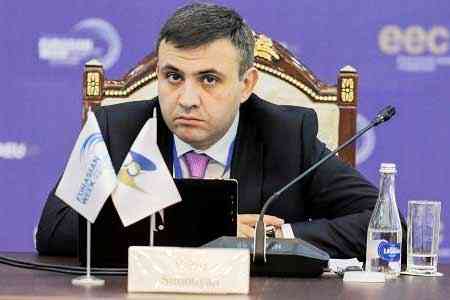



ArmInfo. The HSBC group has been moving its capital and focusing on its preferred markets, as has been the policy in recent years. Only since 2021, as noted by the Chairman of the Union of Banks of Armenia (UBA) Daniel Azatyan during a press conference, the Group has withdrawn from 7 countries, including retail lending in France, the USA, Greece, etc.
Armenia, according to him, is the last country in the CIS where the Bank's representative office is closing.
"This type of deal is not a decision that was made in 10 days. Discussions and negotiations lasted a very long time and took place in accordance with international standards. This is a very difficult and lengthy job that needs to be treated with respect," he said.
Ardshinbank, the largest Armenian banking group, is today announcing it has reached a binding agreement with HSBC Europe B.V., a subsidiary of HSBC Holdings plc, to acquire its fully owned banking subsidiary in Armenia.
HSBC Armenia has a well-established base of loyal clients across Armenia and specialises in serving affluent retail customers and blue-chip Armenian corporates. Historically orientated towards corporate customers, its growth over the recent years has been driven by its wealth and personal banking proposition.
The proposed acquisition of HSBC Armenia is a unique opportunity to build upon Ardshinbank's operational and financial strengths. The combination aims to add a high-quality customer franchise and a highly experienced team of relationship managers and employees. As at December 31, 2023, HSBC Armenia had total assets of c. AMD290bn, customer loans of c. AMD185bn and c. AMD200bn in customer deposits.
The transaction is subject to regulatory and anti-trust approvals and is expected to close within the next 12 months.
Artak Ananyan, Chairman of the Management Board of Ardshinbank, commented:
"We are delighted to announce today that we have reached agreement with HSBC for the acquisition of its bank in Armenia. Subject to receipt of all clearances, Ardshinbank looks forward to welcoming HSBC Armenia customers onto our award-winning platform and to further delivering on its strategy to accelerate growth and expand product offering for clients. This transaction is about growth and we look forward to welcoming HSBC Armenia employees to the Ardshinbank team. Our intention is to ensure a smooth and fluid transition for all HSBC Armenia customers who will continue to enjoy the benefits of local support and personalised services and Ardshinbank's bespoke range of products."
Established in 1996, HSBC Armenia is the only local commercial bank controlled by a major Western banking group. It currently has total assets worth 290 billion drams ($720 million) and around 200 billion drams in customer deposits.HSBC Armenia's net profit rose from 8 billion drams in 2022 to over 11 billion drams ($27 million) last year. By comparison, Ardshinbank reported nearly 63 billion drams in earnings in 2023.
According to the head of the national rating agency AmRating, Emmanuel Mkrtchyan, the exit from the market by HSBC, which in the late 90s instilled international banking standards in Armenian bankers and taught literacy, can be called the worst case that has occurred in recent years in the Armenian economy.
After all, before HSBC, other institutional banking investors gradually left Armenia, including the German ProCredit Bank, which continues to operate quite successfully in Georgia, Moldova, Ukraine and Eastern European countries, as well as Credit-Agricole Bank, which exited the capital of Acba Bank. Such international financial donors as EBRD and ADB, which remained only in the capital of Ameriabank, as well as IFC, KfW and other smaller ones such as Incofin, greatly reduced or completely eliminated their presence in banking capital.
"It is not necessary to unequivocally negatively assess the withdrawal of donor organizations from banking capital, since it was thanks to their help, financial and advisory support that the formation of the country's banking system took place. However, the exit of strategic institutional financial and banking holdings is nothing more than a litmus test of the state of the national economy. After all, as a rule, such large banks do not operate in the consumer and pawnshop loan markets; they are interested in serious strategic medium- and long-term investments in the real sector of the economy, and Armenia today has nothing to brag about in this sense," he said.