

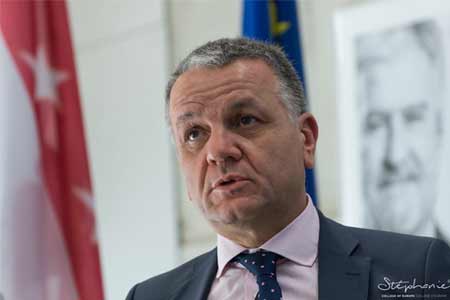
ArmInfo. Within the framework of the EU4Business "Innovative Tourism and Technology Development for Armenia" (ITTD) project, 150 companies were established, that received technical and financial support, 126 received grants and more than 350 took part in various ITTD programs. Vassilis Maragos, head of the EU mission in Armenia, announced during the concluding event held at the National Centre of Chamber Music on February 23.
Reminding that the project's budget was 14.95 million euros, he said that thanks to the latter, 1415 new jobs were opened in the country, more than half of which are occupied by women, and in more than 78% of companies, women hold leading positions. The EU Ambassador to Armenia noted that although the project is finished, the European Union intends to continue participating in projects aimed at the development of Armenia.
Charge d'affaires at the Embassy of Germany in Armenia Erik Tintrup noted that thanks to ITTD, numerous initiatives have been implemented in the northern regions of Armenia that have revitalized the local economy and communities through the establishment of innovative tourism companies. He stressed that the project has recorded remarkable results in terms of creating sustainable income streams in these communities, restoring the ecosystem and stimulating tourism. The diplomat also touched upon the technological development of Armenia, noting that today IT specialists from all over the world work in the country. "This project reveals the technological potential of Armenia. Tourism coupled with technology is a successful formula, and I am glad that we, represented by our state, are involved in this project," Mr. Tintrup said, emphasizing that Germany will continue to assist Armenia in the development of tourism.
The ITTD project was launched in 2019 and was implemented by the German Society for International Cooperation (GIZ) with joint funding from the European Union and the Ministry of Economic Cooperation and Development of the Federal Republic of Germany.