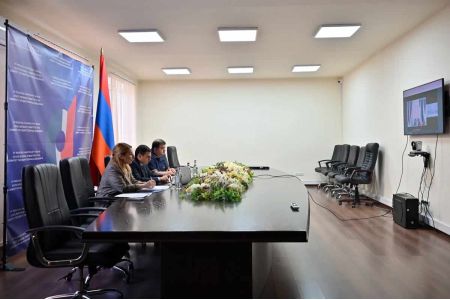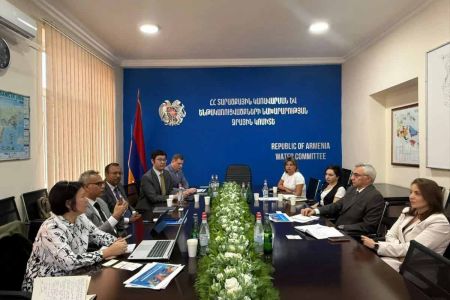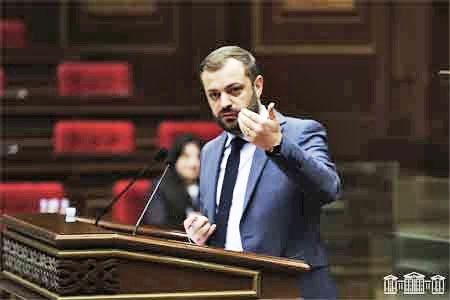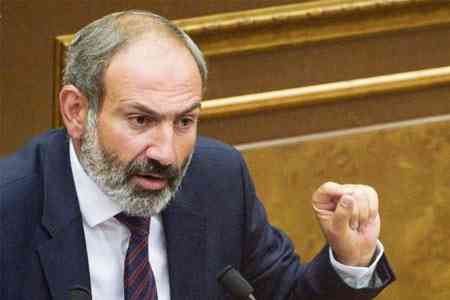
ArmInfo. A meeting was held under the chairmanship of the Prime Minister of the Republic of Armenia Nikol Pashinyan, during which a package of bills adopted by the National Assembly in the first reading was discussed, proposing to revise the turnover tax rates.
According to the press service of the Prime Minister's office, in particular, the turnover tax system, existing problems and possible ways to solve them were touched upon. A discussion of tax policy issues took place.
The Prime Minister noted that it is necessary to correctly formulate the motives, and emphasized that the government has adopted a policy according to which the turnover tax should be completely abandoned in Armenia, since it distorts the economy, the tax system and creates an unhealthy economic environment. According to Nikol Pashinyan, the process should be implemented in stages, and it is necessary to switch to a common single tax system.
Following the discussion, the head of government instructed to continue implementing the necessary steps to improve the tax sector.
According to the initiative of the Cabinet of Ministers, it is proposed to double the turnover tax rates, and subsequently to abandon the system altogether. The main goal of the turnover tax system as an alternative to the main taxation system is to provide business entities with the opportunity to carry out activities in conditions of simple tax accounting and soft administration. However, research shows that instead of an alternative general taxation system, the turnover tax system has turned into a preferential taxation system. In particular, when comparing the tax burden of the general taxation system (VAT and income tax) and the turnover tax system in certain areas of economic activity, it turned out that in almost all industries (except for those industries in which the main transactions are exempt from VAT) The burden of the general taxation system significantly exceeds the burden of the turnover tax. Thus, the total tax burden for VAT and income tax in the manufacturing industry exceeds the burden for turnover tax by 2 times, in construction - by 2.6 times, in the field of trade - by 2.6 times, in the field of accommodation and public catering - 3 times, in the real estate sector - 2.1 times, in the field of professional, scientific and technical activities - 2.8 times.
In addition, past experience and studies of the activities of the turnover tax and micro-enterprise systems show that the types of activities allowed in these tax systems are either similar in nature to the types of activities prohibited in these systems, or, due to their characteristics, are accompanied by other types of activities that cannot be taxed in these taxation systems, for example, commercial activities in the city of Yerevan cannot be taxed in the micro-entrepreneurship system, and car maintenance activities, within the framework of which very often there is also the sale of goods (spare parts), can be carried out in a micro- entrepreneurship system.
Taking into account the above, the Ministry of Finance proposes to revise the turnover tax system from October 2024, and from 2025 to narrow the scope of beneficiaries of the micro-enterprise system. The goal is to reduce the difference between the tax burden of the turnover tax system and the general taxation system, increase incentives to document the expenses of business entities, and also make the two taxation systems for SMEs more targeted. Thus, according to the initiative, the turnover tax rates established for main types of activities will be revised, with the possibility of reducing the tax payable through documented expenses. At the same time, it is proposed to set rates below the current minimum or fixed rates; in this case, the tax burden may be reduced for business entities that have the appropriate level of documentation. For the above types of activities, establish a unified approach to the possibility of reducing the tax payable through documented expenses.
In particular, today a 5% turnover tax rate has been established for entrepreneurs in the field of trading activities, with the possibility of deducting 4% of documented expenses from liabilities, but not less than 1.5% of turnover. As part of the initiative, it is proposed to set a rate of 10% of income with the possibility of deducting 9.5% of expenses, but not less than 1.0% of turnover. Then the already effective tax will increase from 2.3% to 4.1%, providing the state treasury with additional taxes in the amount of 4.9 billion drams.
Representatives of public catering at this stage work with a 6% turnover tax with the possibility of a tax deduction of 3% of documented expenses, but not less than 4% of turnover. As the Ministry of Finance previously stated, Armenian restaurateurs currently pay an average of 4.3% of sales turnover, which they assess as a low tax burden. In this regard, it is proposed to establish a 12% turnover tax with the possibility of a tax deduction of 9% of documented expenses, but not less than 3.5% of turnover. In this case, the effective tax will increase from 4.3% to 6.6%, providing the state treasury with additional taxes in the amount of 4.9 billion drams.
Changes are also planned for representatives of production activities. Currently the sales tax rate is 3.5%. It is proposed to set a rate of 7% of income with the possibility of deducting 5% of expenses, but not less than 3.5% of turnover. In this case, the effective tax will increase from 3.0% to 5.3%, providing the state treasury with additional taxes in the amount of 0.6 billion drams.
For other types of activities, the current sales tax rate is 5%. It is proposed to set a rate of 10% of income with the possibility of deducting 6% of expenses, but not less than 4.5% of turnover. In this case, the effective tax from 5% will increase to 8.5%, providing the state treasury with additional taxes in the amount of 8.7 billion drams. The authorities also plan to expand the range of activities prohibited from taxation in the micro-enterprise tax and turnover tax systems. In particular, from 2025 it is recommended to limit the ability to engage in notarial, lawyer's activities and organization of lotteries in the turnover tax system, in the micro-enterprise taxation system, the activities of taxpayers engaged in the purchase and sale and/or rental of real estate, hairdressing services, care body, car maintenance services, software development and construction work, assessment and measurement of real estate, activities for the organization of baths and saunas. They will have to operate either under the sales tax or VAT system.
The adoption of the project promises the state budget an annual increase in turnover tax revenue of approximately 17.8 billion drams.