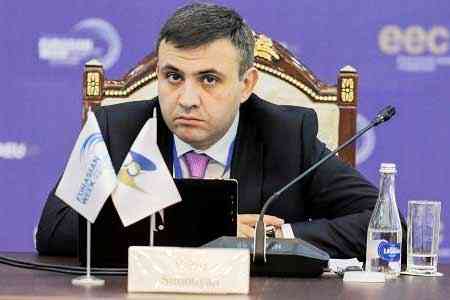


ArmInfo. The creation of the North-South road corridor for will be of double importance for Armenia, Alexander Zaboev, head of the Center for Integration Studies of the Eurasian Development Bank (EDB), said this on the sidelines of the EDB Annual Meeting and Business Forum in Almaty in an interview with ArmInfo.
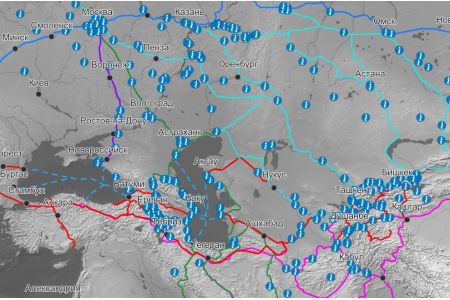
According to him, on the one hand, this is the end-to-end connectivity of the country, which is important for socio-economic development. "On the other hand, this will open up opportunities for the transit of goods from Iran in the direction of Georgia, in the direction of Russia and the countries of the Black Sea region. Therefore, this use of trade and transit potential will have the effect of increasing transit traffic," Zaboev believes.
At the same time, he noted the importance of the fact that in addition to the North-South road corridor, the TRACECA corridor runs through the territory of Armenia, one of the elements of which, in fact, is the Trans-Caspian International Transport Route (TMTM or Middle Corridor, Middle Corridor - Ed.). "They connect in Georgia, so the connection of these two routes, these cargo flows will also allow us to obtain an additional effect. For the Trans-Caspian route, for example, countries are developing port infrastructure - Poti, Batumi, and a new port will be built. Therefore, the development of this direction for Armenia is also very important," says the Bank representative.
In this vein, he drew attention to the fact that Armenia receives a lot of imported cargo, and sends export cargo through the Black Sea ports. "Therefore, the development of their infrastructure provides new opportunities for Armenia, including the development of cargo flows. In addition, improving the infrastructure means reducing transport costs, increasing the competitiveness of goods produced in Armenia, and reducing the cost of imported goods for citizens of Armenia. This will include indirect economic effects," Zaboev noted.
At the same time, he considered it important from the point of view of investment projects not only this corridor, but also other price lists. "For example, a good project for the development of a logistics hub in Gyumri (dry port - Ed.). If corridors are developed, then cargo unloading and storage points will be needed accordingly. The creation of cold warehouses for storing fruits and vegetables will also contribute to the realization of export potential Armenia," added the Bank representative.
And the last thing, according to Zaboev, is the use of the country's air transport potential. The expert noted that for several years now the capital's Zvartnots airport has turned into an international hub where passengers transfer. "Therefore, it is necessary to build up this potential, which, by and large, is a net export of transport services. But, for its development, it is necessary to increase the potential of Armenian national carriers, increase the air fleet, and attract new airlines. This, in turn, will allow us to receive additional fees for aviation services and other services. All this is additional income through the export of transport services," the Bank representative emphasized, adding that all of the above allows creating new jobs, and this in turn increases the well-being of the population.
Regarding the Middle Corridor, Zaboev noted that he perceives this project as a standard line, already in use, from the Azerbaijani port of Alyat to Tbilisi, and further - Georgian ports - Turkey. "Therefore, if we talk about the throughput capacity of this part of the Middle Corridor, then it does not pose any strategic risks for Armenia. In addition, as I already said, the development of Georgian ports is also interesting for Armenia, since it also uses these ports," he noted Zaboev, while noting that now we are talking about modernizing the existing line, especially in a section with low capacity in Georgia.