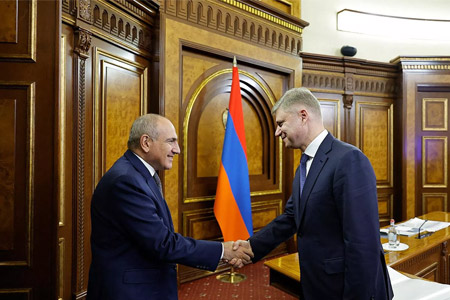
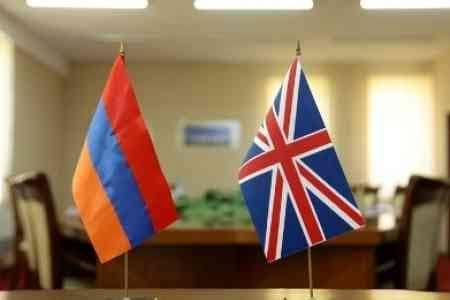
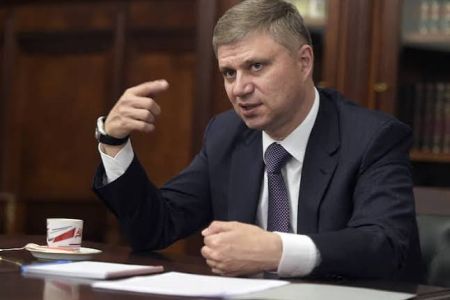
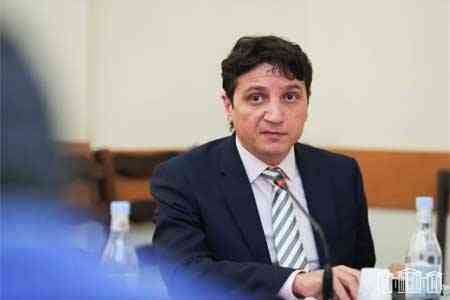
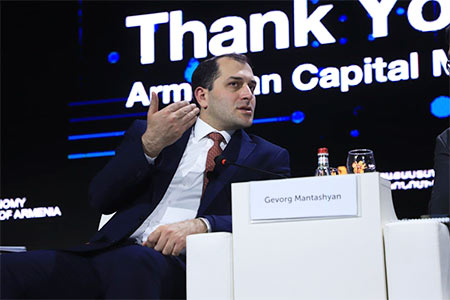
ArmInfo. The regular, 23rd meeting of the Armenian- Russian Intergovernmental Commission on Economic Cooperation was held in Moscow under the joint chairmanship of Deputy Chairman of the Government of the Russian Federation Alexey Overchuk and Deputy Prime Minister of the Republic of Armenia Mher Grigoryan.
As reported by the press service of the Russian government, the parties summed up the results of bilateral cooperation in trade and economic sphere, energy, industry, transport, agriculture, finance, healthcare, culture, science, interregional cooperation, education and tourism.
"Our trade and economic relations continue to be on the rise. Mutual trade between Russia and Armenia, according to data for 10 months of 2024, amounted to 10.2 billion dollars. This is more than twice as much as last year," Overchuk noted, emphasizing that in order to implement trade and economic relations, the countries have almost completely switched to settlements in national currencies - the share of the Russian ruble in mutual settlements has reached 96.3%. The Russian Federation is one of the main investors in the Armenian economy. Investments in industrial projects in the Republic of Armenia have reached 3.4 billion dollars. More than 40 large Russian companies operate in Armenia, some of them are the largest taxpayers to the state budget.
"In addition to direct investment, Eurasian development institutions are also actively working. Active work is underway here, including to support the "Crossroads of the World" initiative, which was put forward by Armenian Prime Minister Nikol Pashinyan," said the Deputy Prime Minister.
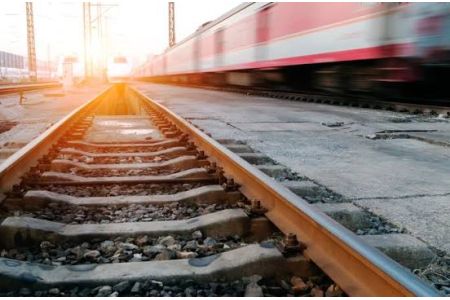
The chairman of the Russian part of the commission also noted that in July 2024, with the assistance of Russian Railways, the railway between Armenia and Georgia, damaged by flooding, was restored in the shortest possible time - the only railway connecting Armenia with the outside world, which is an important channel for delivering vital goods to Armenia.
"All these investments and projects are being implemented with the aim of strengthening connectivity in the Eurasian region and the South Caucasus, in particular, integrating Armenia into the new value chains emerging in Eurasia and realizing the transport and logistics potential that Armenia has, with unwavering respect for its sovereignty and jurisdiction," Overchuk said in his speech.
In the context of the work of Eurasian development institutions, the Russian official also noted the implementation of the irrigation system modernization project:
mechanical irrigation was replaced by gravity irrigation, which provides annual energy savings. 5 main and 22 inter-farm canals were restored. Work on the restoration and construction of on-farm irrigation systems in 105 settlements of the Republic of Armenia has been completed.
"Two weeks ago, our specialists agreed to conduct an assessment of the technical condition of eight bridges damaged by the flood in Lori and Tavush. All work will be completed as soon as possible, we expect that by the end of the year, their results will be transferred to the Ministry of Territorial Administration and Infrastructure of the Republic of Armenia," the Deputy Prime Minister said.
During the meeting, the active development of cooperation in the humanitarian sphere was emphasized.
"Today we are signing an intergovernmental Agreement on the conditions of the activities of the Russian- Armenian University in the Republic of Armenia. This is one of the leading universities in Armenia, where more than 5 thousand students study, mastering 123 educational programs, 80 of which are taught according to Russian educational standards," the Deputy Prime Minister emphasized.
The university's research and teaching staff includes 82 doctors and 332 candidates of science. The university's structure includes 9 institutes, 31 departments and 12 laboratories.
The university cooperates with the Joint Institute for Nuclear Research, the Institute for System Programming of the Russian Academy of Sciences, the St. Petersburg Polytechnic University and other Russian research centers. Research projects are being implemented in such areas as bioinformatics, genomic research, quantum nanophotonics, biochemistry and biotechnology.
Work continues to provide opportunities for education according to Russian standards in the educational and sports complex, which includes a school for 700 students built in Yerevan as part of the Gazprom for Children social program.
The countries pay great attention to cooperation in the field of culture. Since 2023, a program to support Russian theaters abroad has been implemented, within the framework of which the Yerevan State Russian Drama Theater named after Stanislavsky has received financial assistance for the purchase of stage equipment and the creation of new productions based on Russian classics. The Moscow Parajanov Theater, with the support of the Russian Ministry of Culture and the Cultural Center of the Armenian Embassy in Russia, held a large-scale festival "Parajanov Fest".
Bilateral cooperation in the field of creative education is developing. Within the framework of the VGIK International Student Festival, 38 films participating in the festival were screened at the Russian-Armenian University.
In pursuance of the agreements reached at the meeting of the intergovernmental commission, the second Russian-Armenian Forum of Education in the Sphere of Culture was held in Moscow in December 2024.
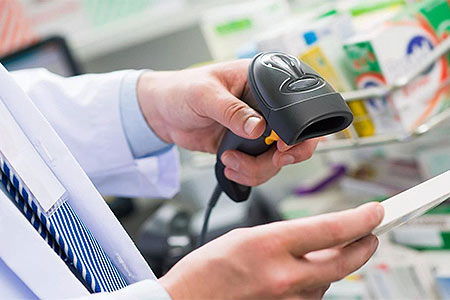
Cooperation in the field of healthcare is strengthening, including within the framework of annual Russian- Armenian forums on healthcare. The ninth Russian-Armenian Forum on Healthcare, dedicated to issues of maternal and child health protection, was held on December 16, 2024 in Yerevan. During the forum, the system of extended perinatal screening developed and successfully applied in Russia was presented.
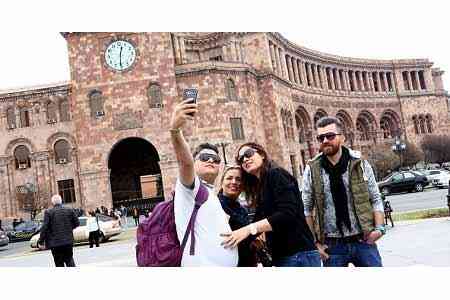
Russia and Armenia are developing mutual tourism. In January-September 2024, the number of trips of Russian tourists to Armenia amounted to 715.8 thousand, and Armenian tourists to Russia - 266 thousand.
Speaking about cooperation in multilateral formats, primarily through the Eurasian Economic Union, the Deputy Prime Minister noted that the union has become a real guarantor of Armenia's energy and food security, as well as its technological development. "The Union countries are the key sales market and the key supplier to the Armenian market. The EAEU accounts for 56% of Armenia's food exports, 80% of machinery and equipment exports, 67% of chemical exports, and 56% of textile exports. The EAEU also provides 72% of energy imports, 49% of precious metal imports, 38% of food imports, and 34% of timber imports. During its membership in the Union, the export of industrial goods from Armenia has grown 15- fold, and food products from Armenia - 4-fold. Since joining the EAEU in 2015, Armenia's GDP per capita has grown almost 2.4-fold. This was made possible by the benefits of a common goods market, low prices for agricultural raw materials and energy resources, a convenient migration regime, and a common services market," said Alexey Overchuk.
Following the meeting, the protocol of the 23rd meeting of the Intergovernmental Commission on Economic Cooperation between the Russian Federation and the Republic of Armenia was signed.
The parties also signed the Agreement between the Governments of the Russian Federation and the Republic of Armenia on the conditions for the activities of the Russian-Armenian University in the Republic of Armenia, the State Purchase Agreement for a polyvalent, cultural, sorbed, inactivated foot-and- mouth disease vaccine, the Agreement between the Government of the Russian Federation and the Government of the Republic of Armenia on the conditions for the activities of the Educational and Sports Complex of Gazprom Armenia CJSC in Yerevan, and the work plan of the Russian-Armenian Business Council for 2025.