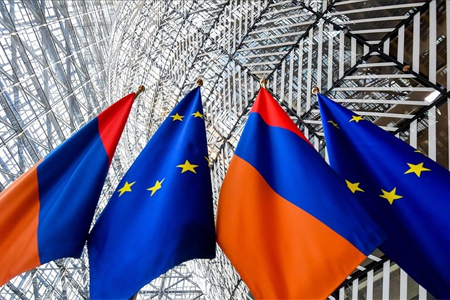
ArmInfo. Over the past few days, two fateful events have occurred that could play both a positive and a negative role in the history of modern Armenia. On the one hand, the country's government gave the go-ahead for the adoption of the law "On the beginning of the accession of the Republic of Armenia to the European Union", and on the other hand, the Charter on Strategic Partnership between Armenia and the United States was signed in Washington.
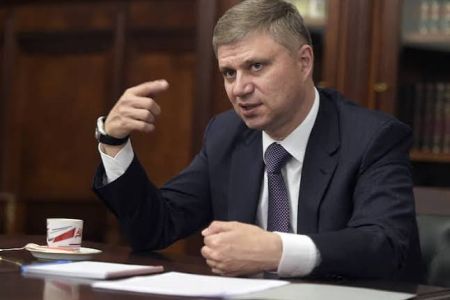
Against this background, the sharply negative reaction from the Russian Federation was quite obvious. Deputy Prime Minister of the Russian Federation Alexey Overchuk directly stated the incompatibility of Yerevan's participation in the EU and the EAEU. He also hinted at Armenia's dependence on Russian energy resources and the further development of the country's economy.
ArmInfo correspondent spoke with the head of the laboratory "Modeling of Economic Uncertainty" of the Armenian State University of Economics, founder of the data processing organization Tvyal.com Aghasi Tavadyan about the risks of such a sharp geopolitical turn of official Yerevan towards the West. According to the economist, the RA government has begun to pursue a rather interesting policy. Since 2018, the country's economic relations with Russia and the states of the Eurasian Economic Union (EAEU) have increased several times. If 6 years ago, Armenia's exports to the EAEU countries amounted to approximately $600 million, today this figure has grown more than 5 times and exceeds $3.5 billion. In parallel with this, transfers from Russia to the country have increased 3-4 times over the past 6 years. At the same time, Tavadyan continued, if in 2018 the share of EU exports in trade with Armenia was 27%, today it has dropped to 4.5%.
He drew attention to the fact that over the past 6 years, the government, while making curtseys to the West, at the same time increased economic dependence on Russia and the volume of trade with it. In such a situation, the economist considered Russia's reaction to Armenia's policy possible. Currently, the lion's share of Armenia's trade turnover falls on the EAEU. However, the refusal of all this, including the re- export of gold from the Russian Federation to the Emirates through Armenia, will negatively affect the economy of the Armenian state. In particular, Tavadyan recalled the speech of the US Ambassador to Armenia several months ago, who directly stated that it is necessary to be realistic and understand that Armenia's reorientation to the West will lead to several cold winters for the country. "It is also necessary to understand that the Armenian government can make one set of political statements, but actually pursue an economic policy in the opposite direction, which is what the experience of recent years shows," Tavadyan noted.
At the same time, the economist also pointed out the risks associated with the economic reorientation to the EU market. First of all, he noted that the only country bordering Armenia and having access to the EU is Turkey. "That is, firstly, the border between Armenia and Turkey must open. Secondly, we must take into account transportation costs, because agricultural products from Armenia will increase in price significantly by the time they reach the EU. Thirdly, it is important to understand the EU's requirements for standards. Even if there are no customs duties, goods must have a high level of standardization, and we have very few such goods," he noted. At the same time, Tavadyan recalled that as a member of the EAEU, Armenia has the opportunity for duty-free trade, but with accession to the EU, these privileges will not exist.
According to the Statistical Committee of the Republic of Armenia, Armenia's foreign trade turnover with the EAEU countries in January-November 2024 amounted to $11.9 billion, which is 68.3% higher than the same period last year. At the same time, exports decreased by 10.1% to $3.1 billion, against the backdrop of a 2.4-fold increase in imports to $8.8 billion. The EAEU accounts for 42.2% of foreign trade.
The EU countries account for 7.5% of trade turnover. In particular, the volume of trade decreased by 14.1%, amounting to $2.1 billion. At the same time, export volumes for the year decreased by 18.6% to $551.8 million, against the backdrop of a 12.4% decline in imports to $1.6 billion.